…See true reversal in ‘few years’
Nigeria’s long-standing reliance on overseas medical treatment is under fresh scrutiny after Central Bank of Nigeria (CBN) data showed a 96 percent plunge in medical tourism spending, a figure healthcare experts dismiss as largely reflecting shifts to untracked black-market forex rather than a genuine halt in patient outflows.
Industry leaders argue that many patients are simply bypassing official FX channels in favour of parallel markets and private payment arrangements, masking the true scale of outbound care.
However, they affirmed that with sustained investment in public hospitals, expanding private-sector capacity and reforms already underway, the country could begin to see a measurable and lasting decline in outbound medical travel within the next few years.

CBN data covering January to June 2025 show Nigeria’s medical tourism spending plunging 96.2 percent year-on-year to just $0.09 million, down from $2.38 million in the same period of 2024. The $2.29 million contraction is one of the steepest recorded declines in outbound healthcare expenditure and has been cited by policymakers as evidence that Nigerians are increasingly turning to domestic hospitals.
“The data only reflects transactions routed through the official foreign exchange window. With the convergence of official and parallel market rates, people no longer see any incentive to source dollars through the CBN. Most medical travel payments are now happening outside that system,” Njide Ndili, president of the Healthcare Federation of Nigeria told BusinessDay.
Read also: Nigeria’s medical tourism spending crashes 96% as local healthcare capacity deepens
According to Ndili, patients increasingly rely on the parallel market, private insurance arrangements, offshore facilitators and employer-funded schemes; channels that fall outside the CBN’s reporting framework. As a result, she said, the data likely understates the true volume of medical tourism spending, even if the direction of travel is changing.
Still, Ndili said Nigeria is genuinely on a path to reversing medical tourism, though, not overnight, but over the next few years, driven by a combination of private-sector expansion and public-sector reform.

“We can reverse medical tourism in a few years’ time. The reason Nigerians travel abroad is largely about trust. As soon as people have confidence in the quality, safety and outcomes of care at home, the incentive to travel disappears,” she stated.
That confidence, she added, is increasingly being rebuilt across both private and public healthcare systems.
In the private sector, hospital operators are investing in advanced technology, specialist training and facility upgrades that now allow complex procedures, once only available overseas, to be performed locally. Cardiac surgeries, robotic oncology procedures, non-invasive fibroid treatment using High-Intensity Focused Ultrasound (HIFU) and AI-assisted urology care have become available in Lagos and other major cities.
Equally important, Ndili said, is consolidation. Hospital groups are acquiring smaller facilities and building integrated networks that allow them to standardise care, improve clinical governance and spread the cost of expensive equipment and talent.
“This is global best practice. Consolidation improves quality control, pricing transparency and outcomes. Nigeria is finally moving in that direction,” she said, pointing to large healthcare systems in Europe and the United States.
Beyond private hospitals, Ndili pointed to growing momentum in public healthcare reform, an area long associated with poor outcomes and patient flight abroad.
A flagship example is the Federal Medical Centre (FMC), Ebute Metta, where PharmAccess has worked with hospital management to implement a comprehensive quality improvement programme using its SafeCare methodology. The initiative focused on digitisation, clinical protocols, process redesign, workforce training and infrastructure optimisation.
“FMC Ebute Metta is now a level-four hospital in terms of quality standards. It is paperless, process-driven and operating at a level comparable to world-class facilities,” Ndili, who is also the country director for PharmAccess Nigeria, an NGO focused on digital health innovation affirmed.
Read also: Remember that time the Nigerian government claimed there was “Reverse Medical Tourism”?
The transformation has also delivered financial results. According to Ndili, the hospital’s internally generated revenue has increased by more than 1,000 percent following the reforms, driven by improved efficiency, patient confidence and referral growth. In December alone, FMC Ebute Metta recorded more than 200,000 new patient visits.
The success has attracted federal attention. Following visits by the coordinating minister of health and the minister of state for health, the government has moved to replicate the model nationwide. In November, PharmAccess signed a memorandum of understanding with the Federal Ministry of Health to support quality improvement programmes across 48 tertiary hospitals, with the potential to scale further.
Under the framework, hospitals will undergo baseline assessments, receive tailored quality improvement plans and implement reforms across three pillars: clinical processes and protocols, human resources, and infrastructure and equipment. While the pace of implementation will depend on funding availability and hospital leadership, Ndili said the process has formally begun.
“With public hospitals improving and private hospitals expanding capacity, the foundations for reversing medical tourism are being laid. It is not just about economics or FX anymore, it is about systems,” she said.
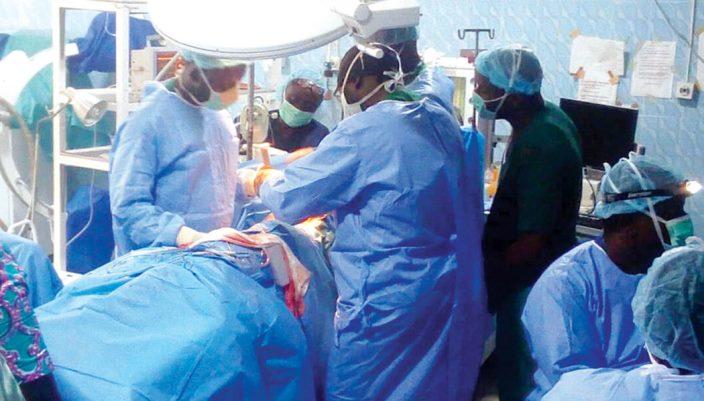
Ndili said one of the most consequential, but often overlooked, shifts in Nigeria’s healthcare landscape is the growing role of diaspora doctors who now return home for short, high-impact clinical missions rather than permanent relocation.
Under this model, Nigerian specialists based in Europe, the United States and the Middle East partner with private hospitals to schedule blocks of complex procedures, ranging from cardiac and oncological surgeries to advanced orthopaedic and urological interventions, over defined periods, sometimes completing up to 20 major operations within a few weeks before returning abroad.
“This approach is helping Nigeria manage the brain drain in a very practical way. Instead of losing these specialists completely, hospitals are bringing the expertise back home, even if temporarily,” Ndili said.
She said the arrangement delivers a dual benefit: it preserves access to world-class expertise while dramatically lowering costs for patients. Nigerians who would otherwise travel abroad, often to be treated by Nigerian doctors in foreign hospitals, can now access the same specialists locally, without the additional burden of airfare, accommodation, visa fees and extended living expenses.
“For many patients, you are seeing the same doctor, using the same techniques, but at a fraction of the cost because the surgery is happening in Nigeria. That translates into significant savings for families and for the country in foreign exchange,” Ndili said.
She added that the model also improves efficiency for doctors, who consolidate their patient load into short, intensive clinical windows, rather than maintaining full-time practices in Nigeria amid infrastructure and security challenges. Private hospitals, meanwhile, provide the facilities, equipment and support teams needed to ensure outcomes comparable to those in overseas centres.
Together with ongoing consolidation in the private sector and quality upgrades in public hospitals such as the Federal Medical Centre, Ebute Metta, Ndili said the diaspora-doctor model strengthens Nigeria’s case for reversing medical tourism over the next few years.
“When you combine improved facilities, better processes, returning expertise and stronger public hospitals, the direction becomes clear. Medical tourism will not disappear overnight, but Nigeria is building the conditions to outgrow it,” she said.
Policy reforms may reinforce that trajectory. In January 2025, CBN Governor Olayemi Cardoso launched the Nigerian Foreign Exchange Code, following the rollout of an electronic FX matching system late last year. The reforms tightened transparency and accountability in the FX market, making discretionary access to foreign exchange for non-essential spending, including overseas medical travel, more difficult.
But not all stakeholders are convinced that Nigeria is close to a full-scale reversal.
Dr. Tunji Akintade, former chairman of the Association of General and Private Medical Practitioners of Nigeria, said claims of a 98 percent reduction in medical tourism should be treated with caution.
“I don’t know where that number is coming from. Yes, private hospitals are improving, but affordability remains a major constraint. Many Nigerians still travel abroad if they can afford it,” Akintade told BusinessDay.
Akintade noted that while top-tier private hospitals offer world-class care, their services are beyond the reach of most citizens, adding that smaller private facilities, which could broaden access and reduce pressure on major centres, continue to face challenges ranging from high operating costs to limited access to finance.
He appealed to the government to establish targeted, long-tenor soft loan schemes for private hospitals, arguing that affordable financing is critical for upgrading facilities, acquiring advanced medical equipment and sustaining operations in a high-cost environment.
“Structured soft loans, would not only strengthen hospital sustainability but also help broaden domestic treatment capacity, reduce pressure on public facilities and curb foreign exchange losses linked to medical travel, aligning healthcare financing with Nigeria’s broader economic and industrial policy goals,” he explained.
Still, even sceptics acknowledge that the healthcare landscape is shifting. The growing presence of diaspora doctors who return for short surgical missions, combined with improved facilities and public-sector reform, is changing patient perceptions.
For now, Nigeria’s medical tourism debate reflects both progress and uncertainty. While data gaps cloud the true scale of outbound care, healthcare leaders agree that capacity is expandingand that, for the first time in decades, the country has a credible path to keeping more patients at home.