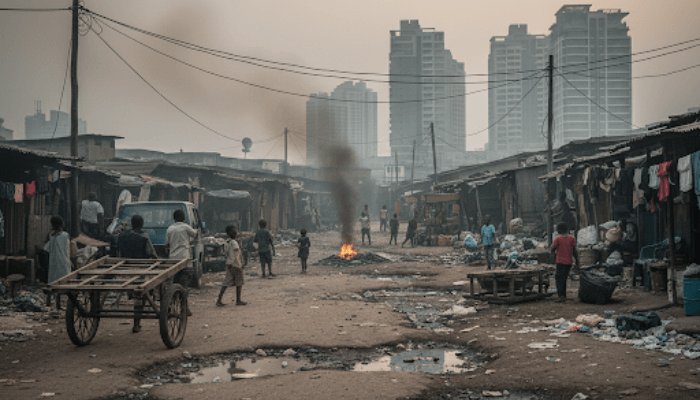
For most Nigerians, the debate about economic reform is no longer abstract or theoretical. It is felt daily in the price of food at the market, the cost of transport to work, the difficulty of keeping children in school, and the quiet calculations households make about what can no longer be afforded. Years of adjustment policies have been justified as necessary sacrifices for long-term stability, yet for many citizens, stability remains elusive while hardship has become routine.
It is against this backdrop that renewed talk of a national “reset” must be judged. Nigeria’s central problem today is not a lack of reform ideas, nor an unwillingness by citizens to endure sacrifice. It is the widening gap between policy announcements and lived outcomes. Targets are cited, progress is claimed, and macro indicators are defended, but everyday experience tells a harsher story. Any meaningful reset must therefore move beyond new rhetoric and confront a more difficult question: whether Nigeria’s governing system is organised to translate reform into relief.
Read also: The Silent Squeeze: Nigeria’s Middle Class Under Pressure.
Since mid-2023, the federal government has embarked on sweeping economic adjustments, fuel subsidy removal, exchange-rate unification, and fiscal tightening, chief among them. These moves corrected distortions that had long undermined economic efficiency, and few serious analysts dispute that postponing them would have deepened Nigeria’s vulnerabilities. Nearly three years on, the results demand more than self-congratulation. Inflation may have slowed by official measures, but poverty has expanded, household resilience has weakened, and informal livelihoods, the backbone of the economy, remain under acute strain.

This divergence should not be misunderstood. Inflation figures alone do not capture the realities of informal markets, food insecurity, or income volatility. Nor do reforms of this scale yield benefits overnight. Some degree of pain was unavoidable. But the persistence and breadth of hardship point to more than transitional discomfort. They suggest failures of sequencing, weak social protection, and an inability, or unwillingness, to correct course when policy assumptions prove wrong.
This is where the notion of a “reset” must be stripped of sentiment and treated as governance reform. Nigeria does not primarily suffer from poor policy choices; it suffers from poor policy execution. Budgetary chaos, implementation delays, and internal contradictions are routinely blamed on financing gaps or underperforming ministries. These are symptoms. The deeper problem is a system where decision-making is fragmented, supervision is weak, and failure rarely carries consequences. Coordination failure in Nigeria is not accidental; it is embedded.
Here lies the uncomfortable truth: Nigeria’s reform problem is sustained not just by technical weakness but by political convenience. Fragmentation protects powerful interests, blurs responsibility, and shields officials from accountability. When no single institution can be clearly held responsible for outcomes, reform costs are socialised downward while benefits and discretion concentrate upward. Until this incentive structure is confronted, calls for discipline will remain aspirational rather than transformative.
Read also: Receipts, not rhetoric: A trust reset for Nigeria
Responsibility for breaking this pattern rests first with the presidency. Economic reform cannot be governed from a distance. Market adjustments require continuous political supervision to manage social fallout and prevent drift. After several years of reform, a structured and public review is overdue: one that openly identifies what has worked, what has imposed disproportionate social costs, and which assumptions must be abandoned. Reform that cannot be questioned hardens into dogma, not progress.

A credible reset must therefore impose coherence across economic governance. Ministries responsible for finance, budgeting, trade, social development, and regulation must operate under a unified framework with shared data, enforceable timelines, and clear lines of authority. Budget preparation and execution cannot remain improvised exercises vulnerable to last-minute revisions. Where officials repeatedly fail to deliver, replacement, not explanation, must follow. Discipline is not punitive; it is the minimum price of credibility.
Nigeria’s crisis cannot be resolved from Abuja alone. Poverty is experienced locally, and so is governance failure. Rural poverty remains alarmingly high, reflecting weak service delivery at the state and local levels. While subnational governments face real constraints, limited revenue autonomy, debt burdens, and dependence on federal transfers, these realities do not absolve them of responsibility. Many effective interventions are neither grand nor abstract: passable rural roads, functioning primary health centres, irrigation support, sanitation, and access to small-scale markets. These are choices, not mysteries.
Security presents a similar test of governance discipline. Defence spending has risen sharply over the past decade, yet insecurity persists. This is not an argument against funding security but a warning against confusing expenditure with strategy. Without parallel investment in education, employment, and social cohesion, military spending treats symptoms while leaving causes intact. Nigeria risks remaining trapped in a security–poverty cycle in which insecurity diverts resources from development, underdevelopment fuels grievance, and violence becomes self-perpetuating.
Read also: Nigeria’s economic reckoning: The long road from collapse to recovery
Ultimately, a meaningful reset is not achieved through declarations. It is achieved through institutional discipline, political courage, and a willingness to confront vested interests. Reform must be governed as a continuous process, tested, corrected, and adjusted, not defended as an article of faith.
Nigeria has reached a point where the question is no longer whether reform is necessary. It is whether the state can govern reform in a way that distributes costs fairly, delivers measurable relief, and enforces accountability at every level of power. If “reset” means confronting these realities, then renewal remains possible. If it does not, the word will simply join Nigeria’s long archive of promises that sounded bold but changed little. The country no longer needs a new language. It needs results and the discipline to demand them.