A case study in turning ambitious gender policy into measurable impact through coordinated implementation…
When Governor Uba Sani launched Kaduna State’s groundbreaking Women’s Economic Empowerment (WEE) Policy and Action Plan in November 2024, accompanied by a ₦5 billion grant for women entrepreneurs, the question quickly became: How do we ensure women can truly access these and other such economic opportunities?
To close the gap between policy ambition and true inclusion, Dev-Afrique Development Advisors partnered with the Kaduna state Ministry of Women Affairs and Social Development (MWASD) to organize a one-day WEE Policy Sensitization Workshop for stakeholders across state, private, civil society, and grassroots structures. This workshop set off a wave of awareness that prompted the formation of cooperatives–the eligibility structure required for accessing the ₦5 billion grant from the MWASD. Within three weeks, 166 new women’s cooperatives, were registered across all 23 LGAs. The surge reflected what strong coordination, clear information, and localized mobilization can unlock.

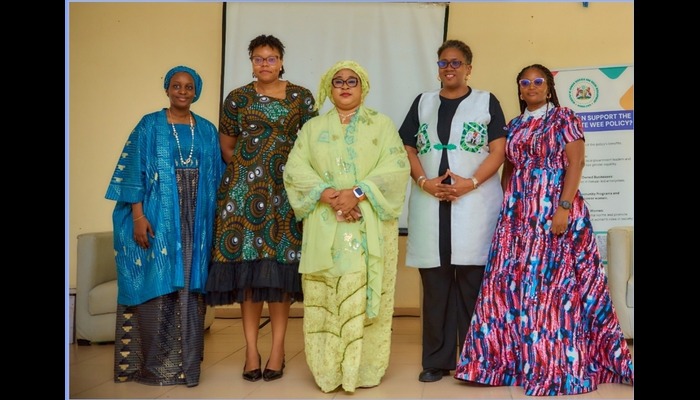
The Dev-Afrique team and the Honourable Commissioner for Women Affairs and Social Development, after a successful Policy Sensitization Workshop in Kaduna State on July 22, 2025. L-R: Khadijah Abdullahi, Associate, Dev-Afrique Development Advisors; Sainaan Dati, Project Manager, Dev-Afrique Development Advisors; Hajiya Rabi Salisu, Honourable Commissioner, Ministry of Women Affairs & Social Development; Hansatu Adegbite, Senior Advisor and WEE Specialist, Dev-Afrique Development Advisors, Folasade Rojugbokan, Implementation Lead, Dev-Afrique Development Advisors.
This transformation captures what makes Kaduna State’s story worth telling: becoming Nigeria’s first state to domesticate the National WEE Policy and building an implementation architecture that actually works.
The Numbers That Demanded Action

Kaduna State’s baseline data as at 2024 painted a stark picture: 68% of women aged 15-35 were neither working nor seeking employment. Female entrepreneurs earn 66% less than their male counterparts. Only 21% of women own bank accounts. A mere 4.7% own land independently. With women comprising nearly half of the state’s 9.5 million population, this represents millions of untapped economic potential.
The National Women’s Economic Empowerment Policy, adopted by Nigeria’s Federal Executive Council in May 2023, provided the framework. However, the real measure of any framework is its implementation. Kaduna was the first state to put this framework into action by recognizing its value and adapting it to suit the Kaduna state context.
Building the Engine Before Starting the Journey
The partnership architecture that would drive implementation came together in June 2024. Dev-Afrique was commissioned to support the domestication and implementation of the National Women’s Economic Empowerment (WEE) Policy in Kaduna state, as a local implementation partner to Albright Stonebridge Group (ASG)/DGA Group. The project, funded by the Gates Foundation’s WEE Catalyst Fund and backed by the Federal Government of Nigeria, focused on tailoring the national WEE policy to Kaduna state’s specific context and ensuring its effective implementation. The MWASD served as the lead coordinating ministry, driving policy implementation across government agencies.
During the implementation, Dev-Afrique commenced project activities with a comprehensive landscape assessment. The assessment revealed that Kaduna state already had strong initiatives operating in silos: the Kaduna State Enterprise Development Agency had 400 field agents across all LGAs implementing various empowerment programs; the Ministry of Business Innovation and Technology operates 29 Technical and Vocational Centers providing skills training, the Agricultural Development Agency trained 25,000 women through its partnership with the Alliance for Green Revolution in Africa. The infrastructure was there—it just wasn’t connected.
The WEE Lift Kaduna team after a strategic meeting with the Kaduna Investment Promotion Agency (KADIPA) to discuss private sector strategies for advancing WEE Policy implementation, May 14, 2025. L-R: Zibiah Dabbason, Operations Manager; Fatima Abdullahi Salisu, After Care Officer; Faisal Abdulkadir Idris, Director – Investor Relations; Omosigho Ozor, Engagement & Project Implementation at Dev-Afrique; Sadiq Muhammed, Executive Secretary; Mrs. Hansatu Adegbeti, Senior Advisor and WEE Specialist at Dev-Afrique; Sainaan Dati, Project Management at Dev-Afrique; Jemimah Tugga Gankon, Admin Officer; Fatima Sani Mailafiya, Admin Officer; and Isaiah Gama Luka, Head of Investment Facilitation.
Also, in February 2025, Kaduna State Public Procurement Authority (KADPPA) independently revolutionized government contracting. KADPPA registration fee became free for women while men paid ₦25,000, removing a key financial barrier to participation. In addition, 20% of supply contracts and 10% of consultancy opportunities were reserved for women-owned businesses, supported by the establishment of a dedicated department for women’s procurement.
These discoveries reshaped everything. Instead of creating parallel systems, the implementation strategy of the project focused on alignment and coordination.
Although these institutional changes such as those of KADPPA transpired independently from the WEE Policy project; when women subsequently discovered these opportunities through the project’s targeted WEE awareness campaigns, they became tangible pathways for economic empowerment for many. The structural change built on KADPPA’s earlier training of over 1,000 women on procurement processes and the policy change meant trained women could now access contracts with built-in advantages.
The Workshop That Changed Everything
On July 22, 2025, the MWASD and Dev-Afrique convened what would become the turning point. The WEE Policy Sensitization Workshop brought together an unprecedented coalition to drive effective implementation of the state’s WEE policy: the Commissioner for Women Affairs and Social Development, representatives from banks and private sectors, women leaders from all 23 LGAs, religious leaders, traditional rulers from three senatorial zones, Persons with Disabilities, and civil society organizations.
A cross-section of participants during the Kaduna State Women’s Economic Empowerment (WEE) Policy Sensitization Workshop held on July 22, 2025 — an engagement that brought together key stakeholders from government, civil society, and the private sector to discuss strategies for advancing women’s economic inclusion across the state.
The workshop generated immediate, specific commitments. Keystone Bank pledged continued effort to help women open accounts. The Africa Women Entrepreneurship Cooperative offered free facilitation services to help with WEE awareness events. Traditional leaders committed to mobilizing their communities. But the real impact came after.
Within three weeks, women across 166 cooperatives had registered. “That workshop demonstrated something fundamental,” reflects Hansatu Adegbite, Senior Advisor and WEE Specialist on the project. “When you put the right people in the same room with clear information and space for authentic dialogue, organic commitments emerge. No top-down mandates needed.”
Systematising What Works
Between August and September 2025, Dev-Afrique conducted targeted sensitization sessions with thirteen critical agencies: Ministry of Finance; Agriculture; Education; Business Innovation and Technology; Justice; Local Government Affairs; Kaduna State Agricultural Development Agency; Kaduna State Media Corporation; Kaduna State Investment Promotion Agency; Kaduna State Enterprise Development Agency; Kaduna State Public Procurement Authority; and Disability Affairs Board. These sessions resulted in each agency designating WEE focal persons — specific individuals responsible for coordinating women’s empowerment activities within their institutions. But more importantly, these sessions revealed the scale of what was already happening.
The Ministry of Business Innovation and Technology’s Arewa Ladies for Tech program had trained 5,000 girls in data science, with many securing remote work as analysts. KADEDA’s ten programs showed 75% female participation. The Ministry of Education’s Second Chance initiative was reaching thousands. Collectively, existing programs had trained over 30,000 women between 2024 and 2025.
The sessions weren’t about creating new programs — they were about connecting existing ones to explicit WEE objectives and establishing accountability mechanisms.
Taking it to the Ground
October 2025 marked the shift from institutional coordination to grassroots activation. Dev-Afrique hosted a town hall in Kaduna State, bringing together traditional and religious leaders, women leaders, LGA gender officers, market women, and community members, including persons living with disabilities, from rural communities in four LGAs, combining policy education with immediate practical support.
The day included financial literacy training by Ramatu Ibrahim covering money management and accessing credit. Digital literacy sessions by CoLab taught women to use mobile phones for business. FirstBank opened bank accounts on the spot, addressing the barrier that only 21% of women had bank accounts. NEAT Microcredit also shared valuable information, teaching women how to access loans through its institution.
All 50 participants committed to becoming WEE Ambassadors, taking on roles as WEE focal points in their communities to raise awareness of the Policy and promote WEE values. The approach acknowledged that lasting change depends on local ownership, not just government initiatives.
The next day, Dev-Afrique partnered with Government Girls Secondary School Barnawa for an International Day of the Girl Child event themed “The Girl I Am, The Change I Lead,” targeting SS1 to SS3 students and aligning with the global October 11 observance declared by the United Nations.
The program established a pad bank with sustainability structures designed in collaboration with the schools’ Old Girls’ Association, addressing menstrual health barriers that limit girls’ education. Dev-Afrique’s Social Empowerment Fund donated sanitary pads reaching 1,400 adolescent girls, reinforcing the policy’s goal of 90% enrollment for girls in secondary education by 2028. The program also integrated engaging sessions on mental health and sexual reproductive education, alongside the distribution of an inspiring booklet by Beyond the Classroom Foundation, titled “The Value of Education Over Boys.” The event concluded with a performance by Policy Champion Mayowa Kilanko, reinforcing the message that empowerment is both institutional and personal.
Building for Permanence
While implementing immediate activities, Dev-Afrique worked with MWASD to design structures that would outlive any single project. Between August and October, Dev-Afrique drafted the structure for a coalition that would ensure sustainability and deeper integration into Kaduna’s economic growth and gender equality ecosystems. The proposed Kaduna State High-Level Advisory Council on Empowerment of Women and Girls (HLAC) will bring together government commissioners, bank CEOs, traditional rulers, religious leaders, and civil society in a permanent governance body.
Technical Working Groups aligned to the policy’s five pillars—Agriculture, Entrepreneurship, Traditional Labor Market, Emerging Industries, and Education—will monitor progress toward 2028 targets: 75% female labor force participation, 15% female land ownership, 60% women’s bank account ownership, and narrowing the income gap between male and female entrepreneurs from 66% to 30%.
By October 2025, the comprehensive Kaduna state HLAC framework had been submitted to government leadership, creating a blueprint for coordination that transcends political cycles.
The Partnership Model That Made It Work
The success comes from each partner playing to their strengths. The Kaduna State Government provided political will and ₦5 billion in funding. Gates Foundation enabled sustained implementation support through multi-year financing. Albright Stonebridge Group/DGA Group provided strategic guidance. Dev-Afrique supplied the on-ground coordination expertise that connected it all.
“Implementation is its own expertise,” emphasizes Ridwan Sorunke, Dev-Afrique’s Executive Principal. “You can have excellent policy and strong government commitment but translating that into coordinated action across multiple agencies while reaching grassroots communities requires specialized capacity.”
Dev-Afrique’s methodology was deliberate: systematic stakeholder mapping before launching activities. Creating accessible materials like the State’s Women’s Economic Empowerment (WEE) policy and action plan, and the simplified policy trifold in English and Hausa. Convening diverse actors to generate organic commitments rather than imposing mandates. Establishing formal coordination through focal persons. Designing governance structures to outlive project timelines.
The approach leveraged rather than replaced. By aligning KADEDA’s 400 field agents, MBIT’s 29 TVET centers, KADA’s 25,000 women in training, and the Ministry of Local Government’s skills centers with WEE goals, implementation became more streamlined without requiring new structures.
Challenges That Persist
Eighteen months in, barriers remain. Cultural practices in parts of Kaduna state still prevent women from inheriting land. Many women remain hesitant about formal banking. Lengthy paperwork processes make accessing grants difficult. High interest rates put loans out of reach. Coordination between agencies, despite focal persons, still need strengthening.
These are the next frontier. The implementation architecture now exists to address them systematically rather than piecemeal.
What November 2025 Leaves Behind
As the WEE Policy Integration and Implementation program concludes this month, it leaves infrastructure for continued progress:
12 ministries with designated WEE focal persons maintaining coordination
Women across 166 registered cooperatives ready for grant disbursement
11 private and social sector champions committed to continued advocacy
Gender-responsive procurement policy creating structural advantages
Kaduna state HLAC framework awaiting approval for permanent governance
Clear 2028 targets with monitoring mechanisms
The Replicable Lesson
For other Nigerian states watching Kaduna State, and for development practitioners globally, the lesson is actionable: policy implementation requires partnership architecture, systematic coordination, structural changes that create real opportunities, and sustained on-ground presence that connects government commitment to community mobilization.
The Kaduna State model proves that when you build the right implementation engine—mapping existing assets, aligning rather than duplicating, changing structures before launching campaigns, convening authentic dialogue, and designing for permanence—policy moves from paper to practice.
Twelve months ago, Kaduna state had a 100-page policy document. Today, it has close to 4,000 women’s cooperatives registered to receive WEE grants, 13 government agencies committed to advancing WEE, structural procurement advantages, activated community platforms, and a governance framework for sustained progress.
That’s transformation.
And for the 4.7 million women of Kaduna State, it’s just the beginning.
The WEE Policy Subnational Integration & Implementation Project in Kaduna State was implemented through a partnership between the Kaduna State Government, the Gates Foundation’s WEE Catalyst Fund, Albright Stonebridge Group, and Dev-Afrique Development Advisors, with the Ministry of Women Affairs and Social Development serving as the lead coordinating ministry.