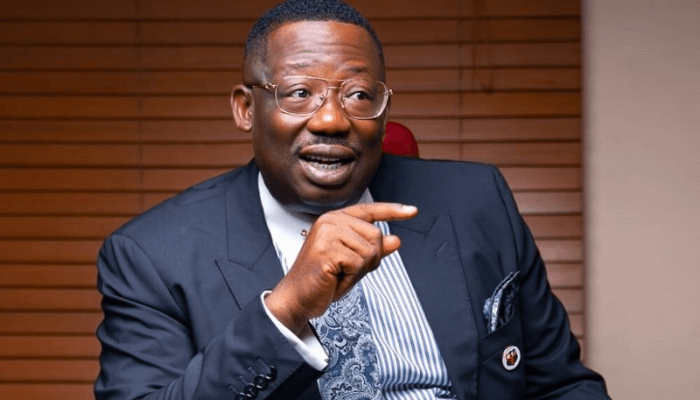
Dele Kelvin Oye, Chairman of the Alliance for Economic Research and Ethics (AERE) and former National President of the Nigerian Association of Chambers of Commerce, Industry, Mines and Agriculture (NACCIMA), has cautioned that Nigeria’s 2026 budget risks repeating long-standing fiscal mistakes despite early gains recorded from President Bola Tinubu’s economic reforms.
In a statement issued on Wednesday, Oye acknowledged that the administration’s reform agenda is beginning to yield measurable results, citing GDP growth of 3.98% in Q3 2025, easing inflation at 14.45% in November 2025, and external reserves rising to a seven-year high of $47 billion.
He attributed the improvement to tighter fiscal and monetary coordination, infrastructure investments, and reforms in sectors such as solid minerals and agriculture, which have boosted transparency and investor confidence.
Oye noted that policies discouraging the export of raw solid minerals and agricultural products without value addition had expanded business activity and strengthened local production.

Read also: Budget office pushes back against claims of illegality in 2024–2025 budget re-enactment
According to him, the 2026 budget, themed “Budget of Consolidation, Renewed Resilience and Shared Prosperity,” is designed to build on these gains through major infrastructure projects, including the Coastal Highway, Sokoto–Badagry Motorway, and the AKK Gas Pipeline, as well as agricultural initiatives aimed at food security through mechanisation and input financing.
He also commended social interventions such as the Nigerian Education Loan Fund (NELFUND) and the Presidential CNG Initiative, describing them as important tools for supporting education, transportation, and youth empowerment.
Oye further lauded the enactment of the 2025 Tax Act, saying it would help broaden the tax base and improve non-oil revenues, though he urged the government to urgently amend the law to remove investment incentives and free trade zone provisions he said were wrongly embedded in the Act.
However, Oye warned that beneath the positive macroeconomic indicators lies what he described as a “fiscal Groundhog Day,” arguing that the 2026 budget reflects a recycling of past errors rather than a clear framework for sustainable growth.

He alleged that capital budgets for 2024 and 2025 reveal repeated project duplication, with some ministries, departments and agencies (MDAs) allegedly funding the same roads and bridges across multiple fiscal years without completion, undermining accountability and value for money.
Oye expressed concern over Nigeria’s debt profile, stating that by early 2025, debt servicing and personnel costs exceeded government revenue, reaching as high as 131% in some estimates. He described the situation as “debt slavery,” warning that excessive borrowing risks subordinating Nigeria’s economic decisions to external creditors and multilateral institutions.
“The choice for Nigeria is clear: restructure our economy internally, reduce cost of governance, increase transparency and build a sovereign, self-reliant nation, or be “restructured” by external powers/creditors, who view our natural
resources as their “fair price” for repatriation.
“Nigeria must be built by Nigerians for Nigerians; if not, we will be managed by others for themselves. Restructuring fiscal policies and reducing the dependency on external borrowing is crucial for a self-sufficient economic future,” he said
On foreign exchange inflows, he noted a sharp decline in U.S. dollar inflows into the official market in late December 2025, with total inflows dropping 20.67% week-on-week to $593.7 million. Foreign portfolio investment fell by 72.91%, while foreign direct investment declined by 81.87%, signalling growing caution among global investors.
Although domestic sources helped cushion the impact, contributing nearly 83% of FX inflows, Oye said Nigeria must prioritise job-rich growth and human capital development if it hopes to achieve the Central Bank of Nigeria’s projection of 4.49% GDP growth and 12.94 per cent inflation in 2026.
He warned that poverty remains widespread, with between 139 million and 141 million Nigerians estimated to be living below the poverty line, partly due to the uneven impact of reforms, insecurity in food-producing regions, oil price volatility, and rising debt-servicing costs.
Oye further cautioned against what he termed a growing global “repo-man” approach to international relations, warning that excessive reliance on foreign loans and security partnerships could expose Nigeria’s sovereignty and natural resources to external pressure in the event of financial distress.
He called for a new Nigerian economic manifesto anchored on economic patriotism, fiscal discipline, reduced cost of governance, strengthened anti-corruption institutions, and greater reliance on indigenous economic models.
Read also: Nigeria current account balance to hit $18.81bn from $16.94 bn Tinubu
He warned that failure to restructure fiscal policies and reduce dependence on external borrowing could leave the country vulnerable to external control.
“We are dancing with the tiger, hoping it’ll be gentle, but what if it isn’t? We need to wean ourselves off foreign “partnerships”, loans, and start taking our sovereignty seriously. It’s time to diversify, invest in ourselves, and stop relying on others to save us.
“Our resources are worth more than just a quick fix; let’s make sure we’re protecting them
for the long haul. We should consciously avoid a scenario where we give the opportunity
for countries or multilateral institutions, to use the current global economic imperialistic
narrative to paint Nigeria’s natural resources as the “unrecovered property of the external
powers/creditors.” Oye noted.