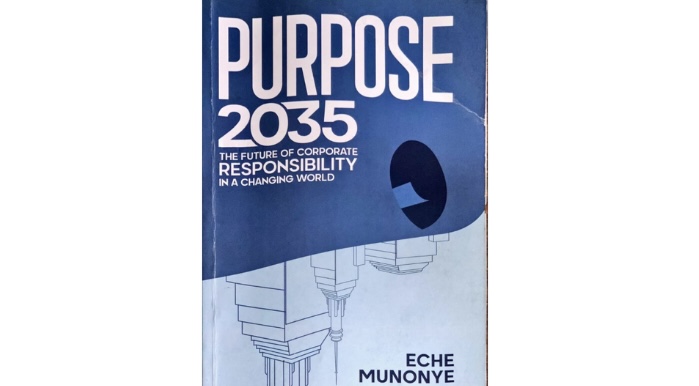
Eche Munonye (2025), Purpose 2035: The future of corporate responsibility in a changing world
Lagos: Winepress Publishing/Candella Content Services Limited
ISBN: 9778-978-61325-5-6 | 98 pages
In Purpose 2035, Eche Munonye delivers a compelling and urgent manifesto for the future of business, framing corporate responsibility not as an optional add-on but as the very currency of modern enterprise. Against the backdrop of 2035—a pivotal deadline in global sustainability and corporate strategy—Munonye argues that a company’s survival will depend on its ability to integrate social and environmental impact into its core model.
From Charity to Core Strategy
The book opens with a powerful declaration: “We now live in an age where reputation is measured not by how much a company gives, but by how it makes its money.” This sets the tone for Munonye’s central thesis—that climate change, digital transformation, and rising inequality have redefined corporate success. Responsibility, he asserts, is now “the business,” not a sideline.

This shift advances beyond traditional CSR, which Munonye describes as a well-meaning but often marginal “let’s give them something” approach. Instead, he advocates for a measurable, integrated framework where reputation is assessed through stakeholder perception surveys, media analysis, and tangible business results. The aim is to turn goodwill into a strategically managed asset.
Structure and Scope
Despite its concise format, Purpose 2035 covers substantial ground across twelve focused chapters. Key sections explore the transition from compliance to consciousness, the rise of the purpose economy, regenerative business models, and the transformative role of technology.
Particularly noteworthy is the chapter “The Purpose Economy,” which defines this new system as one where “value is derived not merely from efficiency or innovation but from meaning, trust, and social contribution.”
Equally impactful is Munonye’s treatment of the ESG revolution, reframed as “The New Language of Accountability.” He notes that by 2025, over $50 trillion in assets will be managed under ESG criteria—evidence that “finance [is] catching up with ethics.”

The 2035 Imperative: Challenges and Corporate Responses
Munonye anchors his argument in the concrete realities facing businesses as 2035 approaches. He highlights the persistent climate policy gap, in which current national pledges fall short of the Paris Agreement targets. He contrasts this with ambitious corporate commitments from players like Verizon and Coca-Cola. The underlying message is clear: sustainability is no longer about saving the planet alone—it is about ensuring operational viability in a transformed world.
The book further outlines megatrends shaping corporate responsibility, including exponential intelligence, the generational remix, and regenerative systems. To navigate these shifts, Munonye proposes a three-part action framework:
1. Integration and Measurement – embedding sustainability into core operations with transparent, data-driven reporting.
2. Innovation for Impact – aligning R&D with future industries built on solving human and planetary challenges.
3. Building Systemic Resilience – strengthening community ties and advocating for a just transition.
Drivers of Change and the New Corporate Playbook
Munonye highlights interconnected pressures driving this transformation: the climate imperative, technology-enabled transparency, and changing societal expectations. In response, he presents an updated corporate playbook, contrasting models before 2025 with the Purpose 2035—approach across five areas—from strategic integration and leadership to metrics, collaboration, and value definition. The shift moves from shareholder primacy to multi-capital accounting, and from siloed CSR departments to purpose-driven governance.
Local Context and Practical Application
The book gains relatable depth when we examine examples of Nigerian firms such as Nestlé, Nigerian Bottling Company, and Lafarge, which are already combining environmental awareness with tangible action. Initiatives like Nestlé’s Safety, Health, and Environment training for plastic waste workers illustrate how multinationals are operationalising responsibility through local partnerships with regulators and industry alliances.
Conclusion: Relevance as the New Responsibility
Purpose 2035 leaves readers with a resonant concluding thought: by 2035, the defining question will not be whether a company is responsible, but whether it is relevant. Success will be measured by the ability to operate profitably within planetary boundaries while contributing to societal stability. Munonye’s work is both a warning and a roadmap—a concise, provocative call for businesses to embed purpose as their final advantage.
Recommended for: Business leaders, sustainability professionals, policy makers, and anyone interested in the intersection of strategy, ethics, and long-term value creation. While the book assumes familiarity with CSR and sustainability concepts, its clarity and conviction make it accessible to a broad audience seeking to understand the future of responsible business.