The presence and identity of terrorist groups operating in Sokoto State have long been debated by security analysts, but the recent joint missile strikes by the United States and Nigeria have renewed focus on jihadist activity in Nigeria’s North-west.
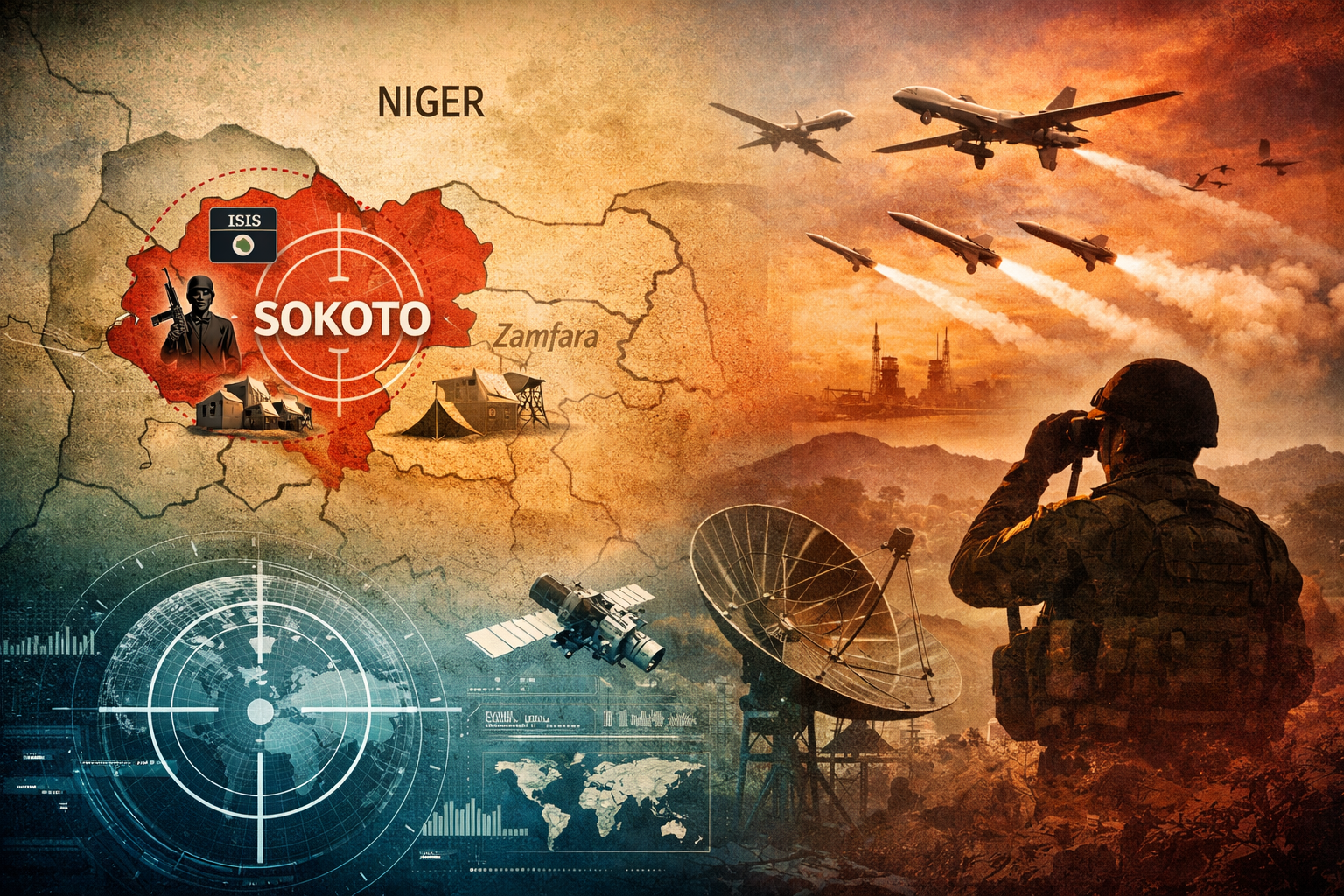
On December 25, the US and Nigeria carried out missile strikes against Islamist militants in Sokoto State, marking one of the most significant foreign-assisted military operations on Nigerian soil in recent years. The strikes, ordered by US President Donald Trump and approved by Nigerian President Bola Tinubu, targeted fighters described by both governments as Islamic State-linked and were characterised as “precision” attacks on designated terrorist camps.
Nigerian authorities said the country participated by providing intelligence support, while Foreign Affairs Minister Yusuf Tuggar confirmed that President Tinubu authorised the operation. Statements from the United States Africa Command (AFRICOM) said the strikes hit multiple ISIS positions in Sokoto, to degrade the group’s operational capacity through intelligence shared between both countries.
Islamic State in Nigeria
The Islamic State suffered a major blow in 2019 with the killing of its leader, Abu Bakr al-Baghdadi, followed by the deaths of his successors in subsequent years. These losses weakened the group’s central command and accelerated the collapse of its territorial control in Iraq and Syria.

Despite this, ISIS adapted by expanding through regional affiliates, particularly in Africa. Groups such as the Islamic State West Africa Province (ISWAP) and the Islamic State Sahel Province have continued to exploit local conflicts and grievances to maintain relevance.
ISIS has been a major factor in Nigeria’s decade-long Boko Haram insurgency. In 2015, Boko Haram leader Abubakar Shekau pledged allegiance to ISIS, leading to ideological and propaganda support. Internal disagreements later caused ISIS to withdraw backing from Shekau and support ISWAP instead. While this split weakened Boko Haram, it strengthened ISWAP, which is now regarded as one of the most resilient jihadist groups in the Lake Chad region. ISWAP, however, remains primarily active in the North-east.
The nature of terrorism in Sokoto
Unlike the North-east, terrorism in Sokoto and other North-western states is more fragmented. The region has seen a mix of cross-border jihadist-linked militants and heavily armed bandit groups that have increasingly adopted extremist methods.
Figures such as Bello Turji have led violent attacks on villages and travellers along major highways. They were later joined by Lakurawa fighters, a group initially welcomed by some local communities to help counter banditry. Over time, however, the Lakurawa became a source of insecurity for themselves.
The extent of the Islamic State’s presence in Sokoto remains contested among experts. A 2022 study by Murtala Rufa’i, James Barnett and Abdulaziz Abdulaziz linked Lakurawa to Jama’at Nusrat al-Islam wal-Muslimin (JNIM), an al-Qaeda affiliate in Mali formed in 2017 through the merger of several extremist groups.

More recent research by Mr Barnett suggests that Lakurawa may now be aligned with the Islamic State Sahel Province (ISSP). “Given the fluidity of jihadi alliances and fracturing in the Sahel, some of the original members of Lakurawa may have been affiliated with JNIM in 2017–2018 but are now affiliated with ISSP,” he said.
Other analysts disagree. Malik Samuel, a senior researcher at Good Governance Africa, has said Lakurawa appears closer to al-Qaeda-linked JNIM. “I haven’t seen any evidence suggesting there is a link to ISIS,” he said.
Lakurawa in the North-west
Research shows that in 2017, community leaders in Tangaza and Gudu local government areas of Sokoto invited Lakurawa fighters from Mali as mercenaries to combat bandits infiltrating from Zamfara State. According to local accounts, the fighters spoke Arabic and Fulfude and were initially paid in cash, livestock, logistics and weapons.
The group later turned violent, killing one of the leaders who facilitated their arrival after a dispute over alleged debts. Before then, the group had imposed radical religious rules, including bans on alcohol and music, and levied taxes on herders.
As Lakurawa attacks increased, Nigerian and Nigerien forces launched joint border operations in 2018. However, analysts say Nigeria’s failure to sustain pressure allowed the group to re-emerge in 2021, this time aligning with bandits and some Fulani communities against the Yan Sakai vigilante group. The coup in Niger and the collapse of joint border operations further emboldened the militants.
The group has since expanded into Kebbi State, where authorities say its fighters killed police officers and telecommunications workers. In one aerial operation targeting the group, at least 10 civilians were killed, prompting compensation payments by the Nigerian Air Force to affected families.
Civilian impact
The violence in Sokoto has taken a heavy toll on civilians, including farmers, women and children, with communities suffering killings, kidnappings and mass displacement over several years.
While President Trump justified the recent missile strikes by claiming the terrorists targeted Christians, Nigerian officials and independent observers stress that insecurity in the region affects people of all faiths. They attribute the crisis to a combination of banditry, jihadist violence and weak state protection, rather than religious targeting alone.