1. Christmas Day American strike on Sokoto dominates the media.
United States Christmas Day 2025 air strikes on Sokoto State changed conversations from the travelling challenges of Nigerians to questions around terrorism, security and sovereignty. President Donald Trump ordered the action and announced it on his Truth Social platform. This action has garnered significant international attention and debate due to its stated justification and the complex security realities in Nigeria.
The U.S. Africa Command (AFRICOM) carried out strikes in Sokoto state, northwestern Nigeria. It stated they killed “multiple ISIS terrorists. The operation was described as a joint effort conducted “in coordination with Nigerian authorities.
On social media and in the Leadership newspaper, some Nigerians queried the alleged success of the strike. It raised many queries that the public attempted to answer.

• U.S. Justification: President Trump announced the strike on social media, framing it as a direct response to the targeting and killing of “primarily, innocent Christians” by ISIS militants, whom he called “terrorist scum.” This action followed months of warnings from Trump, including a November threat to suspend aid and an order to prepare for military action.
• Nigerian Government’s Response: Nigeria’s foreign ministry confirmed the cooperation with the U.S., stating the strikes resulted from “structured security cooperation” involving intelligence sharing. However, officials have consistently pushed back against the characterisation of the country’s violence as a religious persecution issue. President Bola Tinubu emphasised that the government protects all citizens irrespective of religion.
Why Sokoto? Many analysts questioned why Sokoto was chosen over the Sambisa Forest or the North-East operations theatre. Some on Facebook wagered that Trump strategically targeted Sokoto as the engine room of Nigerian jihadism.
Other analysts in both international and local media doubt the strike’s long-term effectiveness. The central plank of their argument is that violence is not a solution to Nigerian terrorism but a mix of approaches.
Experts, analysts, and data from conflict monitoring groups contest Trump’s single-issue framing of the conflict as one primarily targeting Christians. They contend that reality on the ground is more complex, driven by a mix of jihadist insurgencies, criminal banditry, and communal conflicts over resources.
The perspectives.

1. Trump/U.S. Political Narrative blames religious persecution targeting Christians. They cite figures like 3,100 Christians killed in a recent 12-month period. They claim that the Nigerian government has allowed the killings.
2. Nigerian Government & Security Analysts frame it as a complex security crisis affecting all citizens. Nigeria states that the terrorists attack “all who reject their murderous ideology” and point to attacks on mosques and Muslim communities.
3. Data from Conflict Monitors (e.g., ACLED) shows political violence involving victims of all faiths. Their data (Jan 2020 – Sep 2025) indicates 317 deaths in attacks targeting Christians and 417 deaths in attacks targeting Muslims. Most of the over 21,000 civilian deaths during that period had no clear religious target.
The strike has intensified a debate that has been building in U.S. politics.
• U.S. Domestic Politics: The issue of violence against Christians in Nigeria has been highlighted by figures like Senator Ted Cruz, who has called for sanctions against Nigeria. Trump’s “Country of Particular Concern” designation for Nigeria in November set the stage for this action.
• Risk of Inflaming Divisions: Nigerian analysts have expressed concern that Trump’s “binary framing” of the conflict along religious lines could deepen existing political and religious fault lines within Nigeria.
• Pattern of U.S. Intervention: This strike marks another overseas military action by the Trump administration, following operations in Yemen, Iran, and Syria, despite campaign promises to avoid “endless wars.”
Read also: How we got here: The road to US airstrikes in Nigeria
2. Did you notice that they struck Sokoto? Voices on the web.
Not Borno. Not Plateau. Not the obvious front line.
That should teach you something about American intelligence and intelligence gathering.
They know where the problem is. You do not fight only where the noise is loud. You hit where coordination, funding, and command are happening.
The Nigerian Army can handle the front line.
Soldiers can confront fighters head-on.
But to end the problem, you dismantle the powerhouse. You break the coordination, the planners, the enablers. That is how real wars are won.
This was not an attack. It was a warning. A message that says, in clear terms: We know where you are. We are watching you. Leave now or face the consequences.
That is how serious operations begin. Quiet. Precise. Psychological.
And this is only one of many signals. If the attacks in Nigeria don’t stop
America will not back down, especially with this Israeli intelligence
Why am I worried? Because Trump has now put Nigeria on the global map for the worst possible reason ever. A US missile strike on Nigerian soil.
Then, a public announcement that America struck ISIS terrorists in Nigeria. That single statement has done severe diplomatic damage to Nigeria.
Nigeria’s image has been dragged into a category it has never openly occupied before. And this could have been avoided months ago.
Suppose the leadership had acted with precision. If they had controlled the narrative.
If they had managed the media. If they had crushed the insurgents quietly and decisively.
But they failed. Completely. From the security adviser. To the army command. To the media handlers. To the presidential circle. Up to the president himself.
They failed to control the story first. They failed to counter propaganda. They failed, most importantly, to end the insurgency.
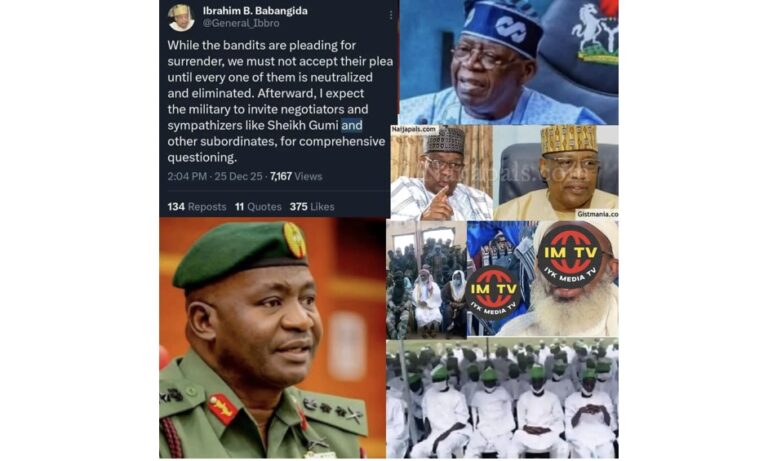
3. Babangida urges the government to persist until it eliminates bandits.
4. Commuters struggle in traffic gridlocks across Nigeria during the holidays.
Headlines such as “Frustrated commuters cook food on the Lagos-Benin-Asaba Road, in traffic for 2 days” highlighted the chaos in transportation across Nigeria before Christmas.
The roads tested the patience, resolve, and determination of Nigerians to reunite with their families.
A combination of poor infrastructure and high holiday travel volume created the gridlock. There were other causes and issues.
1. Chronic Bad Roads & Ongoing Construction were the primary causes. Crumbling highway sections around Benin added to construction and diversions on key stretches, such as the Benin-Asaba Bypass and the Lokoja–Abuja highway. It led to Extreme delays, vehicle damage, and forced use of risky makeshift roads.
2. Massive Holiday Travel Surge. Annual Christmas/New Year exodus, especially to Eastern Nigeria. The volume of vehicles overwhelmed the already strained road capacity.
3. Inadequate Traffic Management and Gridlocks. Single incidents (e.g., a stalled truck) cause hours-long standstills; Poor traffic control in transit hubs like Asaba.
4. Extortion at Illegal Checkpoints. These unofficial toll points caused financial loss, harassment, and further delays for those who refused to pay.
The Human Impact of the Gridlock
The gridlock created dangerous and desperate conditions for travellers:
• Extreme Travel Times: A typical trip from Lagos to Asaba, which took about three hours in the 1980s, now takes 15 hours or more with no accidents. Some luxury bus passengers have been on the road for two full days.
• Hardship and Scarcity: Necessities become a significant challenge. One report noted that food vendors could not meet the demand from the sea of stranded commuters, leading some to cook for themselves. Travellers are advised to pack at least two days’ worth of food.
• Emotional and Physical Toll: Stranded passengers, including children, suffer from hunger, heat, and exhaustion. The journey has been described as a “nightmare” and a “gruelling ordeal”, with some reconsidering road travel altogether.
Official and Public Response
Police Deployment: In response to the congestion, the Kogi State Police Command has deployed officers, including the Mobile Force and Traffic Section, to manage flow and enhance safety on the Lokoja–Abuja highway.
Public Outcry and Criticism: There is significant public anger directed at authorities. Commuters have vented their frustration at the Minister of Works for not acting faster. Prominent figures like Professor Pat Utomi have criticised the situation as a sign of “deep-rooted infrastructure decay and poor governance”.
Broader Economic Concerns: Analysts note that potholed roads increase transport costs, damage vehicles, delay goods, and ultimately contribute to higher consumer prices. This highlights the crisis as more than an inconvenience—it’s a drag on the national economy.
This crisis is not an isolated event but a symptom of systemic failure. Critics argue that it exposes a contradiction in government priorities, in which funding is allocated to new mega-projects. At the same time, essential existing infrastructure that forms the “arteries of the economy” is left to decay.
5. Tax Reform is high on the burner.
Reports indicate that the National Assembly has returned to discussing the challenge facing tax reforms in Nigeria, focusing on the controversial legislation. Details next week.
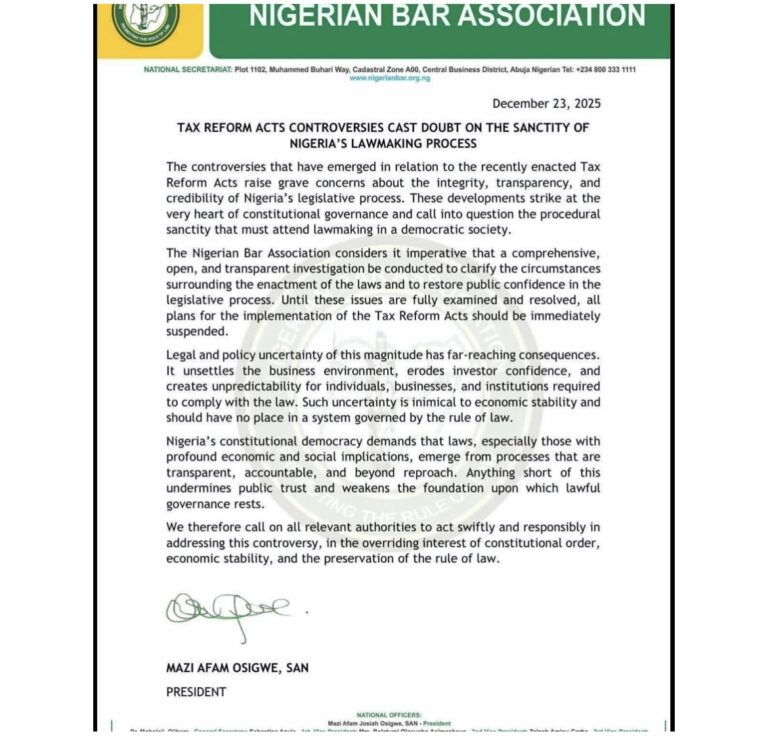
TAX REFORM ACTS CONTROVERSIES CAST DOUBT ON THE SANCTITY OF NIGERIA’S LAWMAKING PROCESS
The controversies that have emerged in relation to the recently enacted Tax Reform Acts raise grave concerns about the integrity, transparency, and credibility of Nigeria’s legislative process. These developments strike at the very heart of constitutional governance and call into question the procedural sanctity that must attend lawmaking in a democratic society.
The Nigerian Bar Association considers it imperative that a comprehensive, open, and transparent investigation be conducted to clarify the circumstances surrounding the enactment of the laws and to restore public confidence in the legislative process. Until these issues are thoroughly examined and resolved, all plans for implementing the Tax Reform Acts should be suspended immediately.
Legal and policy uncertainty of this magnitude has far-reaching consequences. It unsettles the business environment, erodes investor confidence, and creates unpredictability for individuals, businesses, and institutions required to comply with the law. Such uncertainty is inimical to economic stability and should have no place in a system governed by the rule of law.
Nigeria’s constitutional democracy demands that laws, especially those with profound economic and social implications, emerge from processes that are transparent, accountable, and beyond reproach. Anything short of this undermines public trust and weakens the foundation of lawful governance.
We therefore call on all relevant authorities to act swiftly and responsibly in addressing this controversy, in the overriding interest of constitutional order, economic stability, and the preservation of the rule of law.
Mazi Afam Osigwe, SAN
President, Nigerian Bar Association