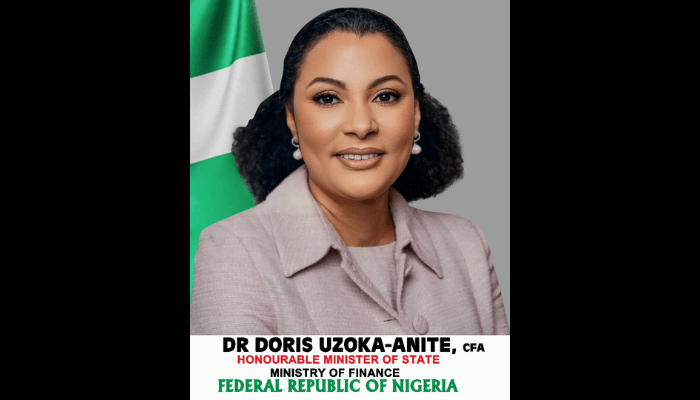
Doris Nkiruka Uzoka-Anite is having one of those rare political moments when preparation meets power. The Nigerian Minister of State for Finance has stepped into the centre of the country’s fiscal machinery at a time of tightening revenues, delayed government payments, and growing anxiety over cash flow. In recent weeks, core revenue generation and cash management responsibilities have effectively shifted to her desk, making her one of the most influential figures in Nigeria’s economic management today.
Born on October 16, 1973, in Orsu Obodo, Oguta, Imo State, Uzoka-Anite did not begin her professional life in finance or politics. She trained as a medical doctor at the University of Benin and qualified in 1999.
For a time, her future appeared set in medicine. Then, in 2002, she made a decision that would define her public life, leaving clinical practice for the banking sector.

She entered Zenith Bank through human resources and training, an unusual starting point for someone who would later run treasury operations. But it proved formative. Those early years gave her a close understanding of people, systems, and institutional culture. In 2011, she moved into treasury, where the pace hardened, and the margins narrowed. She traded fixed income and currencies, managed asset and liability positions, and rose steadily through the ranks.
By the time she became treasurer and later a general manager at Zenith Bank, she was overseeing some of the bank’s most sensitive functions. She played a key role in shaping investment strategy, managing financial risk, and ensuring compliance in an increasingly regulated environment. It was high-pressure work, far removed from the hospital wards she once knew, but it sharpened her instincts.
Read also: Foreign investors show strong confidence in Nigeria at World Bank/IMF meetings.
Alongside her professional rise, she built an unusually strong academic portfolio. She holds the Chartered Financial Analyst charter, specialising in financial risk management and portfolio management. She earned a double MBA from the London School of Economics and New York University Stern School of Business, and completed advanced training in fintech, algorithmic trading, and data science for finance at the University of Oxford. She also undertook executive training with global financial institutions, including Goldman Sachs and Citibank, according to professional records.
Public service followed. In March 2021, Hope Uzodimma, Imo State governor, appointed her commissioner for finance and coordinator of the economy. At the time, she was among the youngest to hold that office in the state.

Her move to the federal stage came after President Bola Tinubu’s election in 2023. She was nominated, screened by the Senate, and inaugurated in August 2023 as Minister of Industry and Investment. In November 2024, she was redeployed to the finance ministry as minister of state, a shift that placed her closer to the core of economic decision-making.
Read also: Finance Ministry forms team to study stablecoin adoption — Cardoso.
The real turning point came with a recent internal reorganisation of the finance ministry. At a time when Nigeria is struggling with a sharp revenue shortfall and what senior officials privately describe as cash management crisis mode, key revenue and cash management functions were reassigned to Uzoka Anite. The move significantly elevated her influence over debts, payments, and inflows.
Since then, she has moved quickly. According to officials briefed on the process, she has ordered a broad review of government cash balances, payment obligations, and revenue streams. She has met with the leadership of the Debt Management Office, the Nigeria Customs Service, and internal cash management units. She has also opened talks with the Nigerian National Petroleum Company to press for improved revenue delivery, while oversight of the oil firm is being tightened in collaboration with the attorney general, according to government sources.
Publicly, Uzoka Anite has been blunt about the scale of Nigeria’s financial leakages. Speaking in Abuja at the National Conference on Illicit Financial Flows, she said the country loses an estimated 18 billion dollars annually to tax-related illicit flows driven by profit shifting and aggressive tax avoidance by some multinational companies. She described illicit financial flows as a serious threat to Nigeria’s development and economic sovereignty, calling the problem a hydra-headed monster, according to a statement from her office.
She has also taken a leading role in Nigeria’s push to exit the Financial Action Task Force grey list by the second quarter of 2025. “We are working tirelessly to address the remaining deficiencies in our AML and CFT regime, and we are confident that our efforts will yield positive results,” she said during a meeting with relevant ministries and agencies, according to official remarks. Exiting the grey list, she argued, is essential for investor confidence and the credibility of Nigeria’s financial system.
Away from Abuja’s balance sheets, Uzoka Anite has kept a visible focus on human capital. She helped conceive SkillUp Imo, a digital skills programme that has trained about 50,000 young Nigerians, particularly from Imo State, in areas such as software development, data analytics, artificial intelligence, cybersecurity, and fintech. At the graduation of the programme’s third cohort, she expressed particular pride in the participation of young women. “We remain committed to widening access, scholarships and mentorship so more girls can lead in STEM and shape the future of our region,” she said, according to programme organisers.
Traditional institutions have also recognised her rise. She was recently conferred with the Ada Ukwu Ndi Orlu chieftaincy title by the paramount ruler of Umudioka Ancient Kingdom in Orlu Local Government Area of Imo State. Accepting the honour, she said, “I accept this title with humility and a deep sense of responsibility. By the grace of God, I will continue to uphold the dignity of this office and work for peace, opportunity, and prosperity for the people of Orlu Zone, Imo State, and Nigeria as a whole,” according to a statement released after the ceremony.