…cancels holidays for directors, state controllers
David Umahi, Minister of Works, has directed contractors working on federal roads to ensure the routes remain open for travellers.
He said no closure of project sites without authorisation, insisting that strategic highways and bridges must remain operational during the holiday season and afterwards.
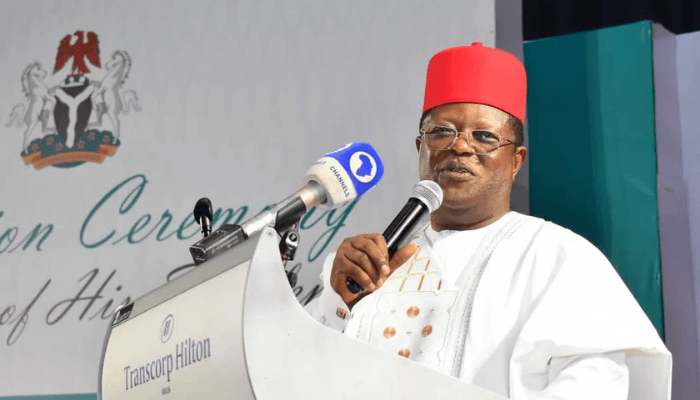
Umahi gave this directive during an emergency meeting with directors and contractors of the Federal Ministry of Works on Tuesday in Abuja.

Umahi who emphasised compliance to this directive, also said that directors in the ministry of works and Federal Controllers of Works across the country are exempted from holiday, he said they are expected to be on site to ensure that ongoing road projects do not obstruct the free flow of traffic during the festive period.
Read also: Coastal highway to be opened to traffic in December – Umahi
“Roads must be freed. No controller should go on holiday. Abuja–Kano has improved, and nobody is complaining again. We will sustain the tempo. Between now and February, I will personally visit the site. Any embarrassment must stop. Directors involved must be on the roads, and any pothole must be fixed. The road is now largely motorable, and we will keep it that way.
“No contractor is permitted to close a site without the approval of the Federal Ministry of Works. Some sites must not close at all. Abuja–Lokoja cannot close. Some corridors are simply too critical. We would like some of our contractors that may be taking holidays to understand what is going on in their sites. Dont close the roads. Open them for vehicular movements.
“There must be approval by the Federal Ministry of Works before any closure. That is what the contract says and that is what the procedure says. We do not just close and open roads. We need to know. If you want to close, there are signs that must be in place. For example, the Abuja–Kano Road cannot just be closed. No place should be closed without our permission. This is very important, and I plead with you to be thorough on the roads,” he said.

According to him, road projects such as the Abuja–Lokoja Expressway, the Abuja drainage canals, and key corridors in Sokoto, Katsina and Kebbi states must not be closed under any circumstances due to their strategic importance.
The minister admitted that recent disruptions on the Abuja–Lokoja highway embarrassed the government but appealed for patience, noting that emergency interventions were ongoing to restore traffic flow.
Describing the traffic gridlock on the Abuja–Lokoja Road as very embarrassing, the minister ordered that the road be further opened up to ease vehicular movement, particularly ahead of the Christmas season. He stressed the need for urgent and coordinated action by contractors and supervising officials to eliminate bottlenecks and ensure smooth traffic flow on all major federal highways nationwide.
Umahi also commended contractors for embracing President Bola Tinubu’s policy shift from asphalt to concrete road technology, describing it as a difficult but necessary transition to improve durability and reduce recurrent failures.
“I commend you for agreeing to adapt to the new policy of Mr President on concrete road technology. Many of you even requested that your projects be changed from asphalt to concrete. That is not easy, but it is necessary,” he said.
He argued that asphalt roads often deteriorate within 10 to 15 years due to drainage failures and poor soil conditions, while concrete roads offer longer life spans if properly constructed.
Beyond construction methods, the minister announced a sweeping reorganisation of the Ministry of Works, revealing that directors and senior engineers would be redeployed to the field to supervise projects directly.
He decried that poor supervision had become one of the biggest challenges in the delivery of federal infrastructure and vowed to end what he described as office-based engineering.
“Everybody is going to the field. Only the Permanent Secretary and I will remain in the office. Every director will supervise a major project, and performance will be judged strictly by output,” Umahi declared.
Speaking further, the announced plans to digitalise project monitoring, including the creation of zonal project portals where contractors would upload site updates, valuations and certifications in real time.
He said the new system would ensure that project evaluations and certifications were completed within 48 hours, improve transparency and reduce delays associated with manual processes.