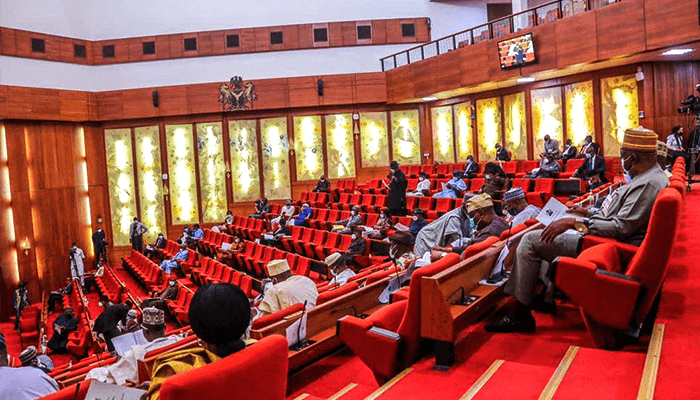
The Senate on Tuesday passed President Bola Ahmed Tinubu’s ₦58.47 trillion 2026 Appropriation Bill for second reading, setting the stage for detailed legislative scrutiny of the proposed spending plan.
The passage followed a lead debate by Opeyemi Bamidele (Ekiti Central), the Senate Leader, who sponsored the bill titled “A Bill for an Act to Authorise the Issue from the Consolidated Revenue Fund of the Federation the total sum of ₦58,472,628,944,759 for the services of the Federation for the year ending 31st December, 2026.”
Leading the debate, Bamidele said the bill was the legal instrument for translating the policy direction outlined by President Tinubu in his 2026 Budget Address into enforceable public expenditure.
“This Bill is the legal instrument through which the policy direction outlined by the President in his 2026 Budget Address is translated into enforceable public expenditure.

“It is therefore central to governance, economic management, and national development in the coming fiscal year,” he said.
Read also: Senate steps down motion seeking to halt Wike’s land revocations in Abuja
He noted that the bill was deemed to have passed first reading, having been laid before a joint session of the National Assembly on Friday, December 19, 2025.
Bamidele described the 2026 budget as one of consolidation, arguing that it builds on reforms already undertaken by the administration to stabilise the economy and strengthen public finance.
“The economy is in a phase of adjustment following far-reaching reforms aimed at restoring stability, correcting distortions, and strengthening public finance.

“The 2026 Budget is therefore not an experimental document. It is a budget of consolidation,” he said.
According to the proposal, total expenditure of ₦58.472 trillion comprises ₦4.097 trillion for statutory transfers, ₦15.909 trillion for debt service, ₦15.252 trillion for recurrent (non-debt) expenditure, and ₦23.214 trillion for capital expenditure through contributions to the development fund.
Bamidele said the structure of the budget reflected deliberate prioritisation, with capital spending emerging as the largest component of discretionary expenditure.
He said the ₦23.214 trillion capital allocation targets critical growth-driving sectors, including transport infrastructure, power and energy, agriculture, industrial development, housing and the digital economy.
“As the President emphasised, sustainable growth cannot be achieved without addressing infrastructure deficits and expanding the productive capacity of the economy,” Bamidele said, adding that the spending plan was designed to stimulate private investment, create jobs and strengthen food and energy security.
On recurrent expenditure, he said the ₦15.252 trillion provision would ensure efficient government operations and service delivery, while assuring lawmakers that strict cost controls and improved payroll management would be enforced to prevent fiscal slippages.
The Senate Leader said the ₦15.909 trillion earmarked for debt service reflected existing obligations, but stressed that the administration was pursuing improved revenue mobilisation, tax base expansion and better performance of government-owned enterprises to reduce borrowing over time.
“This Senate will continue to exercise its oversight responsibility to ensure that borrowing remains prudent and that debt is deployed strictly for development purposes,” he said.
He added that the ₦4.097 trillion set aside for statutory transfers was in fulfilment of constitutional obligations to key institutions, critical to democratic stability.
Bamidele noted that the budget projected revenues of ₦34.33 trillion against total expenditure of about ₦58.18 trillion, with a deficit of 4.28 per cent of GDP, which he said remained within the medium-term fiscal parameters earlier approved by the Senate.
He said the philosophy of the 2026 budget was anchored on four pillars: consolidating macroeconomic stability; improving the business and investment environment; promoting job-rich growth and poverty reduction; and strengthening human capital while protecting the vulnerable.
Security, education and healthcare featured prominently among sectoral priorities, alongside infrastructure and agriculture, which he said were critical for job creation, productivity and inclusive growth.
“The true test of a budget is not in its presentation, but in its delivery,” Bamidele said, urging senators to ensure transparency, realism and value for money as the bill proceeds to committee stage.
He subsequently called on lawmakers to give the bill favourable consideration.
Contributing to the debate, Senator Adamu Aliero (Kebbi Central) said he supported the bill but urged the Appropriations Committee to subject it to rigorous examination.
“I support the bill. However, the committee on Appropriations should do thorough scrutiny,” Aliero said. “₦23 trillion for capital projects is impressive and has never happened since we came in 2023.
“Well over ₦5 trillion on security is also commendable. Education allocation is also good and my prayer is that the funds be released for proper implementation.”
Senator Sani Musa (Niger East) said the debt service provision, though large, was critical for restoring investor confidence, especially as the country approaches an election cycle.
“Now that we are going into a political period, the allocation of ₦15.9 trillion is for servicing our debts, which will further restore confidence between Nigeria and its development partners,” he said.
“I believe that 2026 is going to be better with a single budget.”
Former Edo State governor and Senator Adams Oshiomhole (Edo North) said the emphasis on infrastructure and employment was a positive signal.
“For me, job creation and infrastructure is a way to make a bold statement. We are more likely to witness a job-led growth than a jobless growth,” Oshiomhole said.
He also welcomed the defence allocation but warned against waste. “Allocations to defence suggest our seriousness to tackle insecurity. However, our committee on defence must ensure prudence in procurement processes and account for the funds. We need to get value for money.”
On debt servicing, Oshiomhole said Nigerians needed better understanding of the issue.
“We have to educate Nigerians that these debts accrued over the years. Obviously, huge progress has been made,” he added.
Senator Ahmad Lawan (Yobe North) described the budget as “very bold and courageous,” particularly in its focus on security and welfare.
“The largest sectoral allocation to defence is in line with the mindset of Nigerians. Defence needs more, but we have to appreciate what has been given,” Lawan said.
He also welcomed plans to end the practice of multiple budgets.
“On the issue of multiple budgets, it’s good that it will be sorted by March 31, 2026, by ensuring that political activities do not frustrate implementation. The Ministry of Finance must release funds accordingly.”
However, Lawan expressed concern over the allocation to the Federal Ministry of Livestock.
“The ministry has a paltry allocation, yet it is dealing with security issues and an industry worth over ₦30 trillion per annum. We have to look at this critically,” he said.
Minority Leader Abba Moro (Benue South) said the budget was attractive on paper but warned that implementation would be key.
“This budget looks beautiful. If implemented, it will lead to a prosperous Nigeria,” Moro said. “However, our economic development is worrying, and we hope the money voted for road infrastructure is well utilised.”
He also raised concerns about agriculture. “Farmers who took loans at high interest rates are struggling because of low prices and other challenges. Farm inputs and implements should be made accessible to help them navigate the present situation,” he added.
Senator Amos Yohanna (Adamawa North) called for reforms in budget execution, urging the federal government to decentralise payment processes to improve efficiency.
On his part, Senator Ali Ndume Monguno (Borno North) commended the prioritisation of security but stressed the need for strict adherence to the budget.
“I commend the government for giving security prominence. Two, we expect implementation to the letter,” he said.
Following the debate, the Senate passed the 2026 Appropriation Bill for second reading and referred it to the Committee on Appropriations for detailed consideration.