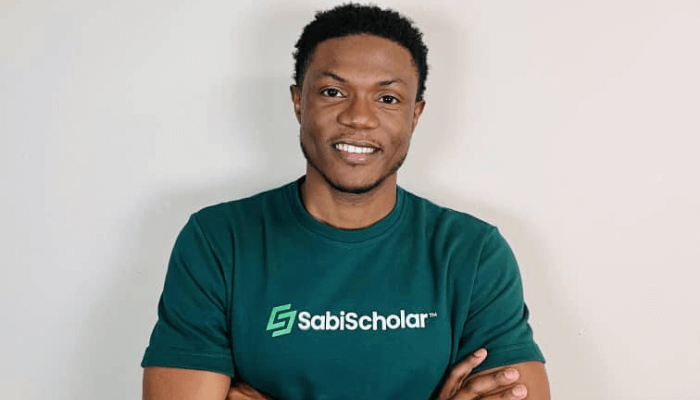
…Emmanuel Ndukuba with excerpts from Divine Iloh, an AI researcher and EdTech founder
In many Nigerian public schools, a class can mean 70 or more pupils squeezed into a room meant for about 40. A recent study of junior secondary schools in Lagos reported average class sizes near 70, far above Nigeria’s own policy guideline of 1:40 and UNESCO’s recommended 35–45 pupils per class.
The pressure does not ease after secondary school. For the 2022 admissions cycle, the Joint Admissions and Matriculation Board (JAMB) said about 600,000 of 1.1 million eligible candidates received offers, leaving roughly half a million qualified students without university places. “You grow up seeing classmates do everything right and still not get university admission,” says Divine Iloh. “At some point, you start asking if the bottleneck is really talent, or just capacity.”
It is against this backdrop that Iloh, an AI researcher and EdTech founder, is trying to re-engineer how Nigerian institutions deliver learning.

As co-founder of SabiScholar, he is building an AI-assisted learning platform intended not for high-bandwidth campuses in rich countries, but for overcrowded classrooms and bandwidth-constrained communities in Nigeria.
From bottleneck to plug-and-play institutional platform. Rather than launch a direct-to-consumer app, SabiScholar has taken an institutional route. The platform functions as a multi-tenant learning management system (LMS): schools can run their own programmes on shared infrastructure, selecting from a catalogue of curriculum-aligned courses or uploading their own materials.
For now, the focus is on secondary students preparing for O-level exams. The team has produced over 1,200 video lectures across roughly 45 courses, organised around national curricula and exam blueprints. Lessons are delivered in short, structured segments with matching notes and assessments.
“In practical terms, a school that has never run an online programme can plug into something that already understands their syllabus. They keep academic control, and we handle the heavy lifting on content and infrastructure,” Iloh explains.
In a recent pilot phase, more than 2,900 students across Nigeria used the platform for exam preparation. Early feedback highlighted improved preparedness among first-time WAEC and UTME candidates, with some students reporting scores well above the national UTME average of around 180. Several participants described the content as compact and easier to revise; one student summed it up: “My scores went up.”

Designing for the bandwidth reality
A recurring theme in Iloh’s work is that software must respect the limits of the networks it runs on. “We can’t pretend a Nigerian classroom has the same connectivity profile as a campus in New York, so if your design assumes perfect Wi-Fi, you’ve already excluded low-income families from your product’s benefits,” he says.
To address that, Iloh has been pursuing a separate line of research on “bandwidth-aware” delivery. Earlier this year, he and his co-inventor secured Nigerian patent protection for “Bandwidth Aware, Curriculum Aligned Multi-Tenant System for Accredited Remote Education with Offline Assessment Integrity.”
The invention describes an architecture that predicts likely connectivity windows, prefetches course materials in small chunks during those windows, and maintains tamper-evident records of offline assessments for institutions.
Although SabiScholar currently operates as a conventional, yet locally tuned, LMS with AI-assisted recommendations, the patented delivery framework is in the research and rollout pipeline, slated for staged implementation as the platform scales. “To be clear, the patent and the low-bandwidth delivery framework research give us a roadmap, but we implement each piece only when we’re sure it makes things more reliable for schools,” he notes.
Early impact and what it suggests
SabiScholar’s first pilot reached more than 2,900 secondary school students preparing for WAEC and UTME exams, many of them first-time candidates from overcrowded schools. Early reports indicate that participating students scored well above the national UTME average of about 180, with several describing the courses as compact, exam-focused, and instrumental in their score improvements.
“What we hear from teachers is that once the basics are on the platform, they can spend their limited contact time diagnosing gaps and coaching students who are behind,” Iloh says.
“It doesn’t solve the classroom crowding overnight, but it changes how each hour is used.” If large-scale implementation confirms these early signals, a scalable, curriculum-aligned platform that consistently lifts exam performance could help institutions stretch limited classroom capacity, support repeat and first-generation candidates, and open alternative pathways for the hundreds of thousands of qualified students who miss out on admission each year.
Recognition at the Nigeria Innovation Summit: The work has started to gain attention in Nigeria’s broader innovation ecosystem. At the 2025 Nigeria Innovation Summit in Lagos, an event that attracts policymakers, founders, and executives, and where Lagos State Governor Babajide Sanwo-Olu was a Special Guest of Honour, Iloh delivered a talk on “Building AI-Ready Universities for Emerging Markets.”
He was also profiled in the Summit’s official Innovation Spotlight, highlighted for using AI research to strengthen digital education infrastructure across African institutions. “For me, that recognition wasn’t just personal,” he reflects. “It signalled that education infrastructure is finally being treated as core innovation work, not an afterthought.”
Beyond one platform: judging, patents, and research: When we asked Iloh about work beyond SabiScholar, he pointed to other impact-driven projects.
“I try to keep my work anchored in everyday problems like students learning on low-bandwidth devices, devices going offline in supply chains, or young developers figuring out AI,” he says. “Judging the Alt School Africa Data and AI Hackathon, and speaking at the finale, was a way to give back to that pipeline.” Those activities sit alongside a growing portfolio of technical work.
In addition to his education-focused patent, Iloh is co-inventor of an AI-driven cybersecurity framework for supply chains, and his research spans privacy-preserving synthetic student data, AI-enhanced environmental monitoring, and other applied data-science projects published in peer-reviewed venues.
Collectively, these show that his contributions extend beyond a single startup and illustrate how research-active professionals can help grow Nigeria’s research and development base by deploying systems in real institutions and mentoring the next generation of developers and entrepreneurs.
“We talk a lot about talent leaving,” Iloh says. “One practical way to grow research and development at home is to make sure students can actually access rigorous learning, wherever they live. If we can get that right, everything else has a stronger foundation.”