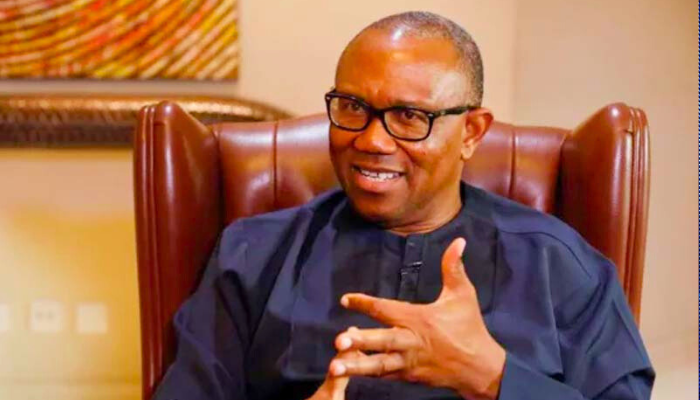
Peter Obi, former presidential candidate, has presented detailed calculations showing that the alleged $5 million spent on educating four children of a former oil regulatory chief could instead fund a self-sustaining education system for 6,000 Nigerian students annually.
The intervention comes after Aliko Dangote, Africa’s richest man and president of Dangote Group, alleged that Farouk Ahmed, former chief executive of the Nigerian Midstream and Downstream Petroleum Regulatory Authority, spent approximately $5 million on secondary school education for his four children in Switzerland. Dangote has called for a full investigation.
At current exchange rates, $5 million equals roughly N7.5 billion, a sum Obi argues could transform educational access in a nation with 18 million out-of-school children, the world’s highest number.
In a detailed social media post, Obi outlined how N7.5 billion could build 25 school blocks at 35 million naira each, totalling N875 million in construction costs. With six classrooms per block accommodating 40 students each, the infrastructure would serve 6,000 students.

The system would employ 450 teachers at 125,000 naira monthly, requiring 675 million naira annually. Combined with construction costs, the initial outlay would total N1.55 billion, leaving N5.95 billion.
Read also: NMDPRA boss disowns alleged response to Dangote’s accusations
The former Anambra State governor proposed investing the remaining funds in Nigerian government bonds currently yielding 19 percent, generating approximately 1.13 billion naira annually. This would cover teacher salaries, school operations at 10 million naira per block annually, and leave over 200 million naira in surplus.
“In effect, the system becomes permanently self-funding, without touching the original capital,” Obi wrote.
Obi extended his analysis to Nigeria’s broader elite class. Assuming 2,400 individuals, representing 0.0001 percent of Nigeria’s 240 million population, with similar resources, he calculated that collective investment could build 60,000 school blocks, educate 14.4 million students annually, and employ 1.08 million teachers.

Such an initiative would virtually eliminate Nigeria’s out-of-school children crisis through a self-sustaining ecosystem, Obi argued.
“Under such a scenario, Nigeria would no longer be debating access to education; the debate would have shifted to quality, innovation, and excellence,” he wrote.
Obi’s comments reference Nigeria’s persistent corruption challenges. He cited former British Prime Minister David Cameron’s description of Nigeria as “fantastically corrupt” and former U.S. President Donald Trump calling it “a now disgraced country.”
The Labour Party’s 2023 presidential candidate emphasised he wasn’t criticising parental investment in children’s education, quoting Plato’s Republic on education’s societal importance. Rather, he questioned the “scale, context, and moral consequence” when such spending involves public officials in a country with extreme inequality.
“The Farouk controversy is not merely about one man,” Obi wrote. “It is a mirror held up to our collective conscience, asking whether privilege will continue to coexist comfortably with abandonment, or whether responsibility will finally rise to meet opportunity.”
Neither Farouk Ahmed nor NMDPRA representatives have publicly responded to Dangote’s allegations or Obi’s calculations. The regulatory authority has not commented on whether any investigation is underway.