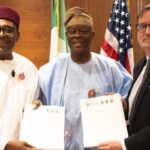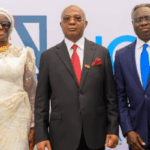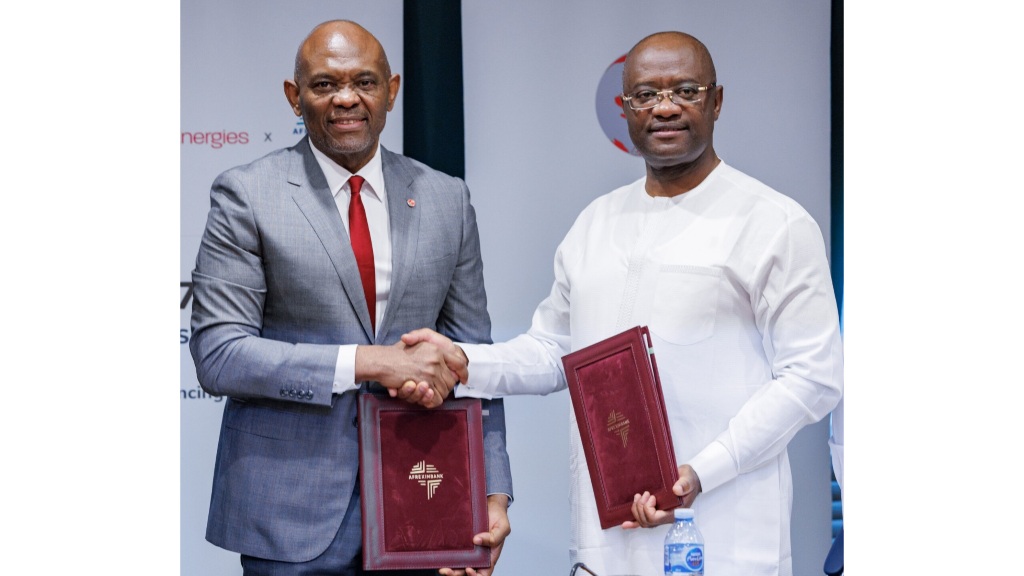
Heirs Energies has signed a $750 million financing deal with Afreximbank, marking a fresh round of funding for the Nigerian energy company as it seeks to scale production, refinance existing debt and pursue growth opportunities across Africa.
The agreement was signed in Abuja over the weekend, with Tony Elumelu, chairman of Heirs Holdings, describing the transaction as a validation of African capital backing African enterprise after years of regulatory and financing challenges.
Elumelu traced the origins of Heirs Energies’ journey to its acquisition of OML 17 from Shell, recalling how difficult it was for an African private sector player to gain confidence and approvals at the time. “When we started negotiating with Shell, there was no proof of us,” he said, adding that early backing was crucial. “The president came and said, ‘I’ve got $600 million.’ With that, we took a close negotiation with Shell.”
Read also: Afreximbank targets $40bn by 2026 to support intra-African trade, AfCFTA

He said Shell eventually approved the acquisition of OML 17, parts of the Eastern pipeline and a power plant, but the transaction later ran into regulatory obstacles under the previous administration. “Our government, led by President Buhari, refused to approve it. And the reason was that it was too big an asset to be in the hands of the private sector,” Elumelu said.
According to him, the delays were costly, forcing the company to spend heavily on bank charges and legal fees while the transaction was unwound and restructured. “We went for over one and a half year. We’re paying bank charges, we’re raising money, we’re paying legal fees, to survive” he said, noting that some assets, including the pipeline and power plant, were eventually taken out of the deal.
Despite those setbacks, Elumelu said support from Afreximbank and other African institutions enabled the company to stabilise and expand. “What we are doing today is a validation, a public recognition of what it is like,” he said. “This is a clear manifestation of African capital working for African businesses.”
He described Afreximbank as “the most impactful and catalytic financial institution in Africa,” adding that strong performance by African companies was critical to sustaining such partnerships. “If you perform, you demonstrate, you encourage them to do more for you and for others also,” he said.
George Elombi, president of Afreximbank, said the bank’s partnership with African private sector players such as Heirs Energies was central to its mandate. He emphasised the importance of sustained collaboration across economic cycles and said the institution remained committed to supporting the continent’s energy sector.

He said Afreximbank was looking ahead to expanding its role in energy financing. “We think we should get to higher strides in creating, in working on the energy bank, so that we can move most of this energy portfolio that’s where it should sit, and we will put tremendous capital into this,” Elombi said.
Following the signing, Samuel Nwanze, executive director and chief financial officer of Heirs Energies, said the financing would support the company’s next phase of growth.
He said Heirs Energies is currently producing “well over 50,000 barrels of oil a day” and about “820 million standard cubic feet of gas.”
“This financing is actually to take us into the next phase of growth,” Nwanze said.
He added that the company believes the asset it operates has the capacity to reach significantly higher output over time. “We think this asset can do up to about 100,000 barrels. Now we are working towards getting to about 100,000 barrels of oil over the next three years.”
Nwanze said the funds would be used both to refinance existing debt and to support expansion, structured as a reserve-based lending facility with a five-year tenor.
“Because we have grown the capacity of the assets, we are getting additional money,” which we will use to pursue growth,” he said.
He said discussions with Afreximbank on the deal began in August and intensified in the months leading up to the signing. “We’ve been working almost every day since August to try and get it done before the end of the year,” he said.
Beyond oil production, Nwanze said increased gas output has already had a measurable impact on Nigeria’s power sector. “Today we are doing about 120,” he said, referring to gas supply, and noting that this has helped triple power generation capacity in parts of the eastern domestic network.
“If we are able to grow the business more, we’ll be able to make significant impact in terms of the energy sufficiency and survival. This is really our dream,” he stressed.