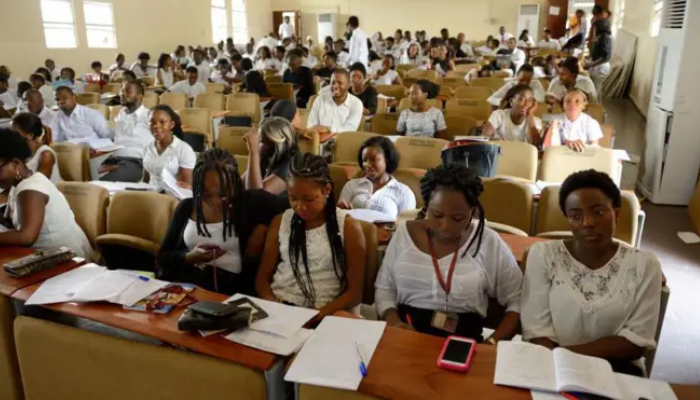
For students in public universities, the battle for education often begins with the search for a place to sleep.
Inadequate hostel space continues to unsettle academic life, sending waves of anxiety through campuses across the country.
As dawn breaks on many Nigerian public university campuses, some students are already awake, not because they live nearby, but because they spent the night on a friend’s floor, in overcrowded hostels, and/or commuting long distances from off-campus rooms they can barely afford.
For thousands of students in public universities, the struggle for education goes beyond lecture halls, epileptic power supply, and hiked fees into the daily anxiety of finding a safe place to sleep.

With limited on-campus accommodation and rising living costs, the promise of higher education is increasingly shadowed by hardship, uncertainty, and resilience.
As many institutions matriculate new students for the commencement of a new academic calendar, many of the freshers are faced with accommodation malady.
Daniel Akinsola, who matriculated on Wednesday at the University of Lagos, had his joy cut short as he was faced with hostel challenges. He could not get a hostel allocation, and finds it challenging travelling from Igando to Akoka every lecture day.
Even at N80,000 accommodation fees, Adewale Akinsola, his father was ready to make the payment, but the university management insists there was not enough accommodation.
Read also: UniJos restores calm after student protest over hostel sanitation issues

Akinsola is left with no other choice than paying N400,000 for accommodation off the campus to ensure his son is not embodied with the hustles of shuttling from Igando to campus at Akoka.
Another student who gave his name as Kazeem, said he was asked to pay N700,000 to secure a slot in the Femi Gbajabiamila hostel, a private built on-campus accommodation by the former speaker of the House of Representative.
There are concerns that privatisation of public universities’ hostels will only lead to the gentrification of the university environment pushing the poor majority out of school especially with the fee regime imposed by the school management on students.
Hostel accommodations have been persistently inadequate for undergraduate students across Nigerian public universities, making it difficult for them to remain dedicated to their studies.
Jibola Ogunjobi, a student at the University of Ibadan, buttressed this point when he explained that because of the limited number of hostel slots, the institution’s management decided to attend to 100 level and final year students first before considering others.
“The hostel fee is N60,000 for freshers, but the main challenge is that there is enough accommodation on campus, hence, many are forced to seek refuge elsewhere,” he said.
This challenge is driving many parents crazy, even as some are questioning the rationale behind offering students’ loans when they cannot secure accommodation to pursue their studies.
Experts argue that it is more advantageous for undergraduates to reside on-campus hostels than staying off-campus; but the total number of hostel accommodations in public universities is grossly inadequate to meet the need of the overpopulated number of undergraduates in the various universities.
Gift Osikoya, a parent whose child is a student at the University of Lagos decried the unhealthy challenges her son had to face on a daily basis to meet up with his academic routine from Ejigbo suburb of Lagos to the Akoka campus of UNILAG.
“My child has to shuttle from home to school daily because of inadequate accommodation on-campus, and we have not been able to get a lodge for him off-campus.
“It’s quite disturbing, he has to jostle to and fro campus every other day, and it’s affecting his health and studies. The government who should rise to the challenges are building hostels at exorbitant rates,” she said.
At Obafemi Awolowo University (OAU), Ile-Ife, the on-campus hostel fee is at N50,000, though some students expressed concerns that the university management would hike the money any moment, especially with the number of students increasing every session.
A student who spoke with BusinessDay in anonymity, said though there is constant power supply, the water supply is epileptic.
“We have 24/7 lights on campus, but water in my hostel is usually put off and on at a particular time,” she said.
A fact remains that education cannot thrive in Nigeria where basic needs are unmet. If Nigerian public universities are to fulfil their mandate, ensuring adequate hostel accommodation must be treated not as a privilege, but as a fundamental part of student welfare and academic success.