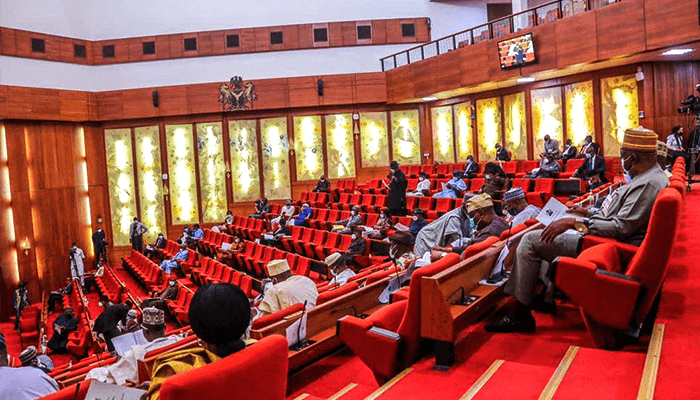
… says illegal minnimg, major source of insecurity
The Senate Ad-hoc Committee on National Security has warned that Nigeria’s current security framework is outdated and ill-equipped to deal with the scale of threats confronting the country, insisting that urgent reforms are needed to stem worsening insecurity nationwide.
Presenting its post-zonal hearings report, Opeyemi Bamidele, tge Senate leader who is also the chairman of the committee, said Nigeria is effectively “fighting 21st-century crimes with 20th-century tools and apparatus,” describing the nation’s security architecture as largely reactive rather than preventive.
“Our current national security architecture seems designed to be reactive rather than being preventive, which is against global security norms in today’s world,” he said.

The panel, which conducted public hearings across the six geopolitical zones, noted that stakeholders overwhelmingly commended the Senate for initiating a national security dialogue, but stressed that dialogue must now translate into action.
“Stakeholders unanimously applauded the Senate and indeed the National Assembly for this bold and courageous legislative step in the face of the rising spate of insecurity in the country, which has become a source of national concern,” the Senate leader stated.
The committee identified illegal mining as a major driver of insecurity, warning that proceeds from unregulated mineral exploitation are increasingly being channelled into criminal activities.
Bamidele reading the report said, “Illegal exploitation and mining of minerals across the country is a major factor fuelling insecurity in the zones,” calling for the immediate shutdown of unlicensed mining operations and stricter federal regulation of the sector.
It also warned that ethnic, regional and religious profiling has deepened divisions and undermined national unity.

Read also: Senate steps down motion seeking to halt Wike’s land revocations in Abuja
“Nigerians have over time been profiled along tribal, regional or religious lines, and unfortunately, this has had a negative impact on our growth and development as an entity,” Bamidele added.
Central to the committee’s recommendations is the establishment of state police, arguing that Nigeria’s overcentralised policing system has failed to respond effectively to local security challenges.
“Since the Constitution recognises state governors and local government chairmen as chief security officers of their respective domains, it is imperative that the Constitution be amended to give them control over security apparatus in their areas,” the report states.
According to the committee, decentralising policing would “strengthen local vigilante groups and enhance community-driven security responses.”
The committee faulted weak intelligence gathering and poor inter-agency coordination, urging a shift to technology-backed, intelligence-led policing.
“There is lack of deep intelligence-driven policing, leveraging on digital intelligence and data-driven analysis, which is the way forward to combat insecurity in the 21st century,” it said.
It recommended the deployment of drones, CCTV cameras, sensors and real-time intelligence platforms, particularly along Nigeria’s porous borders and forest corridors now exploited by terrorists, bandits and kidnappers.
“The security agencies should leverage technology and innovation by strengthening border security infrastructure through modern surveillance systems and improved rapid response capacity,” the report added.
The committee also linked insecurity to socio-economic pressures, including unemployment, poverty, hunger, drug addiction and radicalisation.
“Unemployment, poverty, porous borders, illiteracy, hunger, drug addiction, cultism and radicalisation by extremist groups are responsible for the rising insecurity in the country,” Bamidele stated.
To address these drivers, the committee proposed a National Youth Stabilisation Fund, targeted at conflict-affected areas to support economic recovery, youth empowerment and community resilience.
Highlighting the human toll of insecurity, the committee said many victims have lost ancestral lands, livelihoods and cultural heritage.
“Victims of violent attacks have suffered varied degrees of losses ranging from ancestral lands and shelters to farming equipment, animals and historic sites tied to their culture and tradition, which must be recovered,” ihe said.
It also called for the identification and prosecution of sponsors of insecurity “both locally and internationally,” alongside the creation of mobile courts to ensure swift justice.
Traditional institutions, forests and local governance
The panel urged the restoration of constitutional roles for traditional institutions and stronger oversight of religious teachings to curb radicalisation.
“There is need to restore and empower traditional institutions with constitutional roles, while religious institutions must be activated and supervised to stem radicalisation,” it said.
It warned that Nigeria’s vast forests have become “breeding grounds for insurgents, terrorists, kidnappers and criminal elements,” backing legislation to establish forest guards and enhance surveillance.
The committee further described large parts of the country as “ungoverned spaces,” noting that weak local governance has left rural communities feeling abandoned by the state.
“A large swath of the nation’s territory can be described as ungoverned space, where citizens do not feel the presence or effect of governance,” the report said.
The committee said its findings would guide legislative action, including the fast-tracking of a National Security and Recovery Bill, as the Senate prepares for a full National Security Summit scheduled for early 2026.