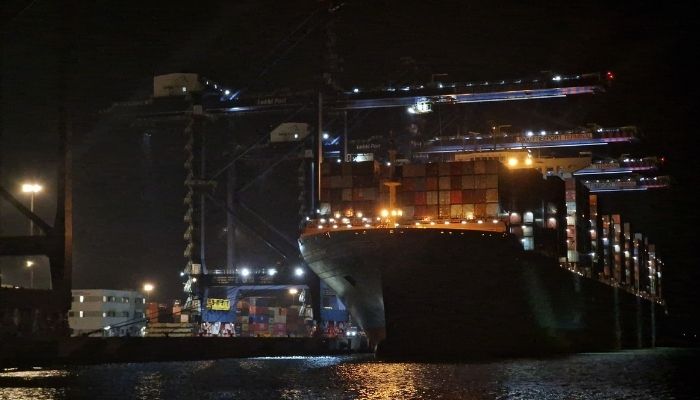
Nigeria has begun handling regional transshipment cargo through Lekki Port, with more than 20 percent of the terminal’s container traffic in 2025 discharged in Lagos and shipped onward to neighbouring West African ports, executives at the facility said on Tuesday.
The development marks the first time Nigeria has recorded transshipment activity since BusinessDay reported transshipment of European-bound Chinese vehicles from TinCan island port in 2024. It is a more familiar activity at ports in Ghana, Côte d’Ivoire and Togo, despite Nigeria being the region’s largest cargo market.
Lekki Freeport Terminal handled 503,443 twenty-foot equivalent units (TEUs) in 2025, up from 284,297 TEUs in 2024, according to official port figures, and the terminal is currently operating at about 50 percent of its installed capacity, up from 20 percent as of July.
“They’re offloading the container here, and then it’s distributed to Tema, to Côte d’Ivoire, to Abidjan,” said Ajay Tyagi, chief operating officer of Lekki Freeport Terminal.

Tyagi said Lekki has increasingly become a redistribution point for regional trade flows as shipping lines consolidate cargo in Nigeria before moving it to neighbouring markets.
Jedrzej Mierzewski, managing director of Lekki Freeport Terminal, said Nigeria’s large domestic market gives it a structural advantage in attracting and retaining transshipment cargo.
“Once vessels are calling Nigeria anyway, it is much easier to put transshipment on top,” he said, noting that Nigeria’s “buying power” makes volumes less vulnerable to small price changes.
He contrasted this with his experience running Kingston Freeport Terminal in Jamaica, where transshipment volumes were more price-sensitive. “If someone was offering a cheaper option, we were losing the volumes because the cargo did not have to come there,” he said.
Mierzewski cautioned, however, that transshipment is “a very complex system” that depends on coordination between terminal operators, port authorities, regulators and customers.

“We need every stakeholder working together so we can provide a competitive price to the vessel and to the shipping lines,” he said.
He pointed to Poland’s experience more than a decade ago as an example of how regulation can shape port competitiveness.
At the time, Polish-bound cargo was often discharged at German ports because importers could defer value-added tax payments there, unlike in Poland where VAT was paid upfront. “After the regulation was changed, within five years we became one and a half million TEUs,” he said.
Cargo evacuation at Lekki remains largely road-based. According to the port’s management, the terminal currently handles about 200 trucks daily via the coastal road, supported by an electronic call-up system integrated with port operations.
Meanwhile, barge movements account for roughly two percent of total container volumes, translating to between 2,000 and 3,000 TEUs.
Port executives said further capacity expansion at Lekki would depend not only on improvements in terminal performance but also on wider changes to infrastructure, regulation and coordination across Nigeria’s maritime trade ecosystem.
Before you leave, read: Inside Nigeria’s most advanced deep-seaport