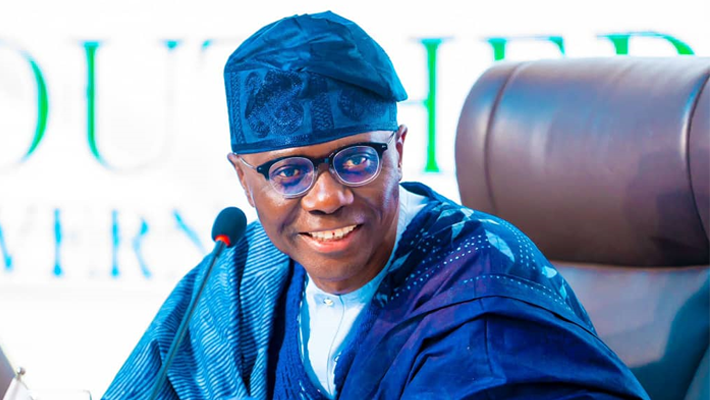
To bridge the housing deficit in Lagos, there’s a need for public-private partnership (PPP), Governor Babajide Olusola Sanwo-Olu, said on Tuesday.
Sanwo-Olu stated this at the 6th Lagos Real Estate Marketplace Conference organised by the Lagos State Real Estate Regulatory Agency (LASRERA), in Lagos, with the theme, “Shaping the Future of Lagos Mega City: Infrastructure Investment, Innovation and Affordable Housing.”
Lagos, Nigeria’s economy hub and most populous city in West Africa (with an estimated population of over 22 million people) is grappling with a housing deficit of over 3.4 million units, according to available housing data.
To close this gap, the state is estimated to require roughly 227,000 new homes annually to keep up with population growth and replace dilapidated stock—but actual deliveries are far below this target.

As a result, millions of residents live in slums in different parts of the state, a development the government is battling to address, with regular demolitions of what it terms ‘illegal developments’.
According to Sanwo-Olu, his administration was committed to building an inclusive and sustainable housing sector for all residents, but noted that achieving this goal requires the active participation of private developers, financial institutions and investors. According to him, housing goes beyond physical structures and speaks directly to human dignity, economic productivity and social stability.
“Housing is not just about buildings. It is about the kind of city we choose to become. In Lagos, affordability means homes people can actually live in, pay for and access close to where they work and raise families. This can only be achieved through partnerships, leveraging public-private partnerships, structured finance and demand-led planning,” Sanwo-Olu said.
He said that the government’s role was to act as an enabler, regulator and partner, rather than the sole provider of housing, adding that no meaningful progress can be made without strong collaboration with the private sector.
“A true mega city is not defined by how tall it builds, but by how well it lives. That is the Lagos we are committed to building thoughtfully, inclusively and sustainably,” he added.

Earlier, Moruf Akinderu-Fatai, the state Commissioner for Housing, said Lagos has attracted global attention due to its development strategies, capital projects and housing initiatives aimed at positioning the state as Africa’s model megacity.
He added that regulatory agencies such as LASRERA play a key role in ensuring that innovation in the housing and construction sector does not compromise public safety, integrity or compliance.
According to him, “Lagos is an integrated model of urban development where infrastructure investment, spatial planning, regulation and social planning work together. We have moved from vision to implementation, from plans to performance.”
Barakat Odunuga-Bakare, the Special Adviser to the governor on Housing, said the conference was a strategic platform for government and private sector stakeholders to address challenges facing the housing sector in a rapidly growing megacity like Lagos.
She said partnerships with countries such as Saudi Arabia, the United States, the United Arab Emirates, Canada and other African nations reflect the state government’s readiness to strengthen its real estate infrastructure and adopt global best practices.
Odunuga-Bakare also disclosed that the state government is reviewing a new tenancy bill at the Lagos State House of Assembly, aimed at streamlining the roles of real estate practitioners and providing clearer guidelines for property transactions.
The conference attracted local and international stakeholders, who explored innovative financing, infrastructure investment and collaborative solutions to address the state’s increasing housing needs.