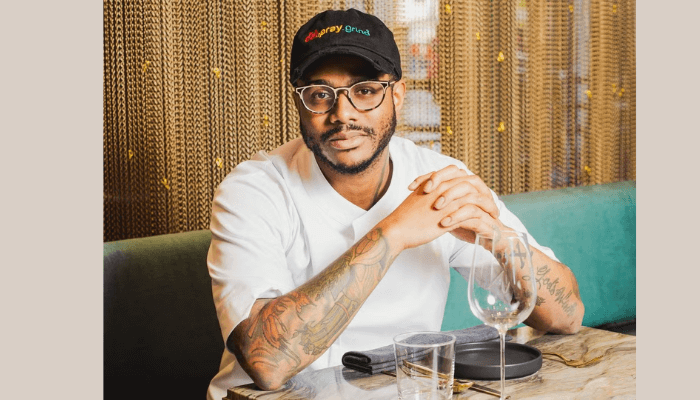
Kwame Onwuachi’s food begins long before it reaches the plate. It begins in Nigeria.
At the age of 10, the New York-born son of a Nigerian Jamaican father and a Trinidadian Creole mother was sent to live with his grandfather in Ibusa, Delta state. His mother hoped the move would teach him discipline and perspective. Instead, it quietly shaped one of the most distinctive culinary voices in modern American dining.
“We didn’t have running water or electricity. We raised our own livestock and grew our own food,” Onwuachi recalled in an interview. “That experience gave me a deep respect for ingredients.”
Today, that respect anchors a career that has carried the chef from a turbulent childhood in the Bronx to the centre of American fine dining, with his flagship restaurant Tatiana at New York’s Lincoln Center widely hailed as one of the most famous restaurants in the country.

Read also: Once told he’d amount to nothing — now Chef Izu Ani owns some of Dubai’s finest restaurants
A restless beginning
Born on Long Island and raised mostly in the Bronx, Onwuachi grew up in a financially struggling household. His mother, Jewel Robinson, was a caterer and private chef who ran her business from their home. By the age of five, he was already helping in the kitchen.
“I saw my mum cook every day and I fell in love with it,” he said in a separate interview.
But outside the kitchen, his early years were marked by instability. He was expelled from several schools for behavioural issues and later from university for dealing drugs. After high school, he briefly attended the University of Bridgeport before being sent away. By his own account, he was heading down a dangerous path.
Nigeria proved to be a turning point. The discipline of rural life, the closeness to food production and the cultural grounding left a lasting mark. When he returned to the United States, the struggles continued, but so did the lessons.


Read also: Every entrepreneur needs a mind shift of evolving to overcome business challenges ChefT
Finding purpose through food
In 2010, Onwuachi moved to Baton Rouge, Louisiana, to reset his life. There, he found work cooking on a boat feeding crews cleaning up the Deepwater Horizon oil spill. It was his first professional cooking job, and the moment food became more than survival.
“I fell into cooking because it was the only thing I was good at and could get a job quickly,” he explained in an interview.
He returned to New York later that year, waiting tables at Tom Colicchio’s Craft before launching a small catering business. In 2012, he enrolled at the Culinary Institute of America, where he trained formally and completed an externship at Per Se. After graduating, he joined the kitchen at Eleven Madison Park, one of the world’s most celebrated restaurants.
The rise was rapid. In 2015, he competed on Bravo’s Top Chef, placing sixth and gaining national attention.
Read also: Meet Chef Frank: German-born chef with passion for Nigerian menu
Failure in public, lessons in private
At just 25, Onwuachi was given what many chefs only dream of: full creative control to open a fine dining restaurant in Washington DC. Shaw Bijou was one of the most anticipated openings of its time. It closed after just 11 weeks.
The failure was loud and public. Critics questioned the pricing, concept and execution. Investors pulled the plug.
“I learned that picking the right partners is crucial,” Onwuachi later reflected. “Running a business is a marriage.”
For a moment, it seemed his career might not recover.
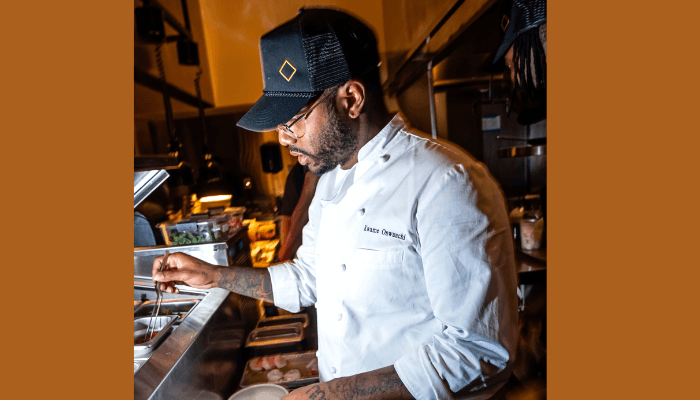
Finding his voice
Ten months later, he opened Kith and Kin at the InterContinental Hotel on the Wharf in Washington DC. This time, the food was deeply personal. Afro Caribbean dishes shaped by his Nigerian, Jamaican, Trinidadian and Creole roots. The response was immediate.
In 2019, the James Beard Foundation named him Rising Star Chef of the Year. Esquire named him Chef of the Year and listed Kith and Kin among the best new restaurants in America.
“A dish should tell a story,” Onwuachi said in an interview with Richard Fowler. “If it does, it has a soul.”
That philosophy now defines his work. Food, for Onwuachi, is history, memory and identity. Jerk chicken tells the story of Maroon resistance in Jamaica. Curry goat carries the imprint of Indian indentured labour in the Caribbean. Egusi and jollof reflect the rhythms of West Africa.
Read aslo: Chef Chua: Showcasing culinary artistry at Lagos Continental’s Soho Restaurant
Tatiana and beyond
In November 2022, Onwuachi opened Tatiana at Lincoln Center, naming the restaurant after his older sister. The menu blends Caribbean, African and Southern American flavours, presented without apology or dilution. Within months, it was reviewed by The New York Times, Food & Wine and Eater, cementing his status as a leading figure in American cuisine.
“Afro Caribbean food is not exotic or far-fetched,” he said in an interview. “It is accessible. It is familiar. It is delicious.”
In 2024, he expanded again with Dōgon in Washington DC, a restaurant rooted in African and diaspora cuisines. A year later, The New York Times named it among the 50 best restaurants in the United States.
Alongside his restaurants, Onwuachi has written two books with Joshua David Stein. His memoir, Notes from a Young Black Chef, traces his life from gang involvement to fine dining. His cookbook, My America, translates those stories into recipes. A film adaptation of his memoir is also in development.
Read also: Chef Eze: Making Potorio Burger a game changer
Carrying Nigeria with him
Despite his global acclaim, Onwuachi remains anchored to where his story began.
“I’m still a kid from the Bronx,” he often says. But Nigeria remains ever-present in his food and philosophy. From egusi seeds to the discipline he learned in Ibusa, his Nigerian heritage is not an accent to his cooking. It is the foundation.
“Preserving our food is how we keep our history alive,” he said in an interview. “When you tell those stories, you preserve who we are.”
At 33, Kwame Onwuachi is not just cooking meals. He is carrying cultures, memories and histories across borders, proving that Nigerian roots can shape the very centre of global fine dining.