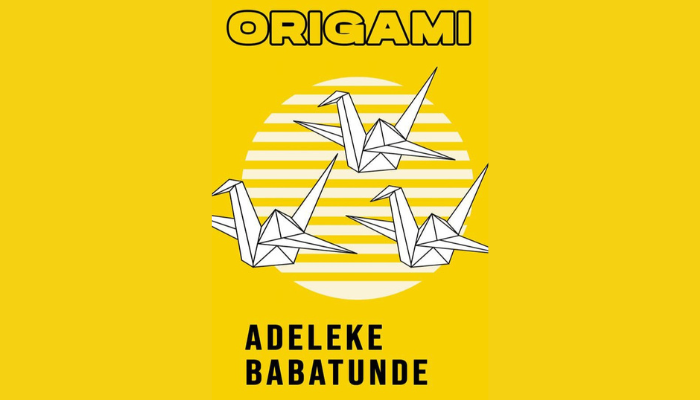
Adeleke Babatunde’s ‘Origami’ memorialises how the human body remembers pain, love, and faith. Composed of thirty-three poems, the collection allows for reading the body not only as a physical form but also as a symbol of identity, memory, and healing. The title Origami, adapted from the Japanese art of paper folding, captures Babatunde’s idea that life shapes and reshapes us. Like paper, the self can be folded, torn, or refolded into something new. In this way, Babatunde turns the body into both metaphor and reality, (to borrow a phraseology casually used by Jide Badmus), that is, a site where emotion takes shape and survival becomes art.
The title poem, ‘Origami’, sets the tone for the collection just as the cover photo. “The boy is an origami, he can be folded, balanced or torn,” the poet writes. The father’s voice — “Son, do not spend your strength on women” — folds the boy into silence and self-restraint. But as the poem goes on, puberty and desire begin to pull the folds apart. When “the origami topples, its folds loosening,” the boy’s sense of self comes undone. Here, Babatunde shows how masculinity is built through control and denial — yet also how fragile that structure can be. The body, both literal and symbolic, becomes the space where culture and emotion meet.
In ‘The Poem in Which I Come Clean’, the poet abandons ornament for raw confession, echoing therapy’s honesty and the healing of self-unfolding. This tension between repression and expression extends through ‘Schadenfreud’, where pain breeds selfish joy, and ‘Life Is a Bed of Roses’, which entwines beauty with suffering. Together, they reveal Babatunde’s belief that the body — and the mind within it — must hold both joy and pain as inseparable truths.
The most haunting moments appear in ‘A Story of Pronouns’ and ‘The Portrait of a Boy as a Book’, where childhood trauma exposes how the body stores pain. Fragmented lines mimic fractured memory, showing healing as a slow circling of old wounds. In ‘Conversations with My Demons’, faith becomes resistance — the poet silences shame through spiritual affirmation.

‘Therapy Session’ widens this struggle to society, where depression, violence, and lockdown merge personal and national wounds. Babatunde thus presents the body as both archive and battlefield — bearing scars of self and country alike.
‘This City that is My Body’ deepens this connection between the physical and the political. ‘My Body is a City without Walls’, the poet writes, ‘Broken into by My Beloved’. The body becomes a map of invasion and desire, while the soul is described as a “country” seeking refuge. The poet’s refusal: ‘A City Cannot House a Nation’ bespeaks the inner conflict between spirit and flesh. Babatunde’s image of the body as a city connects private emotion with public decay, suggesting that healing must begin within but cannot stop there.
Even love, in ‘Origami’, becomes part of this larger meditation on the body. In ‘My First Girlfriend Was a Poet’, love is expressed through language — “Her smile like a comma” — yet
ends with heartbreak written “in lines and stanzas.” ‘Letters to Aduke’ carries a gentler tone, filled with longing and faithfulness, but its repeated use of departure and distance shows that love, too, is fragile. These poems reveal the body as a vessel of both desire and loss — a reminder that affection, like paper, can fold and unfold.
Throughout the collection, Babatunde’s imagery ties the physical and the metaphorical together:
the origami, the phoenix, the city, the water. Each image shows transformation through breaking — whether by fire, folding, or drowning. In ‘Of Failures’, the poet recalls losing earlier manuscripts — “their bodies were never found” — but turns that loss into rebirth: “Out of the ashes, the rebirth of the phoenix will begin.” Failure, like pain, becomes part of growth. The body bends, but it survives.

Other poems herein show the body stands as both metaphor and memory — scarred, desiring, and reborn. In ‘Breaking Bodies’, scars mark endurance. In ‘Lies They Told Us’, healing myths unravel. ‘Bones’ fossilizes regret, while ‘A Toast’ turns flesh into ritual. ‘Baker’ entwines sensuality with creation; ‘There Are Still People Like Us’ defends solitude as truth. Finally, ‘Reintroducing Myself’ embodies rebirth through grief.
Notwithstanding, a possible weakness in ‘Origami’ lies in its occasional overindulgence in visceral imagery — at times, the intensity of bodily metaphors risks overshadowing emotional nuance; coupled with minor typographical errors and a mismatch between the table of contents (‘Boys We Stones’) and the actual poem title (‘Boys Are Stones’), these small lapses slightly disrupt the otherwise cohesive artistry of the collection.
Be as it may, ‘Origami’ is a declaration that the body remembers but also reimagines. Babatunde redefines masculinity not as rigidity but as resilience — the ability to fold without tearing. It is a book of flesh and metaphor, sorrow and song, a boy’s anatomy of becoming. Like the art it borrows its name from, ‘Origami’ proves that brokenness can be shaped into beauty — and that every fold is, ultimately, a form of healing.
The collection is orgasmic indeed as mooted by Kolawole Adebayo; pun intended on the title. Izang Alexander Haruna, author of ‘In a Man’s Body’, is a Nigerian based in Jos who
works as a critic, editor, researcher, and educationist, with interests spanning philosophy, criminology, and data analysis. He is known as a prolific author, book reviewer, and
essayist with works in various publications, including The Nigeria Review and CỌ́N-SCÌÒ Magazine.