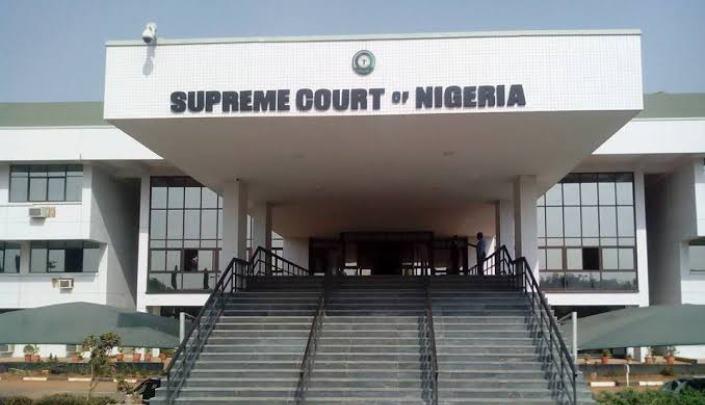
The Supreme Court has dismissed a suit filed by 11 states challenging President Bola Tinubu’s actions following the declaration of emergency rule in Rivers State.
The states, all governed by the opposition Peoples Democratic Party (PDP) at the time the suit was filed, approached the apex court through their attorneys-general to question the legality of the president’s decision to suspend a sitting governor, his deputy, and members of a state legislature.
In their suit, the states argued that President Tinubu lacked the constitutional authority to suspend Governor Siminalayi Fubara, his deputy, and the Rivers State House of Assembly under the guise of emergency powers.
They relied on Sections 1(2), 5(2), and 305 of the 1999 Constitution (as amended), urging the court to hold that the president had no such powers under any circumstance.

Read also: Supreme Court nullifies Tinubu’s pardon, upholds Maryam Sanda’s death sentence
The plaintiffs also sought declarations that the suspension of the Rivers State executive and legislature violated Sections 192(4), 192(6), and 305 of the Constitution, insisting that the actions were unconstitutional, unlawful, and a gross abuse of constitutional provisions.
Listed as defendants in the suit marked SC/CV/329/2025 were the Attorney-General of the Federation (AGF) and the National Assembly.
Delivering judgment on Monday, a seven-member panel of the Supreme Court, in a majority decision of six to one, struck out the case for lack of competence. The lead judgment, delivered by Justice Mohammed Idris, held that the plaintiffs failed to disclose any cause of action capable of invoking the court’s original jurisdiction.
Justice Mohammed Idris explained that the Supreme Court can only assume original jurisdiction where a dispute exists between the federation and a state, or between states. According to him, the plaintiffs failed to demonstrate that such a dispute existed between them and the federal government.

The court further ruled that the subject matter of the suit did not qualify as a constitutional dispute warranting the apex court’s intervention as a court of first instance.
The panel, presided over by Justice Inyang Okoro, had earlier reserved judgment on October 21 after the parties adopted their written addresses. Before the judgment was delivered, Delta State withdrew from the suit following the defection of its governor, Sheriff Oborevwori, from the PDP to the ruling All Progressives Congress (APC).
Other states that initiated the suit included Adamawa, Enugu, Osun, Oyo, Bauchi, Akwa Ibom, Plateau, Taraba, Zamfara, and Bayelsa. Since the filing of the case, some governors from these states have also defected from the PDP.
During proceedings, counsel to the plaintiffs, Eyitayo Jegede, SAN, clarified that the suit was not intended to challenge the president’s power to declare a state of emergency, but rather to contest the extent to which such a declaration could affect the offices of a governor, deputy governor, and members of a state House of Assembly.
In response, the Attorney-General of the Federation maintained that President Tinubu acted in the best interest of Rivers State, which he described as being engulfed in a severe political crisis involving all arms of government.
The AGF argued that the suspension of the governor, his deputy, and lawmakers was an extraordinary measure necessitated by extraordinary circumstances. He told the court that the president acted swiftly to prevent a breakdown of law and order, stressing that the affected officials were suspended, not removed from office.
The National Assembly aligned with the AGF’s arguments, urging the court to dismiss the suit. It contended that the plaintiffs failed to meet the statutory conditions required for the Supreme Court to entertain the matter, including issuing a three-month pre-action notice to the Clerk of the National Assembly, as required by law.
Describing the suit as frivolous and speculative, the National Assembly asked the court to award N1 billion in costs against the plaintiffs, jointly and severally.
Other justices on the panel were Chioma Nwosu-Iheme, Haruna Tsammani, Obarinde Ogbuinya, Stephen Adah, Habeeb Abiru, and Mohammed Idris.
President Tinubu had, on March 18, declared a six-month state of emergency in Rivers State, suspending Governor Fubara, his deputy, and the state lawmakers. He subsequently appointed Ibok-Ete Ibas, Vice Admiral (rtd.) as Sole Administrator to oversee the state’s affairs. The action received approval from both chambers of the National Assembly.
Aggrieved by the development, the PDP-controlled states filed the suit, which the Supreme Court has now struck out.