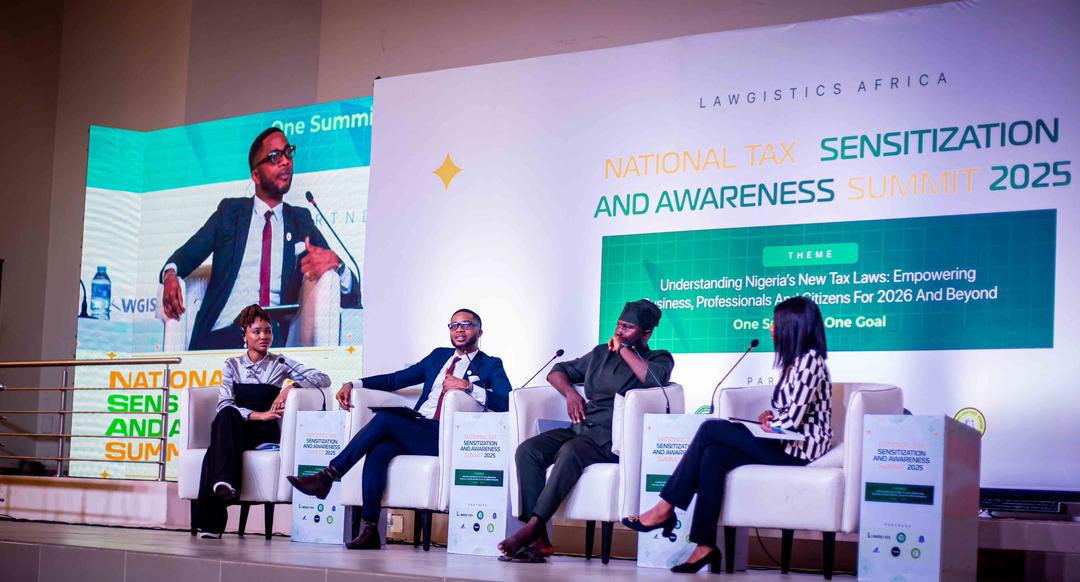
Lawgistics Africa, an organisation committed to strengthening citizenship, enterprise, governance, and rights literacy across Nigeria, has successfully hosted the National Tax Summit 2025 on Thursday, 11 December 2025, at the NBA House, Plot 1101 Muhammadu Buhari Way, Central Business District, Abuja.
Convened by the Chief Executive Officer, Samuel C. Chukwu, Esq., the Summit brought together policymakers, tax practitioners, legal professionals, civil society organisations, media stakeholders, and young leaders for a robust national conversation on Nigeria’s evolving tax landscape and the civic responsibilities that accompany it.
The centrepiece panel, “Building a Culture of Tax Awareness: The Role of Government, Media, Civil Society and Citizens,” featured prominent voices including Rinsola Abiola, Director-General of the Citizenship and Leadership Training Centre (CLTC); Dr Jude Isaac Dahilo, Founder of Kings Patriots Development Foundation; Zullaihat Muhammad Ohiare, Esq., Chairperson of the Young Lawyers’ Forum, Garki Branch; Ajibola Bello, Esq., Deputy Managing Partner at Law Corridor; and Ater Solomon Vendaga, lawyer and tax expert.
The discussions offered practical insights on strengthening public understanding of Nigeria’s new tax laws, improving compliance, countering misinformation, and promoting civic accountability at all levels of society.

Speaking after the Summit, the Convener, Samuel C. Chukwu, Esq., a prolific speaker, mentor, and thought leader dedicated to empowering young Africans to become global actors, emphasised that the event was designed to close the civic awareness gap surrounding the newly enacted tax reforms:
“Too many citizens encounter new tax laws without guidance. This Summit was a deliberate attempt to demystify these reforms, empower the public with accurate information, and encourage a culture of responsibility that supports national development.”
Lawgistics Africa affirmed that the Summit represents the beginning of a broader, nationwide effort to expand tax literacy across communities, markets, schools, digital platforms, and grassroots institutions.
Lawgistics Africa is a leadership and capacity-building platform advancing SDG 16 – Peace, Justice, and Strong Institutions. The organisation also promotes human rights through digital platforms and structured capacity-building programs. Over the years, it has grown into a cornerstone institution for strategic capacity development, human capital training, and human rights education.
Its successful engagements include training for personnel of the Ministry of Petroleum, Nigerian Army Resource Centre, Tindax, Nigeria Police Academy, Nigeria Technical Aid Corps, National Judicial Council, National Youth Service Corps, among others. Given that many of these bodies serve critical national security and regulatory functions, Lawgistics Africa’s training programs continue to play a vital role in strengthening institutional professionalism and ethical governance.

Still on the issue of national tax reform, Sam Omotoso, FIMC, the organisation’s Senior Consultant on Human Rights and Policy Programs and a front-runner internationally in the emerging field of Digital Human Rights Education, recently authored a landmark article examining the intersection between Nigeria’s 2025 tax reforms and international human rights norms. In the article, he explains that taxation occupies a dual position in human rights discourse: it can burden citizens if improperly structured, yet it remains the primary mechanism for funding socio-economic rights guaranteed under international law.
In his widely circulated analysis titled “Nigeria’s Tax Revolution: An International Human Rights Perspective on the 2025 Reforms,” Omotoso writes:
“While Nigeria’s 2025 tax reforms represent a significant legislative achievement and incorporate several human rights-compatible provisions, they do not yet constitute a fully rights-compliant tax system. Achieving such compliance requires addressing critical gaps in institutional independence, procedural fairness, access to remedy, and alignment between revenue generation and public expenditure priorities that advance human rights.”
The National Tax Summit 2025 stands as a pivotal moment in Nigeria’s civic and policy landscape, underscoring the urgent need for national tax literacy and transparent public engagement. Lawgistics Africa’s leadership in convening this dialogue demonstrates its continued commitment to shaping informed citizenship, strengthening public institutions, and advancing human rights through knowledge-driven advocacy. As the country navigates the implementation of its new tax regime, platforms like this Summit will remain essential to ensuring that citizens understand their obligations, the government upholds its responsibilities, and Nigeria moves toward a fair, inclusive, and rights-based tax system that supports sustainable national development.