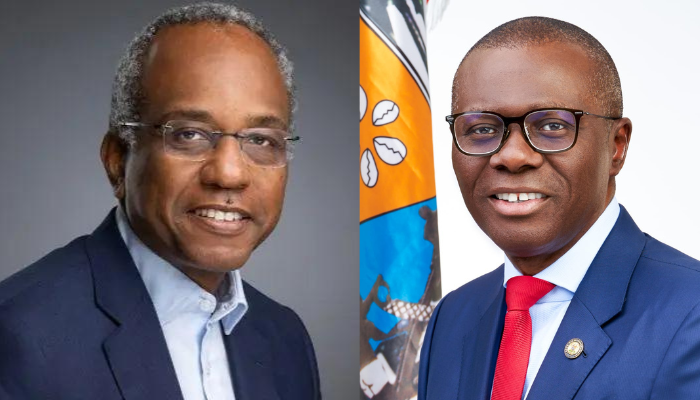
Funso Doherty, a former governorship candidate, has raised serious concerns over alleged errors, lack of transparency and misplaced priorities in the N4.237 trillion 2026 proposed budget presented to the Lagos State House of Assembly by Governor Babajide Sanwo-Olu.
In an open letter dated December 11, 2025, Doherty argued that key figures in the budget are inconsistent and potentially misleading. Doherty said the proposed recurrent expenditure of N2.052 trillion was overstated because it included debt repayments of N383 billion, which he described as a capital rather than recurrent item.
According to him, “It is therefore misstated by almost N400bn. Consequently, the capital expenditure and overall budget figures may also be inaccurate.”
He also pointed to discrepancies in the sectoral breakdown of the budget, noting that listed allocations summed up to N3.4 trillion, far below the total proposed size of N4.237 trillion. “One, or possibly both, of these must therefore be wrong,” the letter said.

Beyond figures, the opposition figure criticised what it described as Lagos State Government’s persistent failure to publish detailed budget proposals before passage, limiting public scrutiny. Doherty argued that this opacity had allowed questionable spending to pass unchallenged in previous budgets.
Citing examples from the 2025 budget, he highlighted allocations such as over N20.6 billion for vehicles for 40 House of Assembly members, which he said implied “a cost of N516 million for vehicles for each House of Assembly Member,” calling it “a colossal appropriation that speaks to a government that is completely disconnected from the people.”
Other examples included more than N4.5 billion for 40 units of 50KVA generators, an amount he said translated to about N113 million per generator against a market price of roughly N16 million, as well as N212 million for just 20 office tables and chairs, which he described as “completely unreasonable.”
The letter also drew attention to Lagos State’s poor transparency ranking, noting that the state placed last among the 36 states in BudgIT’s fiscal transparency ranking for the first two quarters of 2025. Doherty warned that declining openness was especially troubling at a time of rising revenues following currency devaluation and fuel subsidy removal.
On budget priorities, Doherty argued that the state had consistently underinvested in social sectors. He noted that between 2021 and 2025, combined spending on education, health, housing development and water supply accounted for just 17 per cent of total government expenditure.

“In a young population with the demographic characteristics of Lagos, Education and Health should receive closer to 15% EACH,” he said.
He further described it as “alarming” that the 2025 capital expenditure for the Lagos State House of Assembly alone exceeded allocations to both the education and health sectors, linking such priorities to poor outcomes, including high failure rates in public school examinations and weak health indicators.
The open letter also questioned the realism of the revenue assumptions underpinning the 2026 budget. Doherty said the proposed size followed “the predictable trend of unrealistic projections,” noting that as of September 2025, actual revenues stood at N2.07 trillion compared to a full-year projection of N3.37 trillion.
While acknowledging some improvements, including the removal of a large “special duties expenses” line item and a moderation in foreign currency borrowing, Doherty urged the House of Assembly to insist on greater openness. He called for full details of the 2026 budget and future proposals to be made public before legislative approval, “as part of the legislative process prior to passage into law.”