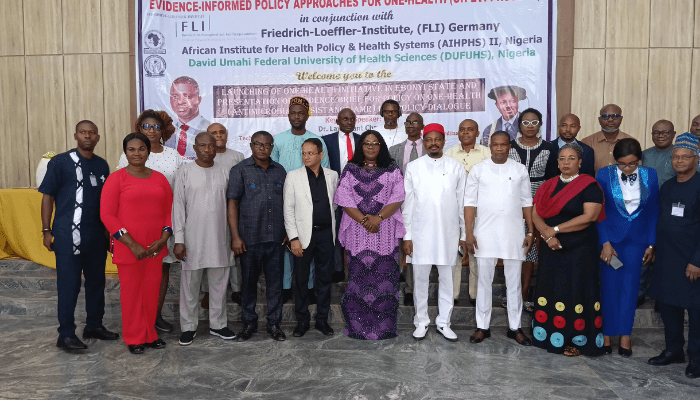
When officials, researchers, development partners, and global health experts gathered in Abakaliki for the launch of the One Health Initiative, it was clear Ebonyi State was taking more than a ceremonial step.
It was signaling a long-awaited shift toward evidence-informed governance one grounded in science, multisector collaboration, and proactive health planning.
The event, jointly supported by the Evidence-Informed Policy Approaches for One Health (OH-EVI Project) in partnership with Germany’s Friedrich-Loeffler-Institute (FLI), the African Institute for Health Policy and Health Systems (AIHPHS), and the David Umahi Federal University of Health Sciences (DUFUHS), brought the interplay between health, agriculture, and the environment into sharp focus.
And for Ebonyi, a state historically challenged by outbreaks from Lassa fever to cholera, the timing could not be more crucial.

Performing the launch, Governor Francis Ogbonna Nwifuru declared that the One Health framework aligns fully with his administration’s People’s Charter of Needs. His message was both cautionary and resolute: “The Ebola crisis and the COVID-19 pandemic exposed the dangers of poor preparedness. Ebonyi must build systems that can withstand future epidemics,” he said.
Represented by prof Grace Umezurike the secretary to Ebonyi state government, the cited rapid urbanisation, deforestation, and increased human animal interaction as local drivers of disease emergence echoing concerns raised by global health bodies.
The governor pledged sustained funding and called for deeper collaboration among ministries, agencies, and academic institutions.
One of the highlights of the day was the presentation of an Evidence Brief for Policy on Antimicrobial Resistance (AMR) a policy tool designed to guide decision-makers ahead of an upcoming technical policy dialogue.
The brief, developed by DUFUHS researchers and partners, was widely praised for being evidence-informed a quality that has made it useful not only in Ebonyi but also at the national level.

Read also: NSSF launches new initiative to empower one million youths in healthcare advocacy
Vice Chancellor, Prof. Jesse Uneke, described the moment as “remarkable,” noting that Ebonyi is now among the first states in Nigeria to domesticate the national One Health framework. “We expect actionable working documents that integrate the roles of ministries and strengthen surveillance, detection, and response,” he said.
Delivering the keynote, Dr. Laxmikant Chavan, WHO Technical Officer for AMR and One Health Coordinator in Nigeria, drew a striking connection between everyday activities and growing global health risks.
From climate change to deforestation, from food markets to intensive agriculsaid, Chavan explained how these pressures have increased interactions between humans, animals, and the environment, driving outbreaks worldwide.
He presented sobering statistics: 60% of emerging infectious diseases are zoonotic, 75% of new human pathogens in the last 30 years spilled over from animals, AMR could cause 39 million deaths globally by 2050, Nigeria recorded 265,000 AMR-related deaths in 2019, mostly in children under five, “One Health enhances states’ ability to detect outbreaks early, promote responsible antimicrobial use, strengthen agribusiness value chains, and protect water sources,” he emphasized.
Chavan noted that implementation must start at the subnational level, where states like Ebonyi are closest to communities and frontline services.The Challenge and the Promise.
Chavan also spoke extensively on global efforts, including the Quadripartite Alliance WHO, FAO, WOAH, and UNEP whose 2023 One Health Joint Plan of Action now serves as the world’s guiding implementation framework.
Nigeria is currently revising its national One Health strategic plan, but Chavan stressed that without state-level structures and data sharing, much of the effort will remain theoretical: “Unless states institutionalize One Health platforms, it will remain documents on paper. When all 36 states join, that becomes the real game changer.”
Joining virtually, Francis Nuvey represented Germany’s Friedrich-Loeffler-Institut, funders of the OH-EVI project in Nigeria. He reaffirmed Germany’s commitment to building stronger, evidence-driven policy systems across Africa.
The Ebonyi event concluded with a consensus on the next steps:
Key priorities for Ebonyi’s One Health rollout include: Establishing a State One Health Council and multisectoral technical working groups, Starting implementation from AMR, where evidence already exists, Conducting further studies on zoonotic diseases, climate-linked outbreaks, and environmental health risks, Strengthening surveillance and data-sharing across sectors, Developing a tailored State One Health Action Plan based on Ebonyi’s unique disease profile.
For a state that has borne repeated public health shocks, Ebonyi’s One Health launch is more than a policy announcement. It marks the beginning of a future where science informs action, sectors work in synergy, and outbreaks are detected before they become crises.
And as stakeholders departed the venue, one thing was clear: Ebonyi is positioning itself as a model for how Nigerian states can strengthen health security one evidence-informed step at a time.