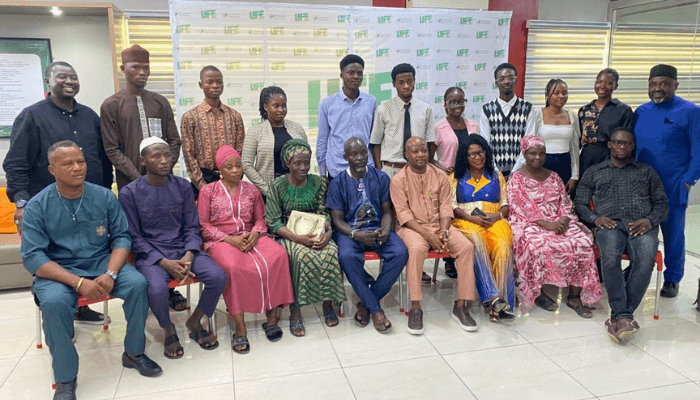
For 10 determined youngsters in Ajegunle, a suburb of Lagos State, the dream of attending university is now within reach as Paradigm Initiative (PIN) steps in with full scholarship grants, offering hope and a pathway to a brighter future.
The organisation expanded its scholarship programme for low-income families in Ajegunle, raising the number of beneficiaries from two in 2024 to 10 new awardees in 2025.
The move is part of a growing effort to close deep education gaps in one of Nigeria’s most under-served communities.
Gbenga Sesan, executive director at PIN, made this known during the ceremony, when he said, “We started with two scholars last year. This year we are supporting ten. The goal is to help young people stay in school, focus, and worry less about survival.”

The Taiwo Bankole Award, created to honour PIN’s roots in Ajegunle, now supports 12 current scholars, including the first two recipients selected in 2024.
The award pays full tuition, books, accommodation and a N25,000 monthly stipend for each student. Payments go directly to the schools to prevent misuse..
According to the organisation, some of the criteria for eligibility is that applicants must reside in Ajegunle, show financial need and present a valid admission letter.
“They must study in a public university and maintain a minimum CGPA of 3.5. Two current beneficiaries have GPAs above 4.6,” Sesan said.
Besides, Sesan emphasised that rising costs make education “harder than ever,” noting that accommodation alone can cost more than N600,000 yearly, a heavy burden in a country where minimum wage is N75,000.

“If your parents earn that much, how can they give a child N50,000 every month for school?” he asked.
Oluseyi Adebayo-Olubi, a PIN board member, urged young Nigerians to ignore the popular belief that “school is a scam,” emphasising that education still transforms lives.
“If you think education is expensive, try ignorance. “Digital skills and access are now basic human rights,” he stated.
Moreover, he said that the programme shows what even small organisations can do. “If PIN can support students in its own community, what bigger institutions can do?” he queried.
Kenneth Bassey, father of one of the new beneficiaries, Havilla, who studies at the University of Uyo, shared the emotional weight lifted from his family.
“As a parent, you always hope your child gets a fair chance. This scholarship removed a burden we could not carry alone. It gives my daughter room to breathe, learn and dream,” he said.
Another recipient, Goodness Otiede, 23, said she once juggled teaching and sewing clothes to survive. “I was missing classes. I was tired,” she said. She now maintains a 4.5 GPA and returns to school in January with renewed hope.
PIN began in Ajegunle with four staff members and now operates across six African countries. According to Sesan the programme’s long-term goal remains, “Let these students finish school, build meaningful careers, and give back to the community that raised them.”