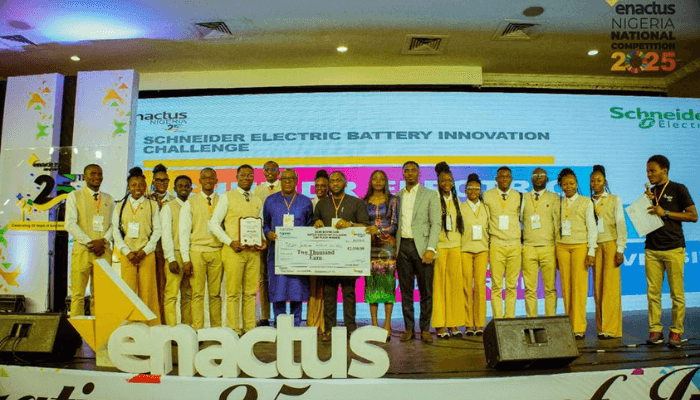
Schneider Electric and Enactus have announced the 2025 winners of the Energy Transition Battery Innovation Challenge, showcasing groundbreaking battery technologies developed by students across English-speaking Africa.
The competition, now in its second year and funded by the Schneider Electric Foundation, awarded first-place honours to four institutions: BioWatt from WITS University in South Africa, Strathmore University’s Afya Cell in Kenya, Joseph Sarwuan Tarka University’s Energiv in Nigeria, and the University of Zimbabwe’s LithiumX project.
These winning projects address critical energy challenges facing the region through innovative approaches to battery technology. WITS University’s BioWatt harnesses microbial fuel cells to generate electricity from organic waste while promoting STEM education. Kenya’s Afya Cell employs artificial intelligence to analyse battery health and extend lifespan for electric vehicles, solar systems, and IoT devices. Nigeria’s Energiv converts plastic waste into carbon nanotubes to enhance lithium-ion batteries, while Zimbabwe’s LithiumX focuses on low-cost recycling of lithium-ion batteries using environmentally friendly hydrometallurgy.
The programme has already demonstrated remarkable real-world impact through its 2024 winners. Bindura University of Science Education in Zimbabwe transformed their CaLIX project into VoltStep, a commercial micro-battery module that stores low-voltage current from piezoelectric sensors embedded in shoes.

Read also: Schneider Electric warns Nigeria’s data centres must become AI-ready
In its first year, VoltStep sold 8,070 pairs of shoes, generated over $104,000 in revenue, and provided reliable lighting access for 892 rural students while reducing household lighting costs by up to 65 percent. The project also secured second place in the 2025 Enactus World Cup.
Kenya’s 2024 winner, Afterlife, has become a registered company focused on repurposing and recycling worn-out batteries. The team won the Power the Community 2025 International Design Competition and joined the Emerging Circular Leaders programme, sparking national discussions on circular economy innovation.
In Nigeria, the third-place winner from 2024, originally called Repo, has evolved into Ecovolt, a scalable clean energy solution made from recycled e-waste. The company has created 20 youth jobs and sold 40 units powering household appliances and small businesses, with 55 additional orders pending.
South Africa’s Airnergy & Tech Solutions, third-place winners in 2024, successfully commercialised their ElectroBoost300, a 300-watt portable power station now available on Takealot, South Africa’s largest online retailer. The lithium-based storage solution serves households, students, and small businesses.

“Schneider Electric believed in us. Their support and funding helped Airnergy & Tech build a viable product, and that gave our team the confidence to keep pushing forward with sustainable energy innovation,” said Neo Moabi of Airnergy & Tech Solutions.
Elihle Obi, Marketing Communications and Corporate Citizenship Director for English-speaking Africa at Schneider Electric, emphasised the programme’s significance: “The Battery Innovation Challenge is proof that with the right support, students in our region can create scalable, sustainable solutions that accelerate today and tomorrow’s energy transition.”
The 2025 winners received euro cash prizes ranging from €1,000 to €2,000 from the Schneider Electric Foundation. The initiative forms part of the Foundation’s New Skills for the Future and Innovation programme, originally conceived by a South African Schneider Electric engineer.
Letitia de Wet, CEO and Country Director of Enactus South Africa, praised the participants’ determination to reimagine Africa’s energy landscape through youth-led innovation.