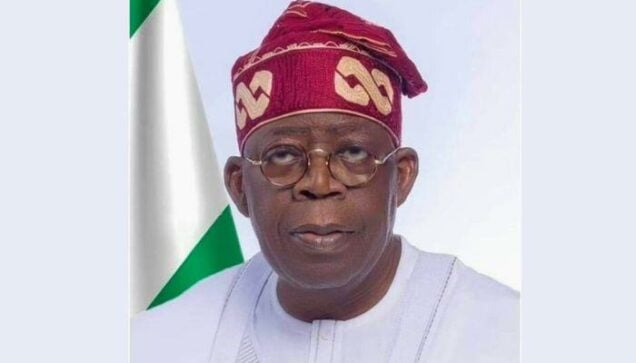
…says he is building a more secured Nigeria
President Bola Tinubu on Monday paid glowing tribute to the late Shehu Musa Yar’Adua, who retired as a Major-General, describing him as a symbol of national conscience, civic duty, and unwavering integrity.
Yomi Odunuga, Special Adviser to the Secretary to the Government of the Federation (SGF), said in a statement that Tinubu made the remarks in Abuja on Monday at the launch of a new civic anthology titled: Letters to the Union We Hope to Become.
This came as the President explained that his administration is investing heavily in economic drivers, youth creativity, infrastructure, and programmes supporting the vulnerable, efforts aimed at building “a union that is fairer, more secure, more prosperous, and governed by citizens’ trust.”

Read also: India’s new High Commissioner presents credentials to Tinubu
The event, held at the Shehu Musa Yar’Adua Centre in Abuja, was organised to mark the 28th anniversary of the elder statesman’s passing.
Represented by George Akume, SGF, Tinubu described the gathering as not merely a commemoration, but a renewal of the national values Yar’Adua fought for.
The late Yar’Adua, who served as Chief of Staff, Supreme Headquarters, and was second-in-command when Olusegun Obasanjo was Military Head of State from 1976 to 1979, fought for justice, unity, accountability, and principled leadership, according to the President.
He added that these “values form the pillars of his administration’s Renewed Hope Agenda.”

“Major-General Shehu Musa Yar’Adua was not simply a soldier in uniform. He demonstrated conviction, political awareness, patriotism, and selflessness. In service and in sacrifice, he embodied that rare spirit that places Nigeria before self and comfort,” he said.
Tinubu, reflecting on the letters Yar’Adua wrote from prison, said they “remain a moral compass for governance.”
“From the solitude of prison, without the certainty of tomorrow, he wrote letters calling us to responsibility, stressing that Nigeria must be governed by institutions stronger than individuals,” he added.
“These convictions shape our efforts today to strengthen democratic institutions, uphold transparency, and build trust between government and citizens.”
He described the anthology as an encouraging sign of a new generation rising to engage in nation-building, adding that the collection echoes his administration’s priorities in education, economic opportunity, security, youth empowerment, and public sector integrity.
“Our pursuit of economic stabilisation, energy reform, food security, digital innovation, and social justice must be anchored in the values we celebrate today,” he said.
Tinubu also highlighted Yar’Adua’s political legacy, recalling his pivotal roles in the Social Democratic Party (SDP), the Peoples Democratic Movement (PDM), and his influence on the political landscape leading up to the annulment of the 1993 presidential election.
“He was a phenomenal political strategist who had the fear of God,” the President said. “With his nationwide acceptance, he remained in pole position as a presidential aspirant before the word ‘annulment’ entered Nigeria’s political lexicon.”
He commended Yar’Adua for his contributions to national unity through faith, noting that he championed the construction of the National Mosque in Abuja, now a landmark of national symbolism.
Tinubu urged Nigerians to treat the new anthology as a mirror of national truth and a guide for the future envisioned under the Renewed Hope Agenda.
“Let us honour Shehu Musa Yar’Adua not only with remembrance, but with resolve. We must not only speak of hope; we must build the nation worthy of it. May the union we hope to become never lose its voice,” he said.