Nigeria’s listed ICT service providers closed the nine months of 2025 in positive territory, delivering net profits despite inflationary pressures and higher financing costs that continued to squeeze operating margins across the services sector.
Data reviewed by BusinessDay from the financial statements of eTranzact International Plc, CWG, and Chams Plc indicate that the three firms collectively remained profitable, despite the significant differences in the strength and quality of their earnings.
The sector’s combined nine-month profit reached N7.66 billion, supported by rising transaction volumes in electronic payments, expanded service offerings in enterprise technology, and moderate but persistent public-sector digitisation demand.
Still, beneath the headline profitability, the details reveal contrasting levels of operational efficiency and financial resilience, especially when comparing cash flow generation, return on assets, and market valuation.

In the face of rising costs and tighter liquidity, CWG and eTranzact emerged as the standout performers, while Chams, although profitable on paper, showed weaker underlying fundamentals. BusinessDay examined the numbers using net profit, net profit margin, return on assets, net cash generated from operations, and market valuation.
Profit—growth and margin
eTranzact posted N2.41 billion in profit after tax, reflecting strong transaction throughput and relatively efficient cost management. CWG delivered N4.75 billion, making it the most profitable in absolute terms among the three, while Chams recorded N500.7 million, the smallest profit of the group.
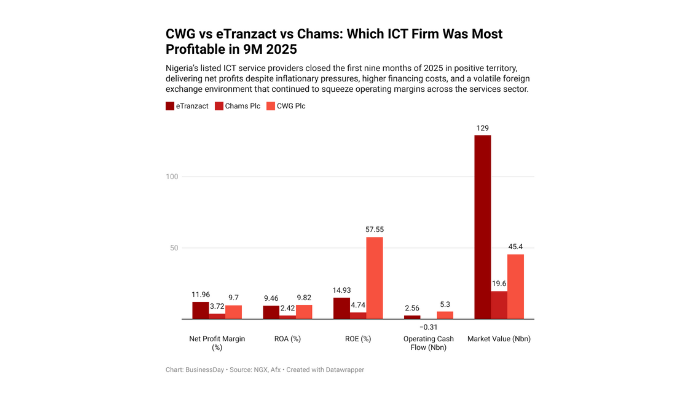
The profitability picture becomes clearer when seen through margins. eTranzact generated N20.11 billion in nine-month revenue for a net margin of 11.96 percent, indicating it retained nearly N12 from every N100 earned.
CWG posted N48.94 billion in revenue, translating to a net margin of 9.70 percent, a healthy level for a firm operating in infrastructure-heavy enterprise servicing. Chams, by contrast, recorded a much thinner margin of 3.72 percent on N13.45 billion in turnover, showing weaker efficiency per unit of sales despite maintaining profitability.
On margins alone, eTranzact leads the sector in profitability relative to sales, even though CWG remains the clear leader in absolute net income.

Read also: eTranzact tops Nigeria’s ICT firms in net margin in nine months
Return on Assets (ROA)
Return on assets offers a deeper look into how effectively each company deployed its resources to generate profit. Based on the data reviewed, CWG achieved an ROA of 9.82 percent, producing roughly N9.82 in profit for every N100 in assets.
eTranzact followed closely with a 9.46 percent ROA, demonstrating similar efficiency in asset utilisation despite a smaller profit base. Chams trailed with an ROA of 2.42 percent, reflecting a weaker capacity to convert its significantly large asset base of N20.66 billion into earnings.
From an efficiency standpoint, CWG marginally outperforms eTranzact and significantly surpasses Chams. The numbers show that CWG’s asset structure is better optimised for generating consistent profit, while eTranzact is also efficiently run but less profitable in absolute terms. Chams’ asset base appears under-leveraged relative to earnings, a challenge that may limit growth if not addressed.
Return on Equity (ROE)
While ROA evaluates efficiency, return on equity (ROE) measures how effectively each firm delivers value to shareholders. Here, the divergence is more pronounced.
CWG reported a 57.55 percent ROE, showing exceptional return generation relative to its equity of N8.25 billion. This makes CWG the most shareholder-efficient company among the three by a considerable distance.
eTranzact delivered an ROE of 14.93 percent, solid by sector standards and consistent with its strong margins. Chams posted an ROE of 4.74 percent, the weakest of the group, and an indicator of the challenges it faces in translating shareholders’ funds into meaningful profits.
While all three firms remained profitable, the level of shareholder value creation was fundamentally uneven, with CWG delivering outsized returns and the others operating at more constrained levels.
Net cash generated from operations
Profit is important, but cash flow tells a deeper story about the sustainability and quality of those profits. Here, the three ICT firms diverge dramatically.
CWG again leads the sector with N5.30 billion in net cash generated from operations during the nine months of 2025. This reflects strong collections, disciplined cost control, and stable operating capacity.
eTranzact followed with N2.56 billion, confirming that its earnings were cash-backed and operationally robust. For both companies, the strength of operating cash flow validates the reliability of their profits and enhances their ability to reinvest, manage obligations, and expand services.
Chams, in contrast, posted a negative operating cash flow of N313.3 million, even though it reported a profit of N500.7 million. This gap suggests operational strains, such as slower receivables recovery or higher cash outflows tied to administrative or expansion spending.
Negative operating cash flow alongside profit often indicates that earnings may not yet be translating into liquidity, a red flag for investors evaluating long-term sustainability.
Overall, while the sector remained profitable, only CWG and eTranzact matched profit with strong cash generation. Chams’ divergence between profit and cash suggests underlying structural issues.
Read also: CBN orders banks to reimburse APP fraud victims within 48 hours
Market valuation and investor sentiment
The stock market offers an additional lens into how investors perceive the performance and prospects of each company.
eTranzact, with a market capitalisation of N129 billion, is the most valuable ICT service firm among the three and ranks 50th on the Nigerian Exchange. Its valuation reflects investor confidence in its consistent earnings, resilient margins, and stable operational cash flows.
CWG follows with a market valuation of N45.4 billion, placing it as the 69th most valuable stock. Despite being far smaller in market value than eTranzact, CWG outperformed both its peers in profit and efficiency metrics. The gap between valuation and profitability suggests that investors may still be gradually repricing CWG’s improving fundamentals.
Chams Plc, valued at N19.6 billion, ranks 83rd on the exchange and remains the smallest by investor valuation. Its weak ROA, low ROE, and negative cash flow likely contribute to cautious investor sentiment, even though it delivered a positive profit.
Market valuation shows a different hierarchy from profitability. eTranzact leads by value, but CWG leads by performance, while Chams remains the smallest both in valuation and fundamental strength.
Was the sector profitable in 9M 2025?
Based on reported profit after tax across the three companies, the ICT sector was profitable during the first nine months of 2025. The total combined profit of N7.66 billion shows that the sector generated positive earnings despite macroeconomic challenges.
However, profitability was highly uneven. While CWG and eTranzact contributed 97 percent of sector profit, Chams accounted for only 6.5 percent despite having a relatively large asset base. Moreover, only CWG and eTranzact recorded positive operating cash flow, suggesting that their profitability was more stable and cash-reliable.
Thus, the sector was profitable, but the strength of that profitability rested mainly on two companies.
Which firm was the most profitable?
Based on the 9M 2025 figures, CWG Plc was the most profitable ICT firm, followed by eTranzact, with Chams a distant third.
CWG leads in net profit, ROA, ROE, and operating cash flow, giving it the strongest fundamental profile of the three. eTranzact leads in net margin and market valuation but trails CWG in total profit and return metrics. Chams, despite positive profit, remains the weakest performer across key indicators.
CWG’s profitability appears broad-based, driven by operational efficiency, shareholder returns, and strong cash-flow support. eTranzact’s performance is driven more by margin strength and market confidence. Chams, while profitable, faces underlying liquidity challenges that indicate its earnings may not yet be fully stable.
The first nine months of 2025 were profitable for Nigeria’s listed ICT service providers, but the performance picture is far from uniform. CWG and eTranzact carried the sector, delivering strong earnings supported by solid margins, efficient asset utilisation, and positive operating cash flows.
Their results demonstrate the resilience of technology-driven businesses that have successfully adapted to a difficult macroeconomic environment. Chams, although profitable on paper, lags significantly in profitability, quality, and operational efficiency. Its negative operating cash flow highlights a need for improved liquidity management and more aggressive optimisation of its asset base.