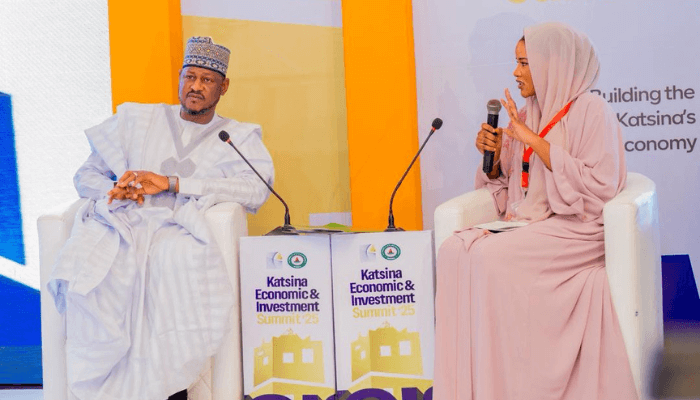
The mood was palpably electric at the Continental Events & Sports Complex in Katsina on November 24 and 25, 2025, as government, global investors, and business leaders converged for the Katsina Economic & Investment Summit.
Under the theme, “Building the Future of Katsina’s Economy,” the maiden summit was not just a dialogue but a decisive inflection point, crystallising the state’s determined shift from being a regional agricultural powerhouse to a modern, investor-friendly economic hub in Northern Nigeria.
The Executive Summary itself delivered the headline: the summit successfully served as a high-level platform for presenting the State Government’s reform agenda, outlining concrete pathways for economic diversification, and most importantly, securing investment commitments exceeding a colossal ₦489.4 billion from both indigenous and foreign private sector entities. This figure, encompassing realised investments and commitments, signals confidence in the Governor Radda-led administration’s ability to stabilise the region and redefine its economic trajectory.
A Foundation Built on Security and Governance Reform
The foundational premise of the summit, as articulated by Governor Dikko Umaru Radda, was straightforward: security is the absolute bedrock of investment. The morning session provided strategic context, detailing the substantial, community-driven progress made in restoring stability across the state, which was critical to boosting investor confidence.

The Governor highlighted that at the start of the administration in 2023, 24 local government areas were significantly affected by insecurity. The response was a holistic, community-centric model combining conventional forces with localised structures: The Katsina State Community Watch Corps: Over 2,500 trained and equipped personnel now operate across the state.
Village and District Security Committees: Engaging 9,747 members across all levels, ensuring security is locally owned and maintained.
This coordinated effort has yielded tangible economic results, including the restored access to farmlands, the crucial reopening of rural markets previously shuttered for years, and the safe resumption of agricultural activities. As Senator Ibrahim Ida, CON, noted in his keynote, security and stability are the “foundation of all development efforts,” and the Katsina model appears to be delivering exactly that.
Parallel to the security consolidation, the Radda administration showcased sweeping institutional and policy reforms aimed at radically improving the ease of doing business and reducing bureaucratic friction, a frequent deterrent for large capital deployment. Key reforms introduced include: Treasury Single Account (TSA): Implemented for transparency and streamlined financial processes.
Katsina Geographic Information System (KATGIS): A major step towards digitizing land administration, simplifying land allocation, and ensuring Certificates of Occupancy are issued within a streamlined 45 days.

Strategic Policy, Research and Evaluation Unit (SPINE): Established to strengthen governance and coordinate the ambitious reform agenda. KASADA and KASEDA: Dedicated institutions for MSME support, enterprise formalisation, and ease of doing business.
These reforms, backed by new bills passed at the State Assembly, demonstrate a rare commitment to institutional sustainability, ensuring that the pro-business environment outlives the current administration.
The Investment Tsunami: ₦489.4 billion Naira pledged.
The centerpiece of the summit was the dramatic series of investment announcements and formal partnership signings, validating the state’s proactive engagement strategy. The cumulative figure exceeding ₦489.4 billion Naira marks one of the most significant single-event investment harvests in the North-West region’s recent history.
The commitment summary underscored the diversity of capital and sector interest:
KUBEK Strategic Partnership: The largest announced investment, committing USD 150 million (approximately ₦225 billion Naira) into strategic industrial projects.
Torq: Pledging USD 80 million (approximately ₦120 billion Naira) for industrial metals projects, including a poultry project (300,000 layer birds capacity) and a 300 metric tons per day soya crushing plant.
ABIS Group: Committing USD 50 million (approximately ₦75 billion Naira) to establish sophisticated and modern industrial facilities.
BOKO Group & Safe Space Energy: Pledging investments ranging from USD 70 million to 100 million in partnership with Afraim Bank.
Gold Energy: A realised investment of ₦1.5 billion Naira in aviation fuel operations, focused on supporting scheduled, charter, and international Hajj operations at Katsina Airport.
Constrix Construction Company (Abuakar Damusa): Committed ₦500 million Naira to the state, notably sponsoring the Katsina United Football Club over five years, blending commerce with social development.
Perhaps the most potent symbol of confidence was the public pledge by the distinguished statesman and industrialist, Senator Ibrahim Ida, CON. Although not pre-briefed, he assured the audience he would follow through diligently to bring investments worth billions of Naira to the state, stressing the critical importance of domestic investors leading the charge to encourage external capital.
The summit also witnessed the formal presentation of the Funtua Brickworks Shares Certificate, confirming the State Government’s 20% equity stake, and the signing of Memoranda of Understanding (MoUs) with Dar Al Halal (for halal-compliant industry development), ABIS Group, and Agill (for technology and agricultural value chains).
From Farm to Fortune: Repositioning Agriculture. The afternoon’s plenary discussion, “From Farm to Fortune: Transforming Katsina’s Agricultural Potential into Economic Prosperity,” provided a crucial roadmap for leveraging the state’s greatest natural asset: its fertile land and leading position in cotton and soft sugarcane production.
Moderated by Jaffar Abubakar Umar, the panel highlighted that transitioning from subsistence farming to an export-orientated economy requires tackling three core challenges: finance, infrastructure, and mechanisation.
Key Insights from the Panel was access to finance: Dr. Nasir Ingawa of the National Agricultural Development Fund (NADF) confirmed that the lack of affordable financing is the main barrier. NADF is addressing this by offering financing at a below-market rate of 17.5% and deploying “first-loss capital” to de-risk projects, making them attractive to private investors.
Value Addition & Offtake: Hajiya Habiba Suleiman of TGI Group stressed that achieving surplus production is essential. Her group promotes working directly with smallholders, providing financing, and ensuring guaranteed off-take of produce, thereby stabilising income and supply.
Livestock Export: Dr. Ilyasu B. Gashinbaki of Abis Group announced the establishment of a modern livestock processing facility to leverage Katsina’s quality hides and meat for export to West Africa and the GCC markets. This ambitious project requires significant investment in logistics, including cold-chain vans and air cargo facilities.
The state government, through Dr. Suleiman Umar, the Agricultural Coordinator, committed to its part; subsidising land clearing, distributing thousands of chilling containers, and providing mechanised equipment at 50% of the market cost to accelerate adoption. This commitment aims to create an ideal environment for investors like Sadik Falalu of Falgates, who expressed readiness to invest significantly in the rice value chain.
Digital Katsina: Building the Technology Ecosystem
The second day’s panel, “Digital Katsina: Building the Infrastructure for a Technology-Driven Economy,” shifted the focus to the future, positioning technology as a cross-cutting enabler for all other sectors.
Tukur Jikamshi, DG of Katsina Investment Promotion Agency, (KIPA), presented Katsina’s investment landscape, citing its population, literacy rate, and agricultural leadership. The “Digital Katsina” panel discussed ICT infrastructure, tax reforms, innovation hubs, and grassroots tech adoption, stressing the need for digital skills and community engagement.
The summit concluded with the launch of the State Development Plan, Economic Development Plan, Katsina Investors’ Guide, and sectoral policies, reinforcing Katsina’s commitment to transparency and growth. Governor Radda pledged focus on job creation, youth empowerment, and measurable outcomes, positioning Katsina as a competitive economic hub in Northern Nigeria.