
1. Open grazing or not?
Within 24 hours, official government statements shifted from a ban on open grazing of cattle to “no ban on open grazing”. The Federal Government clarified that Nigeria has 273 gazetted grazing reserves covering over 4.5 million hectares. The government is working with states to revive and equip these reserves so they can serve as organised centres for pastoralists and livestock enterprises.
Clarification of terms.
Open grazing is the extensive movement of cattle across the country in search of pasture and water. It is characterised by uncontrolled mobility and nomadic pastoralism.

Modern ranching involves breeding and raising cattle in a confined, managed area. It is controlled grazing, often with rotational pastures and dedicated structures.
Nigeria’s official policy is a phased shift from open grazing to modern ranching systems. The government emphasises that this will not happen “overnight” but will involve providing viable alternatives to pastoralists.
The government states it is working with states to revitalise the 273 existing gazetted grazing reserves, covering over 4.5 million hectares, to make them more productive and friendly for livestock operators.
• For years, open grazing has caused violent conflicts between nomadic herders and settled farmers, resulting in thousands of deaths and displacements. This crisis led to the development of policies such as the National Livestock Transformation Plan (NLTP) to modernise the sector and reduce clashes.
• State vs. Federal Authority: The issue is complicated by Nigeria’s governance structure. While some states like Benue have passed their own anti-open grazing laws, agriculture and policing are shared responsibilities. This has sometimes led t2o enforcement challenges and tensions between state and federal governments.

Implementation Challenges: Research shows that simply banning open grazing without providing adequate support for herders to adapt can cause problems. A key issue is ensuring that herders, many of whom are landless and lack capital, are involved in policy development and receive the support they need to switch to ranching.
2. VP Shettima’s preference for “sovereignty over lives
Quote: VP Shettima attended the G-20 summit to reject growing demands for mercenaries to be used as they were against terrorists during GEJ’s last months in office.
He also implied that, in his view, ‘meaningless paper sovereignty’ matters more than Nigerians’ lives.
He even criticised countries that have invited mercenaries to handle their own insurgencies.
So, no help from America or other foreign nations because we’re a sovereign country.
No mercenaries either, since they would breach our sovereignty.
We’ll just keep doing the same things that have caused more deaths, strengthened the terrorists, and allowed them to gain momentum and the initiative, hoping for a different outcome.
Brilliant!
How do my American hosts define insanity again? Doing the same thing repeatedly and expecting a different result.
– PROF MOSES OCHONU
Read also: FG hasn’t banned open grazing–Minister
3. On the matter of Ezra Olubi versus Paystack
Ezra Olubi, the co-founder and former Chief Technology Officer (CTO) of Paystack, was suspended and subsequently dismissed from the company in November 2025 following allegations on social media and the resurfacing of his old tweets.
Paystack suspended Ezra Olubi on 13 November 2025 amid sexual misconduct allegations and the resurfacing of old tweets (2009-2013), which the company described as causing “negative reputational damage.”
On 22 November 2025, Paystack ended Olubi’s employment. The Board stated that his tweets conflicted with the company’s values and leadership standards. An independent investigation into workplace misconduct is currently ongoing.
Olubi considers the termination to be unfair, asserting it occurred before the investigation was completed and without a hearing. His legal team is now reviewing the termination.
Ezra Olubi is a Nigerian entrepreneur and software developer who co-founded Paystack in 2015 alongside Shola Akinlade. He served as the company’s CTO and was recognised for his technical leadership.
Paystack a leading Nigerian fintech company providing online and offline payment solutions. It gained substantial prominence after being acquired by the global payments firm Stripe for over $200 million in 2020. The company’s core values include Transparency, Clear Communication, and Practising Kindness.
4. Terrorism crisis and external pressure
Nigeria is in a state of emergency due to a deteriorating security situation. Terrorists struck in five states over two weeks. The anxiety in Nigeria stems from a serious domestic security crisis involving mass abductions, heightened by international political pressure, notably from former US President Donald Trump. The recent incident was the mass kidnapping of over 300 schoolchildren and teachers from a Catholic school in Papiri (Nov 2025). There is a persistent threat from terrorist groups like Boko Haram and ISWAP, as well as criminal bandits; kidnapping has become a lucrative industry.
This occurs amid political pressure, with US President Donald Trump threatening unilateral US military action, calling Nigeria a “disgraced country” and accusing it of “genocide” against Christians. In response, President Tinubu declared a nationwide security emergency, ordered a large-scale police recruitment, and redeployed VIP bodyguards to frontline duties.
The constant threat of violence has taken a heavy toll on Nigerians. Parental anguish is evident, as parents of the abducted children in Papiri report being “kept in the dark” about rescue efforts. The stress is “unbearable,” with local officials stating that two parents have since died, one from a heart attack. Widespread fear affects the population; a study on the fear of future terrorism in Nigeria’s Kaduna state found that this fear causes significant psychological harm.
It showed that 78.8% of participants experienced moderate to severe clinical distress, strongly linked to depression and generalised anxiety disorder (GAD). This “pre-traumatic stress” arises from the anticipation of future attacks amidst chronic insecurity. The nature of the violence and Trump’s characterisation of it remain highly contested. The “Christian Genocide” claim: Trump and certain US campaigners allege that Islamist militants are systematically killing Christians, citing figures up to 100,000 deaths since 2009. The Nigerian government and independent analysts strongly rebut this narrative, arguing that the data is flawed and the situation is more complex.
Terrorist groups like Boko Haram and ISWAP attack indiscriminately—bombing markets, mosques, and churches—and targeting “all who reject their murderous ideology.” Criminal bandits, responsible for most mass kidnappings for ransom, are chiefly motivated by profit, not religion. They operate mainly in the northwest and north-central regions, targeting both Muslims and Christians. Data from the crisis-monitoring group ACLED indicates that out of 1,923 attacks on civilians in 2025, only 50 specifically targeted Christians based on their faith. Another ACLED analysis found that from 2020 to September 2025, only a small proportion of civilian deaths resulted from attacks explicitly targeting Christians. The crisis has been a longstanding problem, with systemic failures allowing it to escalate. Kidnapping for ransom has become a profitable “economic model” for jihadist and criminal groups. One report estimates that from May 2023 to April 2024, kidnappers demanded roughly $1.42 billion in ransoms. The Nigerian government has struggled to contain the crisis due to underfunded security forces, challenging terrain, and poor coordination. Previously, over 100,000 police officers were assigned to protect politicians and VIPs, revealing a misallocation of resources now being addressed. There is increasing international concern that terrorist groups operating in Nigeria’s ungoverned spaces could eventually plan attacks on the West, raising the stakes for global involvement.
5. Social media flays Defence Minister Mohammed Badaru Abubakar
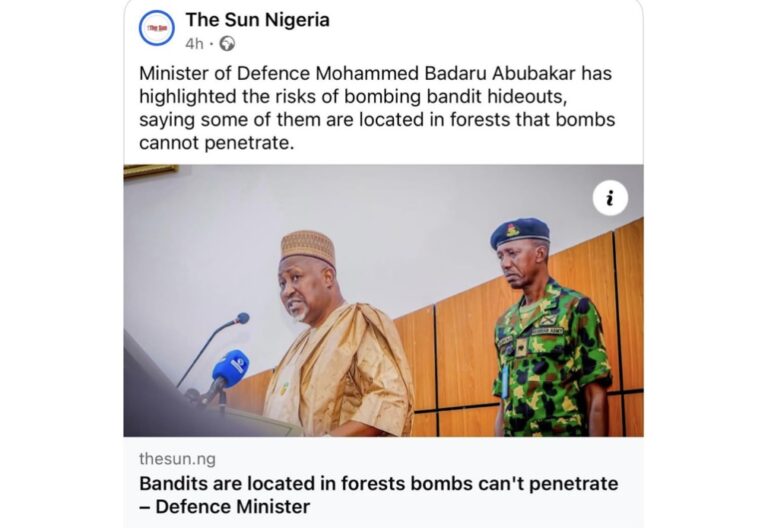
Derisive commentary on social media followed the claim by the Minister of Defence that bombs cannot penetrate some criminal hideouts.
Nigeria’s Defence Minister, Mohammed Badaru Abubakar, stated that bandit and terrorist camps located deep inside forests cannot be effectively targeted with bombs, a claim that has been met with widespread public scepticism and criticism.
The Minister’s Statement and Its Context
In an interview with BBC Hausa, Defence Minister Mohammed Badaru Abubakar explained the challenges in bombing bandit hideouts. His explanation highlighted two main points.
Dense Terrain: He mentioned that some bandit camps are situated deep within forests where bombs cannot penetrate or reach effectively.
Risk to Civilians: He also pointed out that other hideouts are in areas where direct airstrikes could endanger civilians’ lives.
The Minister described the recent attacks as classic guerrilla tactics, where groups strike intermittently to instil fear, but insisted that the armed forces are close to ending banditry.
? Public and Online Reactions
The statement, especially the claim about forests that “bombs can’t penetrate,” has sparked widespread criticism and mockery on social media and in public comments. Reactions include:
• Mockery and disbelief. Many find the claim illogical, questioning whether forests are made of “iron” or possess “bulletproof” qualities.
• Perceived Incompetence. Some comments suggest that the statement reveals the government’s incompetence in addressing security threats.
• Questioning Official Narratives. Critics note that advanced munitions can destroy hardened targets, making the explanation seem technically dubious.