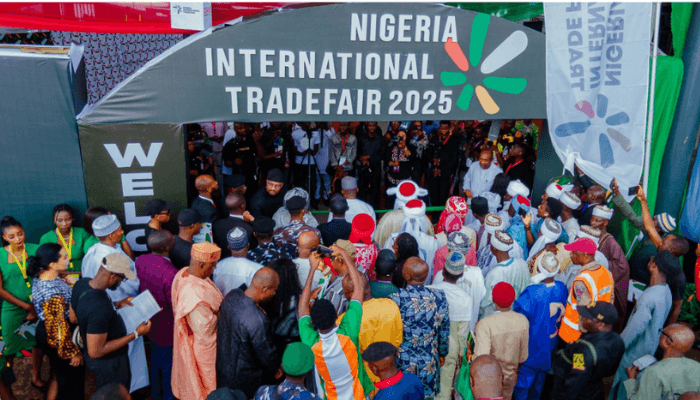
The air inside the 350-hectare sprawling Lagos Trade Fair Complex was thick with ambition. Over 500 exhibitors grabbed a miniature piece of the land, displaying their best products, each with one goal of selling out in ten days.
The Nigeria International Trade Fair had roared back to life after fourteen years of recess, drawing a wave of small, medium-sized businesses eager to prove that their products meet international standards and stitch Nigeria back into the fast-moving network of continental commerce.
The Complex’s grounds was again teeming with manufacturers and informal exporters on Friday, the opening day, as exhibitors hoped to turn foot traffic into purchase orders. Vera Ndanusa, executive director of the Lagos International Trade Fair Complex told BusinessDay that she hopes to close “deals in billions of dollars if possible” by the end of the 10-day event.
“I’m very optimistic,” she said. “We have many states represented here. MDAs have sponsored their MSMEs, including development agencies like GIZ. We have many business already transacting. We have a team that are watching transactions.”

The fair was initially suspended due to policy changes, the organisers said. “Governance gap, funding difficulties and competing priorities, the realities of then and now and then the political will,” Ndanusa said.
According to her, increased investor confidence had prompted a resurrection.“We had to revive the Trade Fair because over the decades we’ve seen investors’ interest in Africa and growth in areas like tech, agribusiness and manufacturing,” she had earlier told Nigerian media. “The opportunities include direct access to buyers and distributors from across West Africa and beyond.”
Read also: Nigeria makes final push for IMO Council seat in London
A major driver of the resurrection was a desperation to meet and beat the competition and plant Nigeria firmly within the African Continental Free Trade Area (AfCFTA), a pact which aims to create a single market connecting 1.4 billion people and a combined GDP of $3.4 trillion.
“Our goods are in demand across Africa,” Jumoke Oduwole, minister of industry, trade and investment, said at the opening ceremony. “We marked 13 southern and eastern African countries that want Nigerian products. We understood that they want our light manufacturing, our snacks, plantain chips chin chin, they also want our zobo, our shea butter beauty products, slippers, the things we take for granted here, our hair wigs.”

She described the fair as “an opportunity to showcase the very best of proudly Nigerian products and continue to accelerate our non-oil exports.”
Theresa Essien, one of the exhibitors representing First Class Refreshment Limited, selling snacks local to Nigeria like Kilishi (Beef Jerky), disclosed to BusinessDay that she had already sold N500,000 worth of products in the first few hours of the fair. She planned to sell up to ten times as much before the end.

“We’re interested in growing these businesses,” Oduwole said. “So a business that is small this year should be medium-sized in the next five years.”
This year, the fair was themed around Trade, Technology and Transformation. Ahmed Munir, chairman house committee on commerce, said that if Nigeria must compete in the $3.4 trillion African Continental Free Trade Area economy, Nigerian products must be value-added and scalable with technology and Artificial Intelligence. “If you want to compete, you have to be at par,” he said.
Read also: New shipping route promises faster, cheaper supply chain for importers
Affiong Ibanga, another exhibitor, with multiple bottles of spices and maual small grinders spread out in front of her booth, told BusinessDay that asides from selling out, she hopes to find international clients and model their innovative technologies to scale.
But with persistent infrastructural issues in logistics, certification, and financing, the incentive to go digital is low. Exhibitors that BusinessDay spoke to said they implement very little of digital trade practices in transactions with current clients. And with limited access to markets, some of them had to physically be at the fair to meet potetntial foreign clients.
Charles Odi, the director of the Small Medium Enterprise Development Agency of Nigeria (SMEDAN) said his agency guides small businesses in navigating these burdens as exporting requires working capital for production, packaging, and logistics.
“If a small business in fashion wants to grow, they can come into SMEDAN, we’ll help with maintenance, even power. All is provided for,” he assured. He said SMEDAN helps small businesses obtain certifications and necessary resources.
“After this [fair], we’ll continue to handhold our small businesses to ensure they get the right guidance, resources, opportunities and workforce to grow and thrive.