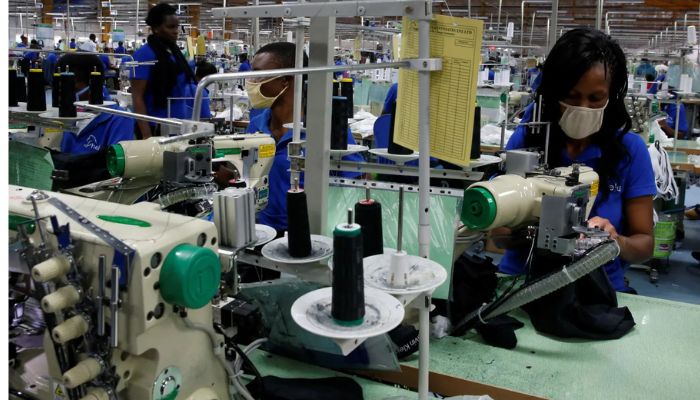
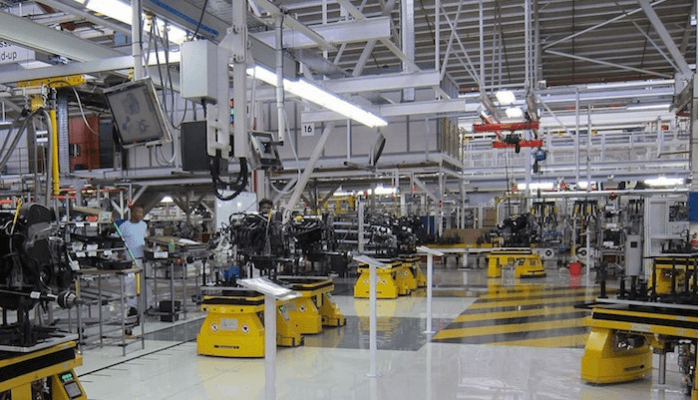
Nigeria’s industrialisation efforts can only succeed with the active participation of its millions of Small and Medium Enterprises (SMEs), according to a new report.
The report by the Fate Institute titled ‘Beyond the Hustle: Nigeria’s Industrial Reawakening,’ highlighted the crucial role small businesses play in driving economic growth, employment and productivity, stressing that their inclusion is key to unlocking the country’s industrial potential.
“Nigeria’s industrialisation will not be built by a few large firms alone. It will depend on enabling millions of small, productive enterprises across regions, sectors and value chains,” said the report.
Read also: Industrialisation, regional trade policy crucial to achieving Nigeria $1trn economy target NESG

“These firms must be supported by better infrastructure, smarter finance, stronger capabilities and coordinated institutions that turn policy into action. Nigeria must create the missing middle,” it added.
The report traces Nigeria’s industrial performance from 1990 to 2025, identifying five key patterns – premature deindustrialisation, employment growth without productivity gains, weak export performance and exclusion from global value chains, limited execution of industrial policies and zones and the persistence of a “missing middle.”
The report explained that the country has struggled to translate industrial ambition into broad-based firm-level competitiveness, noting that as the country strives to diversify and industrialise, enhancing the efficiency and output of small businesses is crucial.
The report noted that the political economy of rent seeking and policy discontinuity has further constrained industrial progress.
Despite these challenges in the country’s manufacturing landscape, the report identified the attainment of self-sufficiency in cement production and new investments in oil refining as areas of progress, noting these remarkable improvements were still driven by large firms and show what coordinated policy and private investment can achieve.

The report set out a new framework for reigniting Nigeria’s industrial engine through five pillars: placing small firms and clusters at the centre of industrial strategy and providing productive infrastructure and secure industrial corridors.
Others are: reforming finance to support firm upgrading rather than short-term liquidity, building industrial capabilities through technology, skills and cluster competitiveness, leveraging the African Continental Free Trade Area (AfCFTA) Agreement and strengthening institutional coordination and delivery mechanisms to ensure policy continuity and measurable results.
Speaking on the report, Amaka Nwaokolo, director & head, The FATE Institute, said, Industrialisation is no longer optional for the country but an urgent requirement for growth.
Nwaokolo explained that 97 percent of Nigeria’s 39 million MSMEs operate at the nano or micro level, with very few transitioning to small and medium-sized businesses, resulting in a missing middle and a small cluster of large firms.
According to her, without transforming nano and micro enterprises into productive, growing firms that plug into industrial value chains, Nigeria cannot industrialise.
“Real industrialisation will not be achieved by focusing solely on large industries or headline reforms. It requires a bottom-up transformation that empowers the enterprises that form the backbone of our economy,” she said.
“To achieve this, Nigeria needs a clear, inclusive, and time-bound national vision, anchored in disciplined execution and continuity across administrations,” she added.
Femi Egbesola, vice-chair, 2025 PDS technical-committee and president, Association of Small Business Owners (ASBON), said that millions of small businesses struggle daily with power, finance, logistics, and inconsistent government policies.
Read also: Afreximbank calls for Africa’s sustainable development, industrialisation
These are not abstract issues, he noted, saying they are daily battles that determine whether a business survives or shuts down operations.
Giving highlights from the report, he noted that the report makes it clear that these obstacles to SMEs’ growth must be tackled.
“If we don’t tackle these firm-level bottlenecks head-on, Nigeria cannot industrialise in a sustainable way.” “Industrial policy has to begin from where entrepreneurs are not from the top, but from the ground up.”
He said that Industrialisation is not just a policy slogan but about enabling production, helping businesses actually make things, adding that it is about creating decent jobs, and building strong domestic value chains that keep wealth circulating in our economy.
When small businesses thrive, industries are born, and when those industries begin to scale, entire economies transform. That’s the real pathway to inclusive growth,” he explained.
Nigeria’s industrial journey so far has been “top-heavy and bottom-fragile,” he said, explaining that it means only a few big conglomerates dominate, while millions of smaller entrepreneurs remain stuck in survival mode.