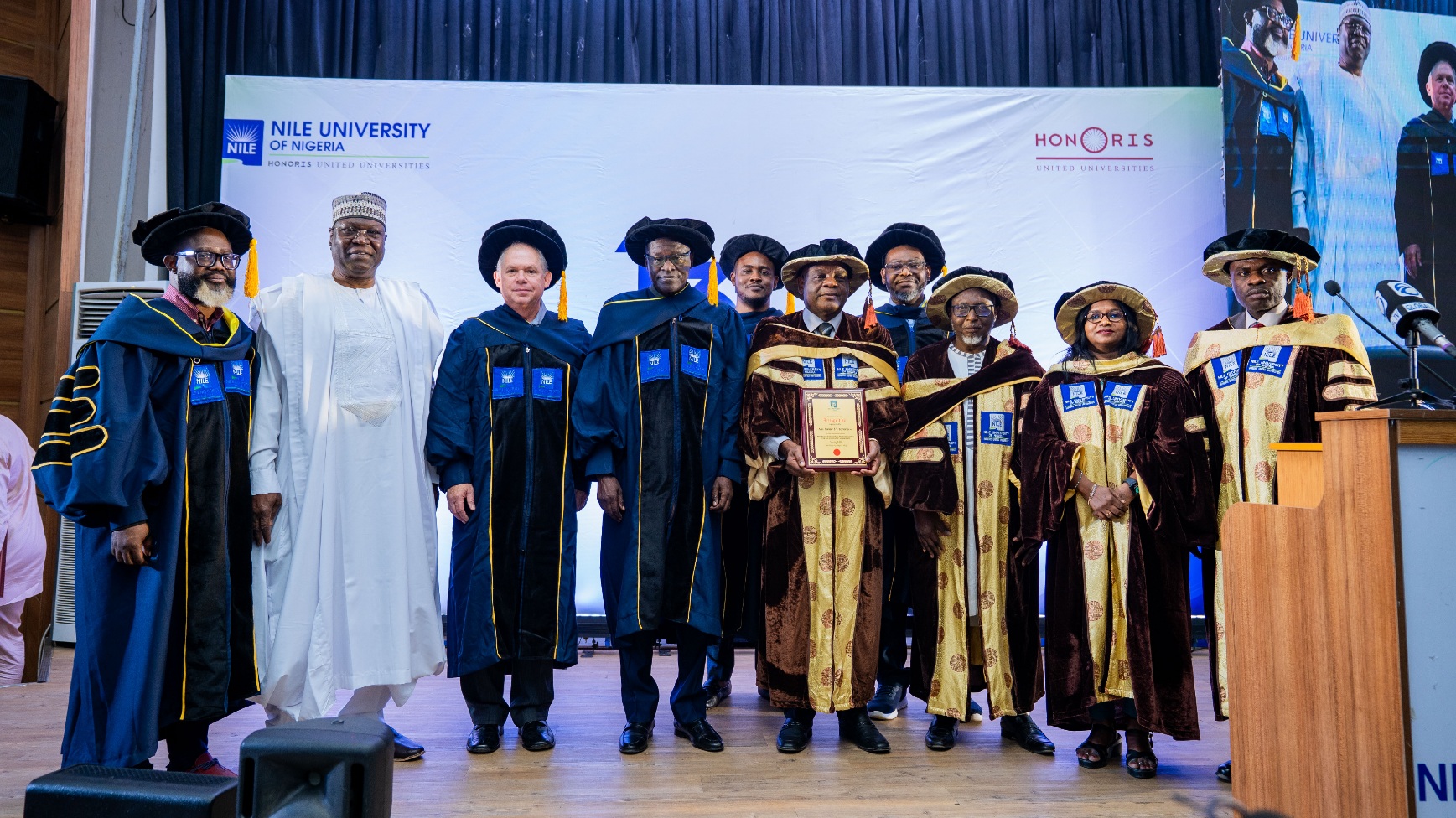
…says Nigeria must redesign education for future workforce
Sonny Echono, Executive Secretary of the Tertiary Education Trust Fund (TETFund), has warned that Nigeria’s persistent graduate unemployment crisis will worsen unless the country urgently realigns its education system with the demands of the 21st-century workforce.
Delivering the 13th Convocation Lecture of Nile University of Nigeria on Tuesday in Abuja, Echono said Nigeria’s education sector is burdened by decades of underfunding, obsolete curricula, inadequate infrastructure, and an entrenched focus on theory rather than practical skills.
These deficiencies, he noted, have left many graduates ill-equipped for the modern labour market, forcing employers to rely heavily on foreign-trained professionals.

“Nigeria’s education system is widely believed to face significant challenges, including inadequate infrastructure, outdated curricula, and an overemphasis on theoretical knowledge at the expense of practical skills.”
Echono expressed concern that despite producing thousands of graduates annually, Nigeria continues to witness rising unemployment and underemployment because of a widening skills gap.
According to him, many Nigerian graduates are considered unemployable due to a lack of practical skills, limited exposure to real-world applications, and an education system that prioritises rote learning over critical thinking, problem-solving, and creativity.
“Employers have argued that Nigerian graduates lack job-ready competencies, compelling many firms to conduct expensive in-house training or engage foreign expatriates.
“For instance, despite the thousands of engineering graduates being produced annually, many companies in Nigeria’s engineering and technology sectors, such as the oil and gas, manufacturing, and construction industries, prefer to engage foreign trained professionals due to a lack of hands-on experience among local graduates.

“This is largely due to an overemphasis on theory over practical training in Nigerian universities, which has led to a growing skills gap that leaves both employers and job seekers frustrated,” he stated.
He cited global rankings such as the Times Higher Education (THE), Academic Ranking of World Universities (ARWU), Webometrics, and QS rankings, where Nigerian universities consistently lag, reflecting deeper structural and quality issues.
The TETFund boss noted that Nigeria’s youthful population, which makes up more than 60 percent of the country’s demographics, presents both an opportunity and a risk. While the potential for economic transformation is immense, he warned that the opportunity will be wasted if the education system remains misaligned with industry needs.
Echono outlined multiple systemic challenges, including inadequate teaching infrastructure, shortages of qualified teachers, weak policy implementation, corruption, low digital literacy, and inequitable access to technology that have weakened the sector’s capacity to deliver quality learning.
To reverse the trend, he said Nigeria must embark on bold reforms, beginning with a significant increase in education funding.
He urged the government to meet the UNESCO benchmark of allocating 15–20 percent of the national budget to education, stressing that comparably placed countries like Rwanda and Kenya, which invested 18 percent and 16 percent respectively in 2021, are already reaping the benefits of education-centred development.
He added that improved funding should support rehabilitation of existing institutions, expansion of digital and physical infrastructure, enhanced teacher training, and better welfare packages to stem brain drain.
Echono also called for a comprehensive curriculum overhaul across all levels of education to integrate digital literacy, entrepreneurship, artificial intelligence, data science, renewable energy technologies, and financial literacy.
He emphasised that innovation-driven education is crucial if Nigeria hopes to build a competitive workforce capable of thriving in a technology-dominated global economy.
He noted that while government reforms and the rise of educational technology (EdTech) provide promising pathways, their impact will depend on sustained political will, adequate investment, and strong collaboration between public and private stakeholders.
Read also: FG orders tertiary institutions to account for unutilised TETFund allocations within 30 days
Echono stressed that Nigeria must act swiftly: “For the country to break the cycle of graduate unemployment and economic stagnation, we must redesign our education system to produce graduates who are job-ready, creative, and positioned for the 21st-century workforce.”
In his welcome remarks, Dilli Dogo, Vice-Chancellor of Nile University of Nigeria, described the convocation lecture as an important platform for shaping the perspectives of graduating students.
He noted that such lectures help address critical themes in national development and guide students as they prepare for future challenges.
Dogo reaffirmed the institution’s commitment to producing graduates equipped with practical skills, entrepreneurial capabilities and a strong sense of purpose.