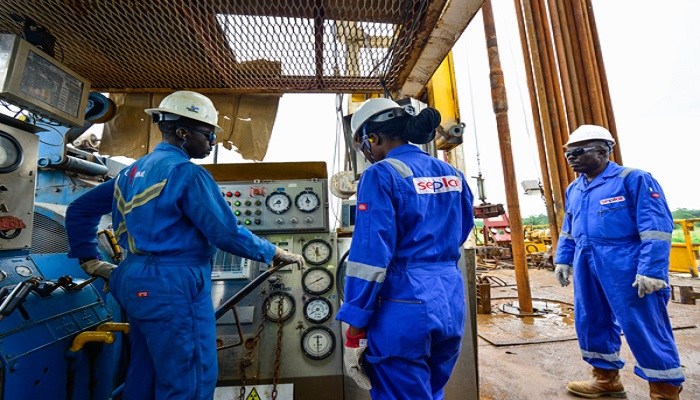
The federal government has warned dozens of oil and gas companies that it will initiate legal action to recover billions of naira in unpaid loans issued under a government-backed intervention scheme designed to boost local participation in the energy industry.
The threat marks one of the most aggressive moves yet by Bola Tinubu’s administration to rein in defaults amid mounting pressure to expand domestic capacity and deepen Nigerian ownership in Africa’s largest oil sector.
Heineken Lokpobiri, minister of state for petroleum resources (oil) said the Federal Government would “no longer tolerate” companies refusing to repay facilities obtained from the Nigerian Content Intervention (NCI) Fund, a low-interest financing pool managed by the Nigerian Content Development and Monitoring Board, or NCDMB.
Read also: Nigeria eyes debut global sukuk, new loans to raise total of $2.8bn

Of the 70 companies that received loans, only 21 have repaid in full, while 49 remain in default, the minister said.
Lokpobiri delivered the warning at an event in Yenagoa, Bayelsa State, where Tamrose Limited, an indigenous marine logistics and oil services provider, announced settling a $10 million loan it obtained in 2019.
The repayment, he said, stands in stark contrast to the behaviour of many other beneficiaries.
“These companies have to sit up to meet their obligations,” Lokpobiri told industry executives and government officials at the NCDMB Towers. “Some of them deliberately don’t want to pay. We will use the instrumentality of the law to recover this money so that we can use it to develop this sector.”
The minister described the extent of defaults as “unpalatable,” noting that several companies had told him they were unwilling to repay despite the loans carrying single-digit interest rates, compared with commercial bank lending rates that often exceed 35%.

“If you are a company of integrity, you have to pay,” he said.
Nigeria’s local content policy has been a cornerstone of efforts to grow indigenous capacity in an industry long dominated by multinational oil majors.
The NCI Fund, launched to support local operators with affordable financing, was designed to help companies acquire assets, expand service offerings and build technical competencies.
Lokpobiri said widespread defaults undermine the scheme’s foundational purpose.
“This fund was created to strengthen local capacity,” he said. “If you don’t service the loans, this money will not be available for other companies to benefit from it.”
Defaults have strained the pool’s ability to support new applicants, NCDMB officials say privately. Fresh disbursements have slowed in recent years as the board reviews its exposure and the repayment discipline of borrowers.
Yet the loan program can be transformative when used as intended, officials argue. Tamrose, for instance, expanded its fleet from four to 15 vessels during the loan period, including 10 security patrol vessels and five platform supply vessels, enabling it to compete more effectively in West Africa’s offshore services market.
Ambrose Ovbiebo, chairman of Tamrose, said the company’s repayment milestone reflects both discipline and the rigor of the NCDMB’s vetting process.
“It shows the impact of the board’s interventions in building capacity among indigenous firms,” he said, adding that the financing helped the company expand across Africa.
Lokpobiri praised Tamrose as a model borrower. “Tamrose chose to plant the seed, and that seed grew from four to 15,” he said. “That is an example I want to recommend to the entire industry.”
He added that companies that successfully repay can reapply for additional support, framing the fund as a renewable pipeline of capital for compliant operators rather than a one-off facility.
The minister said the government is prepared to initiate prosecutions and asset recovery actions against persistent defaulters. He warned that companies refusing to repay are likely to lose government support and industry credibility.
Read also: Sanusi to banks: publish data on loans to women-led businesses
“For those who feel that they’re not going to pay, we will pursue them,” he said. “We are not going to allow anybody to use this money to go and buy private jets.”
The NCDMB has begun reviewing its internal controls and may introduce stricter screening criteria for future applicants. Lokpobiri, who chairs the board’s governing council, said stronger scrutiny is necessary to ensure the fund benefits companies capable of deploying capital effectively.
“Our commitment is to continue to grow this fund so that we can support credible operators,” he said. “We want companies that can take these resources, invest them and grow opportunities in the oil and gas industry.”
Nigeria continues to face production volatility, underinvestment, aging infrastructure and declining output from major fields. While the country remains Africa’s top crude producer on paper, actual barrels pumped often fall below OPEC quotas due to pipeline theft, funding constraints and operational disruptions.
Analysts say stronger local service companies, such as marine logistics providers, rig operators and fabrication yards, are essential to reversing the industry’s decline.
The NCI Fund, they note, is one of the few stable financing channels available to indigenous firms, which struggle to obtain affordable credit due to Nigeria’s high interest rate environment.
The minister said the government sees logistics firms as central to the sector’s long-term viability.
“The oil and gas industry cannot thrive without strong logistics companies,” he said, adding that the NCI Fund’s structure was intentionally designed to enable such operators to scale.
“We are not going to pretend,” he said. “This money must be recovered and recycled back into the industry.”