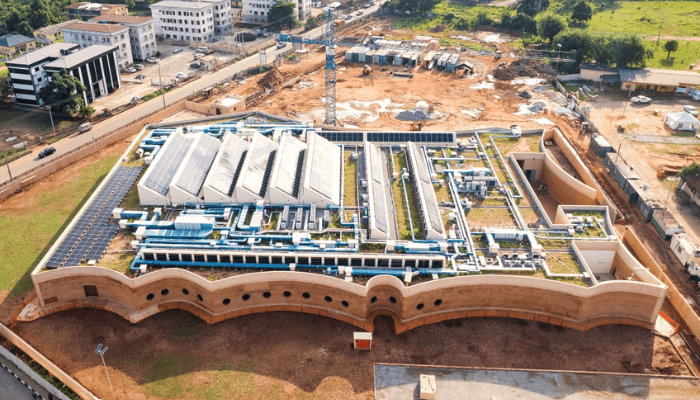
What was meant to be a crowning cultural moment for Nigeria has become a tempest of protest, politics and heritage. On Sunday, a group of protesters stormed the grounds of the Museum of West African Art (MOWAA) in Benin City, forcing a postponement of the museum’s planned opening. The confrontation came amid a fierce dispute involving the state government, the royal palace, the museum’s trustees, and even international partners.
Videos circulating on social media showed demonstrators confronting foreign visitors at a preview event, shouting at them and demanding they leave. The discontent centred around the museum’s name, structure and control, the protesters were insistent that it should be called the “Benin Royal Museum” and placed under the authority of Omo N’Oba N’Edo Uku Akpolokpolo, Ewuare II, the Oba of Benin. Many viewed the MOWAA project as a local legacy being hijacked.
Shortly after the incident, MOWAA issued a formal statement explaining that no official opening had yet occurred and that foreign guests had been safely escorted off-site. “We sincerely apologise for any inconvenience this situation may have caused,” the museum said, adding that it remained “committed to building world-class conservation, research and exhibition spaces in Nigeria.” The museum also reiterated that it had never claimed ownership of the famed Benin Bronzes and that none were on display at the museum.
Read alsoTinubu sets up committee to resolve MOWAA controversy

The protests took place in the shadow of a more decisive move by the state government. On 10 November 2025, Monday Okpebholo, Governor of Edo State, announced the revocation of the Certificate of Occupancy (C of O) for the land on which MOWAA is located. The plot in question, Digital Plot No 61977, Zone HI/A12, Oredo LGA, ormerly the site of the Benin Central Hospital, amounts to some 6.2 hectares. In his letter, the governor cited “overriding public interest”, raised doubts about the museum’s ownership and governance, and questioned the allocation of public resources to a trust still operating outside state accountability.
By revoking the land title, the government has sent a potent message: cultural infrastructure is not exempt from state oversight. It also places the museum project under intense scrutiny over whether public funds and land were properly deployed in the first place.
Palace power and restitution imperatives
The Oba of Benin has become a very visible participant in this drama. In a statement reported by Daily Trust, Ewuare II warned that he “would not allow history to repeat itself”, referencing the 1897 British punitive expedition that looted thousands of artefacts from the Benin Kingdom. He expressed dismay that a project initially conceived as the Benin Royal Museum under royal custodianship had been repackaged into MOWAA without palace consent.
For the Oba, the question of who controls the Benin Bronzes and their home matters not just symbolically, but spiritually and historically. Citing scholars like Peju Layiwola, many argue that the artefacts belong to the monarchy as heirs and custodians of the court that produced them. Layiwola, in her essay Questions of Ownership of Benin Treasures (I), poses provocative questions: “Why should a state governor and his cohorts wield so much power as to want to appropriate these artifacts…?” She further argues that handing over the treasures to a trust outside the palace may amount to a new form of neo-colonialism.
Governor Okpebholo appears to have sided with the palace, escorting a delegation of European Union and German envoys to the palace shortly after the revocation. The visit signalled his intention to realign the museum project with the Oba and traditional authority, potentially shifting away from the independent-trust model that got the project started.

MOWAA’s position: Independence or isolation?
MOWAA’s statement sought to clarify what it owns and does not. It emphasised the following five core points:
The museum holds the Oba of Benin in the highest esteem, is committed to respectful engagement, and wishes to contribute to the preservation and advancement of West African heritage.
MOWAA does not hold, nor ever claimed, title to any Benin Bronzes. Since its inception in 2020, the institution has focused on broader West African art; no Benin Bronzes have ever been on display there.
MOWAA has never presented itself as the Benin Royal Museum to secure funding. It invited authorities to verify this with its donors.
It is committed to supporting existing institutions in Benin City and across West Africa, not to compete with them, and seeks collaboration with artists, researchers, universities and museums. No formal public commissioning or opening has occurred; the recent event was a private preview of its first exhibition which included works from a broader West African remit, not Benin-heritage artefacts.
Director Phillip Ihenacho said he was “saddened by the events of yesterday” but remained hopeful that “this moment can lead to renewed dialogue, engagement and understanding.” The MOWAA Institute’s Ore Disu added that the museum sought to demonstrate that “world-class conservation facilities, research, and exhibition spaces” can be built in Nigeria, that African stories can be told on African terms, and that the project is a “gift for black and African people everywhere, for people today and future generations.”
Despite this, the independence model now appears to be under pressure. The state and palace both questions how a trust operating independently of traditional or government oversight can house artefacts whose provenance and significance rest on palace rights and public interest. Layiwola’s essay warns that giving the returned treasures to a trust instead of the monarchy or state may undermine the long-term goal of restitution and cultural self-determination. She writes: “The looting and rape of Benin is one of the most documented histories of pillage in Africa… If we miss this opportunity to handle this situation properly, it will mess up the case for other parts of the continent.”
Wider implications
The contest at MOWAA is not just local, it taps into global questions of heritage, restitution and institutional governance. The Benin Bronzes have become the poster case for looted colonial artefacts, and their return has been framed as both an ethical and political act of reclamation.
The means by which Nigeria structures their housing and display will signal how the country deals with cultural sovereignty, power balance and global partnerships.
As Layiwola argues, transferring the artefacts to central state or trust institutions may replicate colonial dynamics of external control, why should restituted items be placed under institutions whose legitimacy is often seen as derivative of Western funding or bureaucratic logic, rather than indigenous authority? The Mona Lisa of the Benin debate remains: who owns culture, and who gets to display it?
The museum was promoted as a game-changer for Benin City, a heritage tourism hub, a centre for conservation, research and creativity with ripple effects into the local economy. Edo State had committed around ₦3.8 billion under the previous administration to get construction underway. The trust model was pitched as independent, but the collapse into dispute now puts at risk the very economic and reputational goals behind the initiative.
Observers point out that when public land, public funds and public heritage are involved, there is no such thing as merely “private trust”, accountability, governance and local buy-in matter. The revocation of the C of O may have wider investor and diplomatic repercussions: if land titles can be revoked in cultural projects, what message does that send to donors, partners and philanthropists?
What happens now
To resolve the dispute, President Tinubu appointed a presidential committee chaired by Hannatu Musawa, minister of art, culture, tourism and creative economy.
Members of the committee include representatives from the federal ministry of art, culture, tourism and creative economy; the presidency; the National Council for Arts and Culture; the Edo State government; the palace of the Oba of Benin; the ministry of foreign affairs; the German and French embassies; the National Commission for Museums and Monuments; and MOWAA.
In Edo state, Governor Okpebholo also established a special review committee, headed by Adams Oshiomhole to examine the museum’s governance structure, land transactions, donor funding and engagement with the Benin Palace. A report is expected in the coming weeks.
The committee’s remit is wide: it will look at how the land was allocated, how the trust was constituted, what governance mechanisms exist, whether donors were fully briefed on the traditional custodianship issues, how the museum aligns with the palace’s cultural rights, and whether the project remains fit for purpose under public interest.
What will come out of these two committees could help set the records straight.
Whether MOWAA emerges as a unifying cultural beacon or becomes tangled in its own politicised context will depend on whether the key actors recognise that culture is not just a trophy to manage, it is a legacy to steward. And in Benin City, the weight of the past insists that the future be a carefully negotiated one.