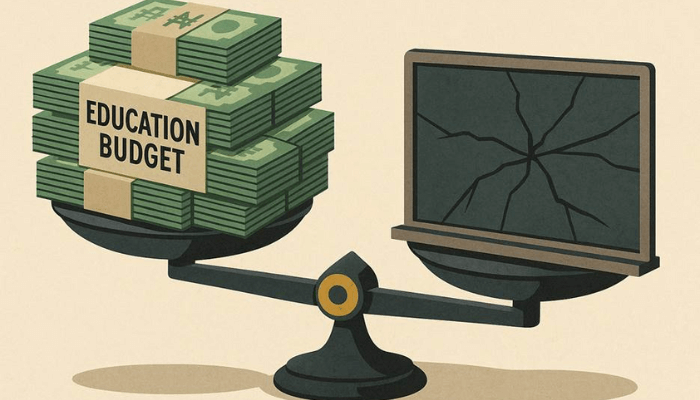
Nigerian states recorded an average of 66.9 percent of their education budget implementation in 2025, according to the latest State of States report released by BudgIT.
The report highlights gradual improvements in fiscal discipline and governance across several states despite prevailing economic challenges.
According to the report BudgIT, Nigeria’s leading civic-tech organisation promoting fiscal transparency and accountability, in social sectors, implementation remains uneven.
“For education, states budgeted N2.41 trillion but spent only N1.61 trillion, achieving 66.9 percent implementation.

Read also: Adamawa begins CBT-based recruitment for 5,000 teachers to boost education sector
Out of the 36 states, nine states, Edo, Delta, Katsina, Rivers, Yobe, Ekiti, Bayelsa, Bauchi, and Osun, exceeded 80 percent of their budgeted allocations, with Edo, Delta, and Katsina surpassing 100 percent.”
Besides, the report indicates that average per capita spending remained low at N6,981, with no state exceeding N20,000 per capita and only eight states above N10,000.
Meanwhile, in health, states budgeted N1.32 trillion but expended N816.64 billion, achieving 61.9 percent implementation.
Seven states, Yobe, Gombe, Ekiti, Lagos, Edo, Delta, and Bauchi—spent over 80 percent of their health budgets, with Yobe leading at 98.2 percent, though total expenditures remained modest.

Average per capita spending was N3,483, with only a few states exceeding N5,000, highlighting significant gaps in service delivery relative to education.
Some states exceeded international/UNESCO-recommended benchmarks about 20 to 26 percent for education spending in their state budgets:
Enugu State, for instance, spent 33 percent of its budget in 2024, and Jigawa State spent 26.4 percent of its 2025 proposed budget went to education.
On the other hand, many states still fall significantly short of these benchmarks; some states allocate less than six to seven percent to education.
Nubi Achebo, director of academic planning at Nigerian University of Technology and Management (NUTM), described the 66.9 percent education budget implementation rate by Nigerian states as a mixed bag.
He said while this indicates some progress, it does not necessarily translate to adequate funding per student or achievement of educational goals.
Read also: Yobe recruits 948 teachers to strengthen basic education
“The 66.9 percent rate suggests that states have partially executed their education budgets, but there’s still a significant gap in implementation.
“This percentage doesn’t directly correlate with the achievement of educational goals or adequate funding per student,” he said.
Achebo explained that the metrics for measuring success should be to accurately assess states’ performance, considering funding per Student.
“Adequate allocation of funds per student, considering factors such as infrastructure, teacher training, and learning materials.
“Besides, considering the key performance indicators, that’s achievement of specific educational goals, such as improved literacy rates, increased access to education, and better learning outcomes,” he noted.
He emphasised that improvement in school infrastructure, including classrooms, libraries, and sanitation facilities, should be a key metric to consider.
Achebo emphasised that while implementation percentage is important, it is not the sole indicator of success.
“States should prioritise achieving key performance indicators, such as improved student outcomes, increased access to education, enhanced teacher quality, and better infrastructure.
“By focusing on these metrics, states can ensure that their education budgets are effectively utilised to drive meaningful progress in the education sector,” he said.
Isaiah Ogundele, an education administrator, said the record is not worth celebration in a country that got its independence 65 years ago.
Read also: The urgent case for evidence-based education in Nigeria
He emphasised that Western nations of the world take education as a priority, and that is why they always give the lion’s share of their annual budget to education.
Ogundele urges Nigerian leaders to do the needful and pay adequate attention to education, which is the bedrock of development in any nation.
Education funding per student is the average amount of money spent on each student’s education, calculated by dividing total education spending by the number of students.
According to the OECD, while the overall level of funding matters, the strategies used to allocate and match resources to learner needs are at least as important.