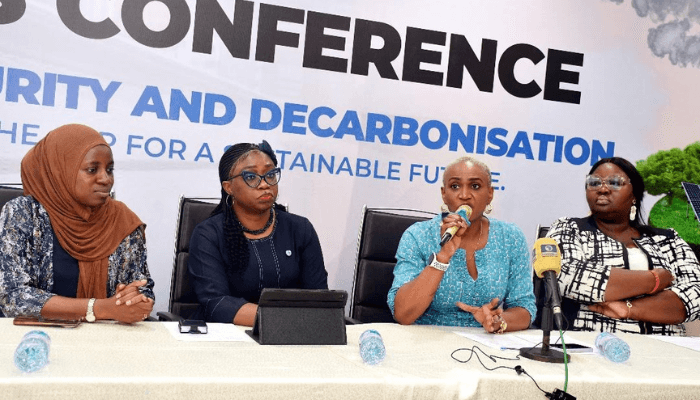
Nigeria’s top business, finance, and sustainability leaders have called for stronger financing mechanisms, sound policy frameworks, and innovation-driven strategies to accelerate Africa’s transition toward a sustainable future.
The call was made on Tuesday in Lagos at the media launch of the 2025 Private Sector ESG Forum, a prelude to one of the continent’s most influential gatherings on sustainability.
The media launch, held ahead of the ESG Masterclass on October 28 and the Main Forum on October 29, highlighted the Forum’s growing influence in shaping sustainable business transformation, climate resilience, and corporate responsibility across Africa.
Now in its third year, the 2025 edition of the Forum, themed “Energy Security and Decarbonisation: Bridging the Gap for a Sustainable Future,” will focus on designing an African energy transition model that addresses energy poverty while advancing environmental responsibility and economic inclusion.

Read also: Stakeholders to discuss Africa’s innovation future at Lagos Prosper Confab
Delivering the opening remarks, Odiri Erewa-Meggison, Chair of the ESG Forum Technical Committee and External Affairs Director, BAT West and Central Africa, highlighted the continent’s most pressing sustainability challenge: how to power development without harming the environment.
“Africa must not merely import global sustainability standards; we must define our own context,” Erewa-Meggison said. “Our conversation is not just about reducing emissions, it is about expanding opportunity. We must begin to look for solutions that work for us; solutions that ensure energy fuels factories, lights homes, and sustains livelihoods.”
She explained that the Forum aims to serve as a rallying point for collaboration between private sector players, policymakers, and financiers.
According to her, the transition to a low-carbon economy must be pragmatic and equitable, ensuring that communities and industries still struggling with basic power access are not left behind.

“The transition is not only about what we stop doing, but what we build in its place: innovation, local capacity, and inclusive progress,” she added.
Read also: Stakeholders urge dialogue, regulatory oversight in Dangote Refinery over labour dispute
Representing the financial sector, Tosin Leye-Odeyemi, Head of Risk and Capital Management at Stanbic IBTC Holdings, underscored that sustainable transformation will remain elusive without robust financing structures.
“Transition financing is not a buzzword; it is the backbone of implementation,” she said. “We must de-risk sustainability investments and build blended finance structures that attract both public and private capital. If we want transformation, we must build financial systems that reward responsibility and long-term value creation.”
Leye-Odeyemi emphasised the need for financial innovation to unlock climate finance. She urged the private sector to explore instruments such as green bonds, sustainability-linked loans, and other capital market tools that align with Africa’s development priorities.
Speaking from the agribusiness perspective, Yosola Onanuga, Head of Corporate Responsibility and Sustainability at TGI Group, examined how energy and food security are deeply interconnected.
“Food security and energy security are inseparable,” she said. “By integrating renewable energy into agricultural production and processing, agribusinesses can lower costs, reduce emissions, and build resilience for communities most vulnerable to climate shocks.”
Read also: Stakeholders push for policy incentives, human capital investment as Nigeria eyes energy hub
Onanuga’s remarks reinforced the need for cross-sector collaboration, highlighting how sustainable energy solutions can simultaneously drive agricultural productivity and rural development.
In her closing remarks, Halimat Shuaibu, Head of Business Communication and Sustainability at BAT West and Central Africa, reflected on the Forum’s overarching goal, to move the continent from dialogue to measurable action.
“This Forum is a collaborative commitment to align profit with purpose, and growth with responsibility,” she said.