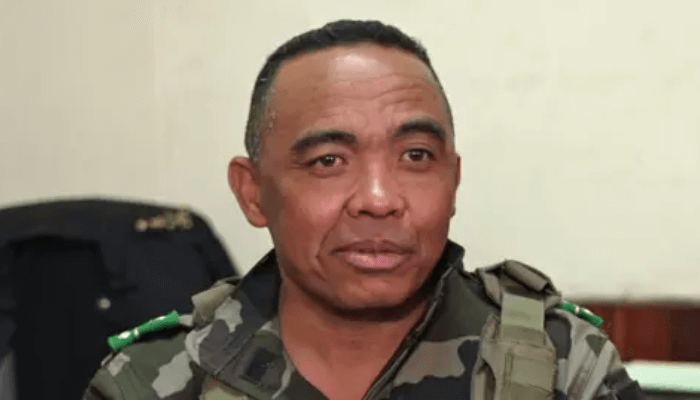
Michael Randrianirina was sworn in as Madagascar’s president on Friday, marking the climax of a fast-moving power struggle that has upended politics on the Indian Ocean island and drawn condemnation from international bodies.
The 51-year-old commander of CAPSAT, the country’s elite army unit, took the oath of office in a ceremony held at the constitutional court in Antananarivo — the same institution he suspended days earlier after seizing power.
Read also:10 things to know about Madagascar’s new military president, Michael Randrianirina
Blaring trumpets, raised swords, and loud cheers greeted Randrianirina as he assumed control from ousted president Andry Rajoelina, a man he once guarded. The colonel’s rise from protector to president followed a week of chaos that saw CAPSAT soldiers mutiny, join anti-government protests, and eventually declare a military takeover after Rajoelina was impeached by lawmakers for “desertion of duty.”

“Today marks a historic turning point for our country,” Randrianirina said in his first address as president. “We will work hand in hand with all the driving forces of the nation to draft a fine constitution and agree on new electoral laws for the organisation of elections and referendums.”
Read also:African Union suspends Madagascar after military coup ousts civillian president
He thanked Madagascar’s youth, many of whom led the street protests that toppled the government — and claimed the army’s intervention came at the request of the top court to “avoid anarchy and disorder.”
mixed international reception
The swearing-in was attended by senior military officers, political figures, youth protest representatives, and foreign envoys from the United States, European Union, Russia, and France.
Despite the ceremony’s grandeur, the power shift has triggered widespread alarm. The African Union swiftly suspended Madagascar, citing “unconstitutional change of government,” while the United Nations condemned the military’s intervention.

Randrianirina has rejected accusations of staging a coup, arguing that the constitutional court’s endorsement makes his ascent legitimate. “This is not a military regime,” he said, promising that “the government belongs to civilians” and pledging to hold elections within 18 to 24 months.
Read also: Madagascar military seizes power, appoints interim leader after declaring presidency vacant
However, the constitutional court has ordered polls to be held within 60 days — a timeline that could set up a confrontation between the new president and the judiciary he has already sidelined.
Supporters of Andry Rajoelina have dismissed the court’s decision as illegal, warning it could plunge the country deeper into instability. They maintain that Rajoelina remains the rightful leader and accuse the army of betraying the constitution.
Rajoelina’s downfall began after weeks of protests driven by power cuts, rising living costs, and public anger over corruption. Security forces were accused of heavy-handed crackdowns that left several protesters dead or wounded — until CAPSAT troops refused orders to shoot, siding instead with demonstrators on October 11.
By the weekend, Rajoelina had fled Madagascar. His office confirmed he left “for safety reasons,” though it did not disclose his location. French media later reported he was evacuated by a French military aircraft to the island of Réunion before travelling on to Dubai.
Madagascar, once hailed as a model of democratic progress in the region, now finds itself added to a growing list of African nations where the military has seized control in recent years — including Mali, Burkina Faso, Niger, Gabon, and Guinea.
It is the island’s third military transition since independence from France in 1960, following coups in 1972 and 2009.
Dressed in a navy suit instead of his army fatigues, Randrianirina used his inauguration speech to project an image of reform and renewal. “We are committed to breaking with the past,” he told the foreign delegations in French. “Our mission is to reform the country’s administrative, socio-economic and political systems of governance.”
Whether his pledges of transition and reform will restore confidence at home or abroad remains to be seen. For now, Madagascar stands once again at a crossroads — with its future hanging between military power and the promise of a return to civilian rul