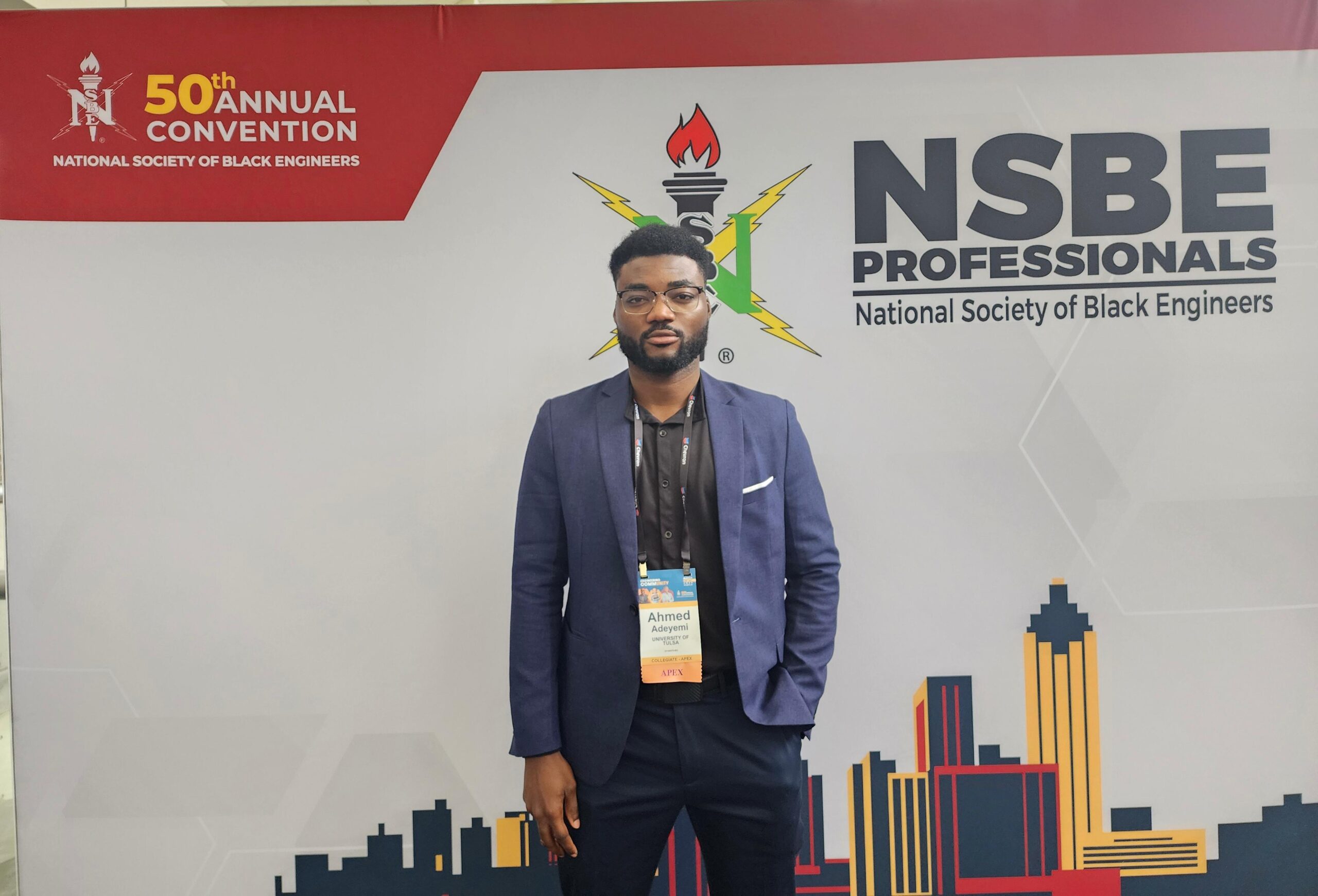
Dr Ahmed Adeyemi’s career is a masterclass in accelerating innovation across borders. From his early days, developing Nigeria’s first indigenous reservoir simulation engine, to his recent role driving AI-driven optimisation workflows for U.S. oil producers, his trajectory reflects not only technical brilliance but measurable global impact.
After leading the numerical engine development for SEPAL Solver at CypherCrescent Ltd, Adeyemi earned a fully funded PhD at the McDougall School of Petroleum Engineering, University of Tulsa – the top-ranking private school in Petroleum Engineering according to US News & World Report. His work centred on building deep-learning-based surrogate models that retain physical reliability while drastically accelerating simulation and control workflows under geological uncertainty.
This research didn’t remain in academic silos. In 2023, his paper on detecting methane emissions through machine learning was presented at the Society of Petroleum Engineers (SPE) Annual Technical Conference and Exhibition (ATCE) in San Antonio. “We showed how intelligent systems could be applied to detect behavioural anomalies in real time,” Adeyemi explains. “It’s not only about reducing environmental impact — it’s also about improving operational integrity and safety.”
In 2024, another of his papers was presented at the European Conference on the Mathematics of Oil Recovery (ECMOR) in Oslo, showcasing a differentiable surrogate-based optimisation framework that gained traction among international operators and researchers.

But it was during his internship at Schlumberger (SLB) in 2024 that Adeyemi built E2CO-Lite, a scalable surrogate architecture tailored to support robust production optimisation and deep reinforcement learning agents for optimisation. This breakthrough reduced computational costs by several orders of magnitude. SLB management formally acknowledged the tool’s measurable financial impact and integrated it into internal workflows. “Seeing a surrogate I built outperform legacy simulators— and be validated by a global leader like SLB — confirmed that this work isn’t just academic. It’s operationally transformative,” Adeyemi reflects.
The surrogate architecture was presented at the 2025 European Association of Geoscientists and Engineers (EAGE) conference in Toulouse, France.
In March 2025, Adeyemi co-authored and co-presented a paper at the SPE Reservoir Simulation Conference detailing a novel deep-learning-based history matching framework using E2CO surrogates.
A follow-up study was accepted for presentation at the 2025 SPE ATCE in Houston, Texas. Shortly after, his paper titled “Accelerated Deep Reinforcement Learning in Subsurface Production Optimisation” was accepted for publication in the SPE Journal, one of the top peer-reviewed platforms in petroleum engineering. A separate manuscript covering the core E2CO-Lite architecture remains under review in the Geoenergy Science and Engineering journal.
Now, as a Reservoir Simulation Research Scientist at Tachyus Corporation, a U.S.-based energy tech firm, Adeyemi is driving deployment of AI-powered tools that allow North American operators to make faster, smarter decisions across shale and offshore assets. These tools have already been adopted to reduce simulation times from hours to seconds — enabling real-time planning that improves profitability and resilience.

“What sets my work apart is that it isn’t just AI for AI’s sake,” he explains. “It’s about building machine learning systems that are physics-aware, control-responsive, and reliable in the field.”
Alongside his technical work, Adeyemi mentors emerging researchers, both at the University of Tulsa and across engineering communities in Nigeria. His guidance has helped several young engineers gain access to top-tier research opportunities in the U.S. and abroad.
As the energy industry enters a new era shaped by decarbonization and data, Adeyemi’s work sits squarely at the intersection of computation, control, and climate responsibility. His journey is not only one of academic and technical excellence, but of real-world transformation — making him one of the most exciting AI innovators working in the U.S. energy today.