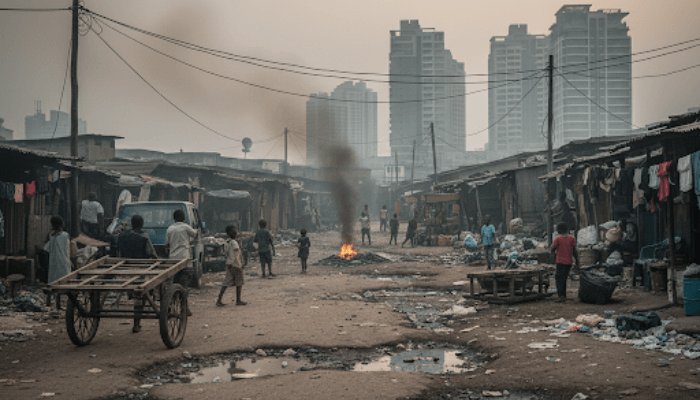
Nigeria’s government insists that tough economic reforms are the bitter medicine the country needs. Yet, for ordinary Nigerians, these reforms feel less like a cure and more like a deepening illness. Over a year after fuel subsidies were scrapped and the naira was floated, the promised stability remains elusive. Food prices have soared, unemployment is still entrenched, and poverty rates continue to climb. The gap between the wealthy and the poor has widened so severely that the social fabric itself is fraying.
To be fair, reformers claim progress. The floating exchange rate has narrowed the parallel-market premium, easing fears of sudden currency devaluations. The IMF has applauded Nigeria’s “bold reforms”, projecting growth of 3.0 percent in 2025. But these are modest gains at best and not remotely felt by citizens. The naira has lost nearly half its value since mid-2023, driving annual inflation above 34 percent, while food inflation hovers at 40 percent, according to the National Bureau of Statistics (NBS). In one of the world’s largest oil-producing nations, petrol prices have tripled, and transportation costs have soared, triggering protests and even stampedes at food distribution points.
These economic tremors are not simply the cost of “necessary reform”; they are a verdict on decades of poor planning. Nigeria entered this new policy era unprepared. The government scrapped subsidies and floated the naira without a social safety net robust enough to cushion 133 million Nigerians already living in multidimensional poverty (NBS, 2023). This “shock therapy” approach contrasts sharply with the gradual reform strategies used in countries like Indonesia and Egypt, where subsidy removal was phased in alongside targeted cash transfers and energy-sector reforms.
The Central Bank of Nigeria (CBN) claims to be pursuing an inflation-targeting framework, but in reality, monetary policy alone cannot tame inflation when insecurity disrupts food production, logistics are broken, and energy costs spiral unchecked. Even as interest rates climb, farmers in Benue and Kaduna abandon fields over fears of banditry, worsening food scarcity. The naira float is hailed as a “market-driven” solution, but analysts note that the CBN still intervenes heavily in the FX market, undermining its credibility.

Meanwhile, fiscal policy has veered into dangerous territory. The federal government continues to finance its deficits through borrowing, pushing Nigeria’s debt service-to-revenue ratio to over 70 percent, one of the highest in the world. The savings from subsidy removal, about 2 percent of GDP, have largely been redistributed to state governments as palliatives, with little transparency or measurable impact. Instead of using these funds to rebuild Nigeria’s crumbling infrastructure or invest in energy self-sufficiency, leaders are recycling short-term fixes.
The political economy of reform also remains untouched. The Nigerian National Petroleum Company (NNPC), long a cash cow for elites, is being outpaced by private refiners like Dangote Refinery. Yet NNPC has failed to close production gaps or increase efficiency. Without deep institutional reform of NNPC, customs, and tax administration, revenue mobilisation will remain weak, leaving the government perpetually cash-strapped.
For Nigeria’s economy to recover, leaders must first abandon the illusion of stability. The current policy mix risks entrenching stagnation: a volatile currency, collapsing consumer demand, and shrinking industrial capacity. What’s needed is a time-bound recovery plan with three pillars:
Social protection and food security:
Introduce scaled cash transfers, food vouchers, and transport subsidies, tied to biometric IDs, to immediately reduce hunger. The World Bank has already pledged $800 million for social safety nets; the government must ensure it reaches households rather than vanishing into patronage networks.

Infrastructure-led growth:
Channel subsidy savings and oil revenues into reliable power, rural roads, and storage facilities to lower production costs. Prioritise agriculture and manufacturing to create jobs and reduce import dependency.
Institutional accountability:
Reform NNPC and other state-owned enterprises to mandate transparency in state-level spending of federal allocations and empower anti-graft agencies. Without political courage, reforms will continue to enrich elites while impoverishing citizens.
Nigeria’s leaders must stop treating economic hardship as a rite of passage for development. The cost-of-living crisis is not a temporary inconvenience; it is a national emergency. Citizens’ anger is boiling over and rightly so. The country has endured decades of stolen wealth and failed policies; patience is wearing thin. If policymakers want Nigerians to trust the reform agenda, they must deliver visible results: cheaper food, stable currency, jobs, and functioning infrastructure. Anything less risks turning today’s economic experiment into tomorrow’s political disaster.