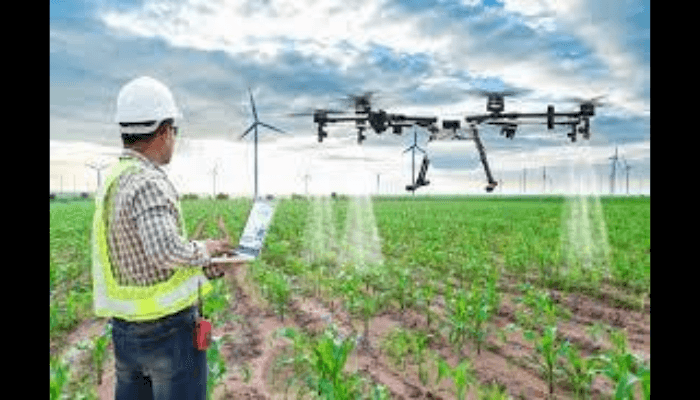
According to Alina Piddubna, renowned as a passionate AgriTech leader and an expert in the sub-sector of the application of technology, the involvement of AI is the future of agriculture. The benefits are to boost food production, enhance the value chain, reduce costs of production and improve on the ecosystem. So important is the AI impact on agriculture that the market is expected to grow from USD 1.7 billion to USD 4.7 billion over five years by 2028, according to MarketsandMarkets.
But how can AI help Nigerian farmers? That is the million-naira question. In specific terms, AI-powered precision farming can help farmers optimise the use of resources like water, fertilisers and pesticides, leading to increased crop yields and reduced environmental impact.
With the growth of the world population, projected to reach 10 billion by 205O, there is significant pressure placed on the agricultural sector to increase crop production and maximise yields. To address looming food shortages, two potential approaches have emerged. These include expansion of land use and adoption of large-scale farming techniques. The alternative is embracing innovative practices and leveraging technological such as Artificial intelligence advancements to increase productivity on existing farmland
Amongst the many challenges to achieving desired farming productivity are limited land holdings, shortage of labour, climate change, environmental issues, and diminishing soil fertility. Truth be told, the modern agricultural landscape is still evolving, branching out in various innovative directions. Given such a situation adaptation matters a lot. Farming has metamorphosed from hoes and cutlasses through plows or horse-drawn machinery to the modern methods of technical application.

Read also:; AI seen improving agric value chains efficiency, tackling food insecurity
From Alina ‘s wealth of experience over the past two decades focus has been on developing innovative systems for quality control, traceability, compliance practices, and more. Stated below are the farming methods used with AI.
On data-based decisions, it should be noted that the modern world is all about data. Organizations in the agricultural sector use data to obtain meticulous insights into every detail of the farming process. These include understanding each acre of a field to monitoring the entire produce supply chain to gaining deep inputs on yields generation process. AI-powered predictive analytics is already paving the way into agribusinesses.
With the application farmers can gather, then process more data in less time with AI. Additionally, AI can analyze market demand, forecast prices as well as determine optimal times for sowing and harvesting.
AI can also help explore the soil health to collect insights, assess weather conditions, and recommend the when and how of application of fertilizer and pesticides to the crops. Farm management software boosts production together with profitability, enabling farmers to make better decisions at every stage of the crop cultivation process.

With regards to cost savings precision agriculture can assist farmers to grow more crops with fewer resources. AI in farming combines the best soil management practices, variable rate technology, and the most effective data management practices. The aim is to maximise yields while minimising spending.
Application of AI in agriculture provides farmers with real-time crop insights, helping them to identify which areas need irrigation, fertilisation, or pesticide treatment. Innovative farming practices such as vertical agriculture can also increase food production while minimising resource usage. Resulting in reduced use of herbicides, better harvest quality, higher profits, alongside significant cost savings.
Considering labour shortages, automation provides a solution without the need to hire more people. While mechanisation transformed agricultural activities that demanded super-human sweat and draft animal labour into jobs that took just a few hours, a new wave of digital automation is once more revolutionising the sector.
Another interesting dimension to farming is the use of automated farm machinery like driverless tractors, smart irrigation, fertilisation systems and IoT-powered agricultural drones. Others are smart spraying, vertical farming software, and AI-based greenhouse robots for harvesting. Compared with any human farm worker, AI-driven tools are far more efficient and accurate.
Read also: AI seen improving agric value chains’ efficiency, tackling food insecurity
Furthermore, AI models can facilitate many tasks to collect and process big data while determining and initiating the best course of action. Here are some common use cases for AI in agriculture:
AI deployment is effective in optimising automated irrigation systems. In fact,
AI algorithms enable autonomous crop management. When combined with IoT (Internet of Things) sensors that monitor soil moisture levels and weather conditions, algorithms can decide in real-time how much water to provide to crops. An autonomous crop irrigation system is designed to conserve water while promoting sustainable agriculture and farming practices. Good enough,
AI in smart greenhouses optimises plant growth by automatically adjusting temperature, humidity, and light levels based on real-time data.
AI plays a critical role in detecting leaks in irrigation systems. This is carried out by analyzing data. Algorithms can identify patterns and anomalies that indicate potential leaks. Machine learning (ML) models can be trained to recognize specific signatures of leaks, such as changes in water flow or pressure. So, in effect, real-time monitoring and analysis enable early detection, preventing water waste together with potential crop damage.
AI also incorporates weather data alongside crop water requirements to identify areas with excessive water usage. By automating leak detection and providing alerts, AI technology enhances water efficiency helping farmers conserve resources.
The wrong combination of nutrients in soil can seriously affect the health and growth of crops. Identifying these nutrients and determining their effects on crop yield with AI allows farmers to easily make the necessary adjustments.
While human observation is limited in its accuracy, computer vision models can monitor soil conditions to gather accurate data necessary for combatting crop diseases. This plant science data is then used to determine crop health, predict yields while flagging any particular issues. Plants start AI systems through sensors that detect their growth conditions, triggering automated adjustments to the environment.
Read also: How AI and data could help avert Nigeria’s looming food crisis
Dealing with limitations of AI in agriculture. This is a piece of advice from experts on AI application to agriculture. One of the main ways to overcome this is by approaching farmers gradually: for instance, offering the use of simpler technology first, such as an agricultural trading platform. Once farmers get used to a less complicated solution, providers can add additional tools and features, resulting in completely AI-based farms.
As AI is still developing, the technology will have constraints. Accurate models depend on diverse, high-quality data, which can be scarce in agriculture. For robots with sensors, limitations can make adapting to changing farming environments difficult. Overcoming these limitations requires ongoing research and analysis of data. Farmers should also remain involved with decision-making rather than entirely handing control over to AI.
All the same, the deployment of AI in agriculture provides yet another golden opportunity for graduates in the related courses to share their knowledge to millions of Nigerian farmers. The aim is to expand their coast across the value chain in the nation’s fertile field from food production through processing, preservation, packaging to marketing and sales.