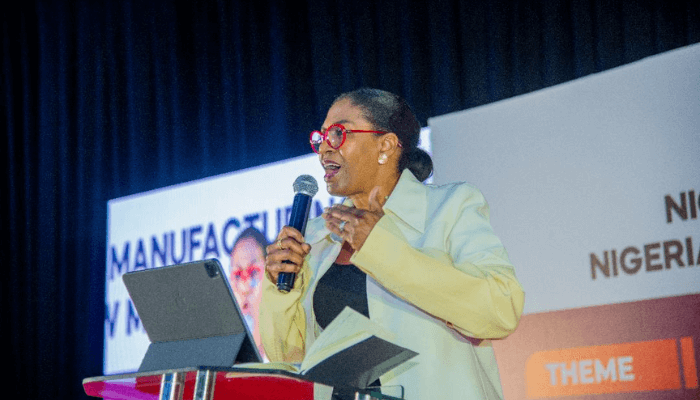
Kofo Akinkugbe, founder and Group Managing Director, SecureID has called for a decisive shift from Nigeria’s current manufacturing model, one tethered to imported machinery, foreign technical support and exported raw materials.
Akinkugbe who spoke at the Nigeria manufacturers equipment expo in Lagos set a bold vision for the future of Nigeria’s manufacturing sector.
While delivering a keynote speech, she stressed that the pathway to this transformation lies not in creating more government agencies, but in strengthening existing institutions in mandate, resources and expertise, enabling them to more agile and responsive as well as providing the technical backbone and policy enforcement that industries require to innovate.
“We cannot talk about real technology transfer when all we do is buy machines from abroad,” Akinkugbe said.

Speaking to an audience of CEOs, industry leaders, policymakers and investors, Akinkugbe offered a strategic blueprint that could pivot the country from dependence on imported machinery and raw materials to a self-reliant, innovation-driven manufacturing ecosystem.
“Real transfer happens when we can fix, understand, and eventually build the machines ourselves.” Her submission was underscored by a sobering statistic that manufacturing accounted for merely 8.4percent of Nigeria’s GDP in 2023, far behind Vietnam’s 25percent and China’s 28percent.
The gap, she cautioned is not merely an economic shortfall but a national competitiveness crisis. For this reason, she reiterated, local raw materials utilisation must be a key pillar of sustainability and enhancement through local manufacturing of equipment and spare parts.
In her address, Akinkugbe outlined actionable strategies to accelerate sustainable innovation and technology transfer. These include reverse engineering for capability building, aggressive investment in STEM talent, developing local spare parts manufacturing, and forging strategic partnerships with explicit knowledge transfer goals.
“Nigeria is blessed with abundant raw materials, from lithium to oil and gas. Our limitation has been the incapacity for local conversion and value addition,” she said.

Drawing lessons from China and India’s rise as global manufacturing powerhouses, she emphasised the importance of starting small, mastering spare parts production, investing heavily in R&D, and eventually owning the design and manufacturing process.
Akinkugbe further highlighted that transformation begins at the top, urging CEOs to champion innovation as a company-wide culture, prioritise R&D and align corporate strategies with national industrial policies.
“Thirty years ago, China was where we are now. They made a deliberate decision to move up the value chain. Nigeria can take the same path. The question is—will we?” she asked.
“The results in Asia speak for themselves once obscure brands in automobile and technology are now global leaders”. Akinkugbe believes Nigeria can achieve a similar leap if its leadership both corporate and political commits to a long-term, consistent industrial strategy, anchored on strengthening existing institutions and fostering seamless public-private collaboration.