Olumide Onakoya, former chairman and managing director of Mobil Oil Nigeria, has cautioned that Nigeria’s booming real estate market could suffer the same fate as the oil industry if policymakers fail to put the right structures in place.
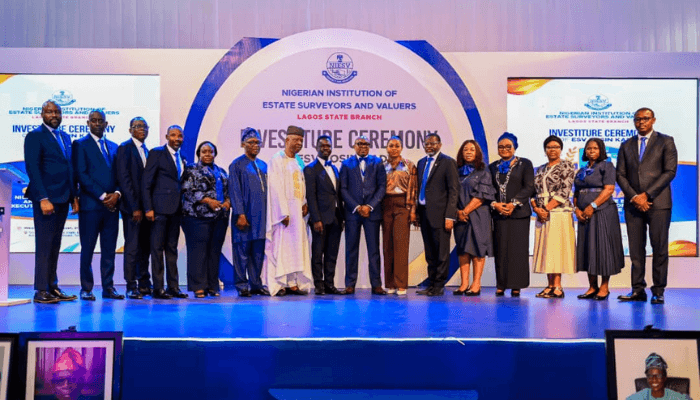
Speaking at the investiture of Tosin Kadiri as the 29th chairman of the Lagos branch of the Nigerian Institution of Estate Surveyors and Valuers (NIESV), Onakoya drew a sharp parallel between Nigeria’s decades-long dependence on oil and its current enthusiasm for property.
“We saw in 1986 that the oil industry in Nigeria was going to fail,” he said, recalling early warnings that were ignored as the country doubled down on petroleum exports. “We must learn from oil. We must diversify not only in the economy but in our investments.”
Read also: High costs shut real estate operators from $13.5bn opportunity

Despite decades of calls for diversification, oil still dominates Nigeria’s export earnings. In Q1 2025, crude accounted for 62.89% of total exports, generating N12.69 trillion, while non-oil exports brought in N7.64 trillion. The reliance leaves the economy exposed to price swings—Brent crude fell below $60 per barrel in April, forcing the IMF to cut Nigeria’s 2025 growth forecast to 3% from 3.4%. Inflation, though easing, stood at 22.22% in June.
Real estate, however, is rapidly emerging as a growth driver. Following a GDP rebasing, the sector’s valuation jumped from N10.5 trillion in 2023 to N41.3 trillion in 2024, making it the country’s third-largest contributor after trade and agriculture. It grew 46.52% year-on-year in Q3 2024 and is projected to reach $2.25 trillion by the end of 2025.
But Onakoya warned that growth alone is not enough. “Without proper policy, it can become another failed opportunity,” he said, urging reforms in affordable housing, land registration, and access to finance.
Read also: ‘Why Lagos real estate market continue to thrive’
His concerns echo those of Oghenakpobo Jonathan A. Idudu, chairman of the day and a veteran estate surveyor, who urged the profession to maintain standards amid rising property valuations. He warned against “overheated” pricing, citing reports of land selling for as much as N2 million per square meter in parts of Lagos. “We must not let things go fast. We have got to be careful,” he said.

Kadiri, in his inaugural address as NIESV Lagos chairman, unveiled a six-pillar agenda focused on professional excellence, member welfare, collaboration, advocacy, youth development, and innovation in emerging areas such as PropTech and green buildings.
“NIESV’s mandate is to maintain excellence, protect public interest, and continually enhance the capacity of our members,” Kadiri said. “We must not only react to trends, but also lead innovation in real estate practice.”