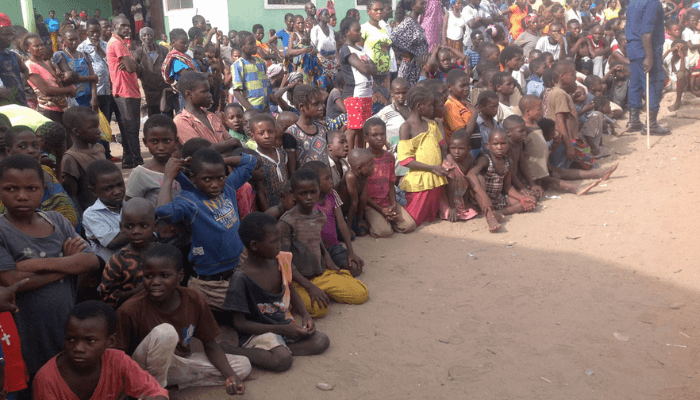
The federal government has secured a $25.35 million loan from the Kuwait Fund for Arab Economic Development in a renewed effort to tackle the alarming out-of-school children crisis in Kaduna State.
The funding is expected to support critical education interventions aimed at boosting enrollment, improving infrastructure, and addressing the root causes of low school attendance in one of Nigeria’s most affected regions.
The funding agreement, signed on behalf of the Kaduna State government, forms a key part of a $62.8 million multi-partner financing package to boost access to inclusive, quality education in the state.
This was made known in a statement issued by Mohammed Manga, the director of information and public relations at the Ministry of Finance, which states that the loan will support the ‘Reaching Out-of-School Children’ programme, a large-scale education intervention targeting vulnerable groups, including girls, children with disabilities, and internally displaced persons.

Read also: UNICEF partners Borno govt to reduce maternal mortality
The programme, according to the statement, is expected to enrol over 100,000 children, build or upgrade more than 200 schools, and improve the learning environment and teacher capacity across underserved communities in the state.
Wale Edun, minister of finance and coordinating minister of the economy, represented by Doris Uzoka-Anite, the minister of state for finance, said the initiative reflects the government’s emphasis on transparency, accountability, and results-based investment in social development.
The minister emphasised that with millions of children still out of school in northern Nigeria, every dollar of investment must deliver tangible impact.
Besides, he applauded Kaduna’s leadership, stating that the programme could serve as a model for replication in other states.

Meanwhile, Uba Sani, the governor of Kaduna State, reaffirmed his commitment to education reform, revealing that his government has already paid its full counterpart contribution of $1 million.
Sani said that education now accounts for 26 percent of the state’s 2025 budget, and that under the new programme, Kaduna will construct 102 climate-resilient schools and rehabilitate 170 existing institutions to support the return of out-of-school children to formal learning.
“The effort goes beyond infrastructure, focusing also on equity and social justice. The upgraded and newly built schools will prioritise accessibility for marginalised groups, including girls and children with special needs, with a focus on hard-to-reach rural communities,” he said.
Wahid Al-Bahar, director-general of the Kuwait Fund, described the project as “an investment in hope.”
Al-Bahar emphasised that the fund is proud to support efforts that ensure no child is left behind and stressed that success would be measured by increased enrolment, improved learning outcomes, and community ownership.
According to the statement, other key contributors to the blended financing structure include the Islamic Development Bank, which is providing a $10.5 million loan, the Global Partnership for Education with a $15.45 million grant, the Education Above All Foundation with $10 million, Save the Children International with $0.5 million in technical assistance, and Kaduna State’s own contribution of $1 million.
The Federal Ministry of Finance is expected to provide fiduciary oversight and coordinate performance tracking alongside Kaduna State and development partners.
This includes regular reviews to monitor student enrolment, teacher training, and measurable learning improvements.
The $62.8 million programme, anchored on community-based solutions and institutional reforms, is expected to set a new standard for education financing in Nigeria.