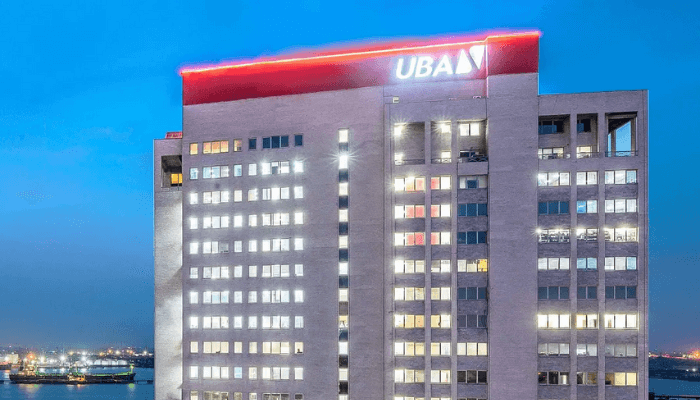
United Bank for Africa (UBA) is emerging as the frontrunner among Nigeria’s tier-one lenders, collectively known as FUGAZ, as their combined performance fuels a bullish momentum on the Nigerian Exchange (NGX), data from Statisense has shown.
This analysis tracked stock price performance between May 30, 2023 and July 16, 2025, and came out with a positive outlook: “Any investor who allocated N1 million to any of First Bank, UBA, GTCO, Access, and Zenith Bank (FUGAZ), would be holding millions in capital appreciation alone.”
UBA emerged as the standout performer, delivering a 395 percent return-on-investment (RoI). A N1 million stake in the bank two years ago is now worth N4.95 million, making UBA the undisputed leader of the FUGAZ cohort in terms of capital gains.
In the past year, UBA has delivered the strongest returns among its peers, with its stock price appreciating roughly around 100 percent, outpacing even the NGX All Share Index’s 12-month rally. The bank’s aggressive earnings growth, strong dividend payout, and Pan-African footprint have made it a favourite among investors seeking stability and upside in a volatile macroeconomic environment.

UBA’s dividend payout has also been robust. Corporate filings from the company revealed that shareholders received annual returns of around N2.80 per share in 2023 and N5.00 in 2024, further boosting total investor value.
Other FUGAZ stocks also posted impressive gains. A N1 million investment in GTCO grew to N3.435 million, delivering a 244 percent return, while Zenith Bank delivered N2.559 million, a 156 percent return. First Bank and Access Holdings followed closely, yielding N2.176 million (118 percent RoI) and ₦2.170 million (117 percent RoI) respectively.
It is important to note that these returns exclude dividends, meaning total investor gains would even be higher when payouts are factored in.
Read also: UBA’s Business Series returns with focus on collaboration for MSME growth
What it means for investors

This data offers more than a scoreboard; it is an outlook through which investor behavior, market efficiency, and sector resilience can be examined.
Two years ago, investing N1 million in any FUGAZ bank may have seemed like a risky move amid a turbulent macroeconomic environment and wavering investor confidence.
Today, that same investment has proven to be one of the most rewarding bets on the Nigerian Exchange (NGX), with returns soaring as high as 395%, even before accounting for dividends.
Despite macroeconomic headwinds, including inflation volatility, FX illiquidity, and tightening monetary policy, the tier-one banks have thrived. Analysts attribute this to several factors: solid earnings growth, successful regional expansions, strong digital transformation strategies, and consistent dividend policies.
It also shows patient, long-term investment still works, despite the high-risks and volatility of the market. FUGAZ, Nigeria’s five largest banks by asset size and market presence continue to outperform their size, leveraging scale, innovation, and regulation to their advantage.
Also, investors who know their way around NGX will always find value for their money.
With the Central Bank’s recapitalisation policy set to change the banking landscape over the next 18 months, current performance gaps among FUGAZ lenders may widen further. For investors, the key question is shifting from which bank has delivered the strongest historical return to which is structurally best positioned to navigate the next wave of regulatory, capital, and competitive pressures and emerge as a long-term market leader.