Nigeria, Africa’s largest economy and most populous nation, is richly endowed with human capital and abundant natural resources such as petroleum, niobium, zinc, natural gas, and arable land. In addition to the country’s status as a prosperous emerging economy in Africa and globally, Nigeria maintains strong political and economic tie with other nations, an avenue for business cooperation and partnerships.
With the implementation of the African Continental Free Trade Area (AfCFTA) and various bilateral partnerships, World Bank and African Development Bank (AfDB) noted that Nigeria holds significant potential for inclusive and sustainable growth. Among the key sectors poised for growth, agriculture stands out as a vital engine of economic development, food security, and employment generation. This brief presents a macroeconomic case for prioritizing investment and financial facilitation in Nigeria’s agriculture sector, illustrating how the long-term opportunities outweigh the perceived risks and costs.
Analysis of Key Macroeconomic Indicators

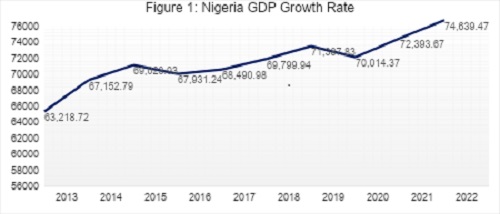
Nigeria’s macroeconomic outlook reflects a steady trajectory toward inclusive and sustainable growth, driven by gradual reforms and sectoral diversification. According to the National Bureau of Statistics (NBS), GDP grew by 3.84 percent in the fourth quarter of 2024, up from 3.46 percent in the third quarter of 2024 and the same period in 2023. Overall, annual GDP growth reached 3.4 percent in 2024, compared to 2.7 percent in 2023. This growth was supported by strong performance in the services and non-oil sectors, indicating the economy’s growing resilience amid inflationary pressures, energy volatility, and global uncertainties.
Source: Author’s computation | Central Bank of Nigeria Statistical Bulletin (2024)
Despite these improvements in output, macroeconomic stability continues to be tested by persistent inflationary pressures. Inflation remains a challenge, peaking at 34.8% in December 2024 due to global headwinds. However, a rebasing of the Consumer Price Index (CPI) in January 2025 reported a drop to 24.5%. The Central Bank of Nigeria’s monetary tightening, with a policy rate of 27.5%, alongside reforms like fuel subsidy removal, aims to stabilize the economy.

Source: Author’s computation | World Development Indicator, WDI (2024)
Meanwhile, NBS noted that Nigeria’s unemployment rate has dropped significantly, from 33.3% in Q4 2020 to 5.0% in 2024 following a methodological rebasing of the labour force survey, with the decline partly attributed to government-led job creation programs, especially within the agricultural sector. Additionally, CBN has implemented major macroeconomic reforms, such as the Electronic Foreign Exchange Matching System (EFEMS) in December 2024, followed by expanded FX auction operations in early 2025, helping reduce volatility.
While macro reforms have introduced short-term FX risks for agribusinesses, their long-term payoff is clear. As of Q4 2024, NBS noted that Nigeria’s total merchandise trade stood at ₦36.6 trillion, a significant increase from the previous year, with exports amounting to ₦20.01 trillion and imports at ₦16.59 trillion resulting in a positive trade balance of ₦3.42 trillion. For the year 2024, total trade reached approximately ₦138 trillion, supported by a trade surplus of ₦18.9 trillion, driven largely by growth in non-oil exports. Agricultural commodities such as cocoa, sesame seeds, cashew nuts, and ginger featured prominently among Nigeria’s top export goods, with agricultural exports alone reaching ₦1.54 trillion in Q4 2024, a 230% year-on-year increase. To further expand trade and attract investment, the Nigerian government has made renewed efforts to improve the ease of doing business, an essential enabler for attracting investment in agriculture and agribusiness. Through the work of the Presidential Enabling Business Environment Council (PEBEC), the government has implemented wide-ranging reforms, including streamlining regulatory processes, and digitizing services such as business registration and permits. In 2025, a new automated e-visa platform was introduced, significantly reducing entry barriers for international investors and agribusiness experts.
Additionally, the government is expanding the State Action on Business Enabling Reforms (SABER) program, incentivizing subnational reforms in areas such as land administration, contract enforcement, and access to credit. For the agriculture sector, which depends heavily on access to land, logistics, and credit, such improvements are pivotal to unlocking large-scale private sector participation and long-term investment.
The Case for Agriculture: High Potential, Underleveraged
Agriculture plays a significant role in economic empowerment, reducing poverty, enhancing food security, stimulating growth and sustainable development especially in developing countries like Nigeria. Among other sectors of the economy, (see fig 5), the sector remains a key determinant of the Nigerian economy, consistently contributing over 20% to annual GDP and providing employment to about 70% of households roughly 140 million people (NBS, CBN, 2023).
Source: CBN Statistical Bulletin (2023)
However, the sector’s output has experienced only modest growth over the past three decades. A central constraint is limited access to finance. While the total credit demand from Nigerian farmers is estimated at ₦8 trillion, only 6% of total bank loans about ₦1.8 trillion go to agriculture.
Figure 6: Sectoral distribution of loans and advances (billion Naira)
[Source: CBN, 2023b]
This credit gap perpetuates low productivity among the 80% of farmers classified as smallholders most of which cultivate less than 5 hectares with limited technology and market access. Consequently, production remains at subsistence level, and value chain opportunities remain untapped. While several initiatives have been launched over the years, systemic issues such as limited financial inclusion and poor data systems undermine their impact. According to Global Findex (2021), only 45% of Nigerian adults have bank accounts, significantly lower than regional and global averages, further limiting access to commercial credit.
Why This Sector Presents an Investment Opportunity
Nigeria’s commitment to the Sustainable Development Goals (SDGs) is increasingly reflected in the country’s adoption of targeted, sector-focused strategies that aligned with SDG 2: “End hunger, achieve food security, improve nutrition, and promote sustainable agriculture.” Recent frameworks such as the Integrated National Financing Framework (INFF), the Special Agro-Industrial Processing Zones (SAPZ-2) initiative, and the National Integrated Agribusiness Agenda (NIAA) demonstrate the country’s renewed focus on sustainability, food security, and inclusive growth. Thus, Nigeria’s agriculture sector presents an untapped opportunity for investors:
- There is massive demand, yet under-supply: There are millions of hectares of arable land, undercapitalized smallholders, and unmet food needs across Nigeria and the region.
- There is rising public commitment: The 2025 federal budget allocation for agriculture rose 127.72% to ₦826.5 billion, and the Bank of Agriculture’s recapitalization signals political prioritization.
- Government credit policy reforms underway: Lawmakers are urging the CBN to increase agriculture’s share of total credit to 7%, while exploring lower interest channels via MFIs and cooperatives.
- Strong demographic and market fundamentals: Nigeria’s large population, urbanization, and AfCFTA access offer growth in demand for processed food, logistics, and export markets.
Conclusion
Nigeria’s agriculture sector is key to the nation’s macroeconomic evolution. To secure long-term impact and attract meaningful investor interest, the government must prioritize national security in agricultural zones, strengthen rural infrastructure, and improve access to agricultural credit through transparent and inclusive mechanisms. Furthermore, reforms must go beyond credit schemes to address issues such as land access, extension services, and climate-resilient farming. Nigeria’s macroeconomic outlook marked by a recovering GDP, positive trade balance, and strong non-oil exports, signals growing resilience, and the agriculture sector is well positioned to drive inclusive growth.
For investors seeking commercially viable opportunities with measurable development outcomes, Nigeria’s agriculture sector provides both scale and impact, making the sector a strategic priority within the country’s broader macroeconomic agenda.
Joseph Nnanna is a professor and chief economist at Development Bank of Nigeria (DBN).