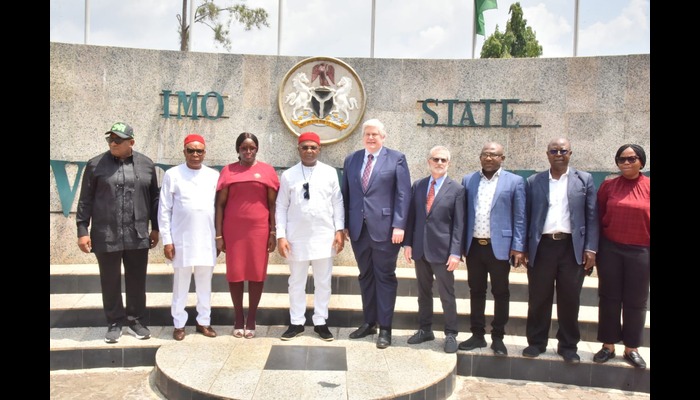
If you had to guess where Africa’s next big wave of software talent would come from, chances are you wouldn’t pick Owerri in Imo state. But that may be about to change.
In a bold move that’s already catching the attention of global employers, Imo State Governor Hope Uzodimma has launched ImoTalentHub.com, a government-backed digital talent marketplace aimed at placing 100,000 trained software developers, designers, AI specialists and data scientists in global remote jobs by 2026. The project, which sits at the intersection of public sector ambition and Silicon Valley expertise, is a striking attempt to reposition a state once better known for politics and petroleum subsidies as a new tech capital for Africa.
“The future is not in oil. It’s in people,” Governor Uzodimma said. “We are training and exporting digital talent, not as labour, but as intellectual capital.”
Backed by a partnership with the University of California, Berkeley, and the US Market Access Center, the Imo Talent Hub is not just a job board. It’s a full-blown digital economy infrastructure. Every graduate from the state’s Skill Up Imo programme gets a verified profile, a smart portfolio, and plug-and-play access to international contracts with escrow payments, KYC verification and tax compliance, all managed on-platform.

A fintech firm in London or Dubai can now hire a backend engineer from Owerri with the same ease and confidence it would hire one in Shoreditch. Salaries are paid in naira, dollars or pounds, and the government tracks hiring data transparently to drive smarter economic policy.
“This is the first time a state government in Africa is building a system that not only trains talent but ensures they can immediately earn a living,” said Dr Chimezie Amadi, the state’s Commissioner for Digital Economy and E-Government. “We’re going from classroom to contract in one pipeline.”
The numbers are compelling. Over 40,000 learners have already graduated from Skill Up Imo since it launched in 2022. Courses include software development, AI, cybersecurity and UX design, with new tracks in blockchain, climate tech and health data analytics set to roll out in the coming year. Many of the modules are designed in collaboration with UC Berkeley’s Sutardja Center for Entrepreneurship and Technology, whose professors are also supporting bootcamps, labs and a new founder development programme with access to venture capital.
Chris Burry, Managing Director at the US Market Access Center, isn’t hiding his enthusiasm. “What we see in Imo is raw talent. What we’re doing is refining it, giving it structure, and plugging it into global markets,” he said. “There’s a real Silicon Valley energy here.”
But beyond buzzwords, the initiative is aiming at something deeper, structural economic transformation. By enabling remote work at global standards, the state hopes to reduce unemployment, boost foreign exchange earnings, and pull tech-savvy youth away from fraud and cultism, issues that have long plagued the region.

More importantly, the hub is designed to be inclusive. The government is encouraging diaspora indigenes in Houston, London and Johannesburg to register as hiring partners or angel investors. Local SMEs in Owerri are being offered subsidised apprenticeships, while Nigerian and African companies can open remote teams without the cost of relocation.
For a country struggling with brain drain, the implications are significant. Instead of lamenting the exodus of young professionals, Imo is offering them a reason to stay and a pathway to earn globally from home.
And there’s more to come. Officials plan to expand to 300,000 digital citizens over the next five years. Meanwhile, the Imo Digital City campus, equipped with NVIDIA GPU labs, is being groomed as a full innovation district.
“If we get this right,” said Governor Uzodimma, “Owerri won’t just be the capital of Imo State. It will be the innovation capital of South-East Nigeria and beyond.”
It’s a bold claim. But with the right partners, infrastructure, and policy continuity, Imo’s talent hub may very well prove that Africa’s most valuable export is no longer oil or raw materials, but human capital ready to shape the digital world.