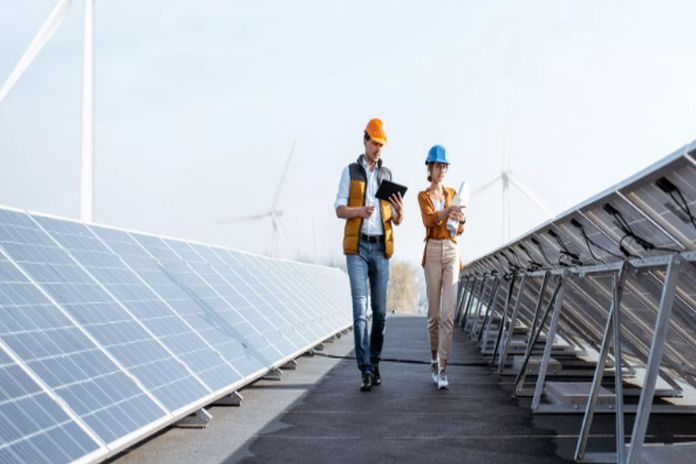
The number of renewable energy jobs globally increased from 13.7 million in 2022 to 16.2 million in 2023, with Africa receiving only 324,000 jobs in the sector.
The report also indicates that women make up 32 per cent of the global renewable energy workforce, but continue to hold an unequal share, even as the number of jobs increases.
This information comes from the newly released Renewable Energy and Jobs – Annual Review 2024, published by the International Renewable Energy Agency (IRENA) and the International Labour Organization (ILO).
Renewable energy is derived from natural resources that can be replenished rapidly, contributing to climate change mitigation, enhancing energy security, and offering significant economic benefits. The different sectors are solar and wind capacity, photovoltaics (PV), liquid biofuels, hydropower and wind.

The jobs in the renewable energy sector include greenhouse worker, recycling worker, environmental technician, environmental scientist, wind turbine technician, urban planner, solar installer, air quality engineer, energy manager, energy engineer, environmental specialist, sustainability engineer, environmental health and safety officer, and solar consultant.
China leads the pack
The 18 per cent year-on-year rise reflects both the significant growth in renewable energy generation capacity and the continued expansion of equipment manufacturing.
However, a closer examination of the report’s data reveals an uneven global landscape. Nearly two-thirds of the new solar and wind capacity installed worldwide last year was in China.
China leads the way with an estimated 7.4 million renewable energy jobs, accounting for 46 per cent of the global total. The European Union (EU) follows with 1.8 million jobs, then Brazil with 1.56 million jobs, while the United States and India each have close to one million jobs.
The most significant continues to come from the rapidly expanding solar photovoltaics (PV) sector, which supported 7.2 million jobs globally. Of these, 4.6 million were in China, the dominant PV manufacturer and installer. Enabled by substantial Chinese investments, Southeast Asia has also emerged as a key export hub for solar PV, generating jobs in the region.

Liquid biofuels had the second-largest number of jobs, followed by hydropower and wind. Brazil led the biofuels sector, accounting for a third of the world’s 2.8 million jobs, with Indonesia in second place with a quarter of global biofuels jobs.
Hydropower became an exception to the overall growth trend, with direct jobs estimated to have declined from 2.5 million in 2022 to 2.3 million due to a slowdown in deployment. Brazil, China, India, Pakistan, and Vietnam were the largest employers in this sector.
In the wind sector, China and Europe continue to dominate, with China contributing 52 per cent and Europe 21 per cent to the global total of 1.5 million jobs through their leadership in turbine manufacturing and installations.
For regions like Africa, which urgently need reliable and sustainable energy, especially in remote areas, decentralised renewable energy (DRE) solutions present an opportunity to address the energy access gap while creating jobs. Additionally, removing barriers for women to start entrepreneurship initiatives in DRE could stimulate the sector, improving local economies and energy equity.
Francesco La Camera, IRENA Director-General, in acknowledging the high degree of geographic concentration said,
“The story of the energy transition and its socio-economic gains should not be about one or two regions. If we are all to fulfil our collective pledge to triple renewable power capacity by 2030, the world must step up its game and support marginalised regions in addressing barriers impeding their transitions progress”.
Strengthened international collaboration can mobilise increased finance towards policy support and capacity building in countries that are yet to benefit from renewables job creation.”
Women account for an unequal share
To address the growing demand for diverse skills and talents in the energy transition, policies should support measures that encourage greater workforce diversity and gender equity. Ensuring that education and training lead to diverse job opportunities for women, youth, and members of minority and disadvantaged groups is essential.
Gilbert F. Houngbo, ILO’s Director-General rightly puts it stating, “Investing in education, skills and training helps reskill all workers from fossil fuel sectors, address gender and other disparities, and prepare the workforce for new clean energy roles”.
“It is essential if we are to equip workers with the knowledge and skills that they need to get decent jobs, and to ensure that the energy transition is a just and sustainable one. A sustainable transition is what the Paris Agreement requires of us and what we committed to achieving when we signed up to the Agreement.”