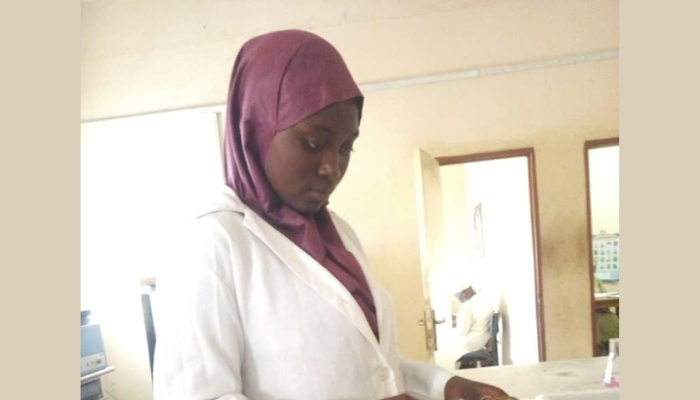
Mariam Olamide Kareem, an accomplished early-career researcher in Soil Science and Irrigation Engineering, is earning recognition across Africa for her outstanding academic record and groundbreaking work in sustainable agriculture.
A recipient of the prestigious World Bank/Republic of Ghana Scholarship (2020–2022), Kareem completed her Master of Philosophy (MPhil) in Irrigation and Drainage Engineering at the University for Development Studies (UDS), Tamale, Ghana. The award, part of the West African Centre for Water, Irrigation and Sustainable Agriculture (WACWISA) Postgraduate Scholarship, supported her two-year study beginning in October 2020 at the UDS Nyankpala Campus.
Her MPhil research, titled “Irrigation Regimes and Growth Media Effects on Growth and Yield of Greenhouse Cucumber,” examined how optimized irrigation scheduling and substrate combinations could enhance water use efficiency and promote sustainable crop production in semi-arid regions.
Kareem’s study revealed that irrigating greenhouse cucumbers at 75 percent of crop evapotranspiration (ETc) produced yields comparable to full irrigation (100 percent ETc). This finding, she explained, “demonstrates the possibility of conserving significant amounts of water without compromising productivity.”

She also identified cocopeat (CP) and soil plus charred rice husk (So + CRH) as effective substrates for supporting healthy plant growth. However, Kareem emphasized that “from an economic standpoint, using native soil remains the most viable option for smallholder farmers due to its affordability and accessibility.”
The research offers practical guidance for farmers, agribusinesses, and policymakers seeking to balance water efficiency with production goals. It also provides a scientific basis for adopting climate-smart agricultural practices tailored to sub-Saharan Africa’s water-limited environments.
Kareem, who has attended several conferences including Irrigation and Agricultural Development (IRAD 2022) Conference, the first 1st and 2nd International Conference on Agriculture and Agricultural Technology (ICAAT 2019 & 2022) and presented her research findings at the Second International Conference on Agriculture and Agricultural Technology (ICAAT), said such platforms “have taught me the importance of framing scientific research around real-world challenges and solutions.”
Her academic journey has been marked by excellence. She graduated as Best Student in her Department and among the Top Three Overall Students at her university. She credits her success to “a deep sense of purpose and the drive to create real impact for farming communities across Africa.”
Beyond her MPhil research, Kareem’s investigations into the synergistic effects of biochar and nitrogen fertilizer on soil carbon sequestration and maize yield further demonstrate her commitment to advancing climate-smart agriculture. Her work highlights biochar’s long-term potential to improve soil health and resilience while supporting sustainable food systems.

“Knowledge must translate into impact,” she affirmed. “My goal is to lead innovative projects that transform how soil and water resources are managed in Africa, through research, policy engagement, and community-driven initiatives.”
Looking ahead, Kareem aspires to become a leading scientist and policy advisor in sustainable land and water management. She also hopes to mentor emerging researchers, particularly women in STEM, to strengthen Africa’s capacity for agricultural innovation.