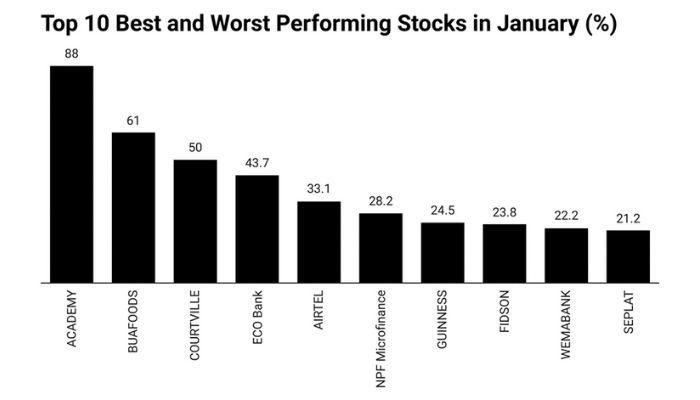
A new report by the BusinessDay Research and Intelligence Unit (BRIU) gives an in-depth analysis on the performance of the equity and fixed income market in January 2022. Here are some major highlights from the report:
The Nigerian equity market rose 9.1% in January
According to the report, the Nigerian Exchange NGX-ASI recorded 14 gains out of 20 trading days in January. Group’s (NGX) All-Share Index (ASI) closed at 46,624.67 points, 9.1 percent higher than 42,716.44 points recorded in December 2021. This is the highest level since 2008.
The gains in the market were largely driven by the price appreciation in Airtel Africa (+33.1%), Seplat (21.5%), and BUA foods (61.0%).

Oil & gas, banking and industrial goods posted best returns
The oil and gas index rose 14.1 percent in January, particularly driven by the performance of Seplat (21.5%) and Total (8.6%).
The banking index advanced 8.7 percent supported by the gains in Ecobank, (43.7%) and Zenith Bank (3.6%). While price appreciation in Dangote Cement (1.4%) and BUA Cement (5.5%) drove the industrial goods index up 3.4 percent.
Insurance/consumer goods were most underwhelming sector
The insurance and consumer goods indices were the losers in January following sell-offs in NEM (-18.0%), Sunu Assurance (-33.3%), Nestle (-7.8%) and Nigerian Breweries (-3.1%), among others.

High investor subscription in treasury bills market
The report noted that the last action of the month witnessed a considerable rise in subscription levels. On the average, subscription level rose to 4.1x across all instruments on January 26 compared to weak sentiment level (0.8x) in the previous auction. The 91-day treasury bill (NTB) had the highest subscription level (4.7x) on January 26 as N12.7 billion was offered by investors against N2.7 billion on offer by the CBN.
Read also: CBN plans to drive $200bn non-oil exports
Buying interest drove yield in FGN Bond market down
On the average, yield on the FGN bond market declined by about 40.6bps amid buying-interest by investors. Out of 18 bonds traded in the secondary market, the yield on 17 bonds declined apart from the 2042 bond that rose 33.0bps to 12.3 percent.
According to the report, the fall in yield could reflect investors’ expectation that January’s inflation may trend lower than December as the impact of the festive season wanes.