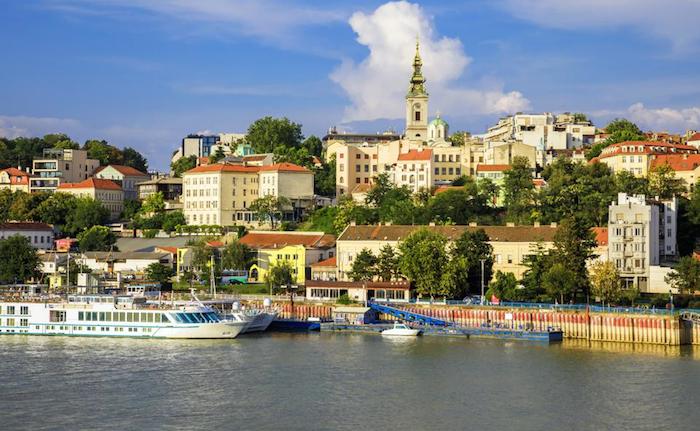
12 years ago, as an 18 year-old first year university student in a new country, I struck up an unlikely friendship with Alex and Katarina, a Serbian couple who ran a takeaway restaurant close to my hall of residence. Perhaps it was the guaranteed stream of nightly revenue that I represented after developing a taste for their food, or maybe it was something else. For whatever reason, we hit it off and we became friends. They were from Belgrade and they had sold everything they had and fled to the UK shortly after the start of NATO’s bombing campaign against the city in 1999.
I had no frame of reference at the time, but something that always stuck in my mind whenever they talked about their former life in Yugoslavia was how ordinary everything was for them. On paper, the Balkan Wars had begun since 1991 but for a professional couple in urban Serbia, there was no sign of such things in their everyday life apart from the news on the telly. Alex ran a restaurant in Belgrade and Kat was a student at the University of Belgrade. When the announcement about upcoming NATO bombings against Belgrade appeared on TV, it seemed like something distant and unthinkable.
I did not randomly decide one day to sneak across the Nigerian border dressed like a backpacking hitchhiker and then start a transatlantic migration just for the fits and giggles. Something was of course, definitely wrong.
At the start of the bombing campaign on March 24, 1999, they had just found a flat together and Kat was preoccupied with decorating their new nest. Life was literally just starting in many ways, and the reality of the brutal war happening a few hundred miles away was completely parallel to their own reality – the war might as well have been in Bolivia, for all it mattered to them. They were just ordinary people doing ordinary things in their ordinary lives, in their ordinary European city.
Until suddenly everything changed one night.

Contextualising the exile decision
As most people reading this article are aware by now, I took the decision to leave Nigeria in a clandestine manner between when my last column appeared and now. Before I revealed this openly, the few people whom I told wanted to know “What happened that spooked me?” “Was I threatened?” “Was my name on the no-fly list?” “Who else was being targeted?” Of course while I responded with the generic “It’s fine, everything is fine,” everyone knows that things are not in fact, fine.
I did not randomly decide one day to sneak across the Nigerian border dressed like a backpacking hitchhiker and then start a transatlantic migration just for the fits and giggles. Something was of course, definitely wrong. The problem is that if one tried to reduce the decision to a single definitive incident or circumstance, the case would seemingly fall apart. Nothing that has gone wrong in Nigeria over the past 5 years has not been repeatedly excused and explained away in increasingly unhinged terms.
A growing crackdown on freedom and expression and press freedom? Just enforcing laws and creating regulatory frameworks to counter new threats. An assault on civil freedoms and constitutional rights? Imaginary, it’s all in your head. The conversion of the presidential seat from a regular civil institution to an unapproachable imperial throne? That’s just politics. Blatantly government-sponsored assault on peaceful protesters, even ferrying thugs to disrupt protest venues using government vehicles? You can’t prove it and the videos showing it are inconclusive. A civilian massacre at possibly the most visible urban location in all of Nigeria streamed live on Instagram and captured across several social media videos? The videos were staged and there are no bodies. Post-massacre crackdown on protest leaders? FAKE NEWS!
With every passing day as Major General Buhari’s regime dismantles one institution after the next, it has become increasingly easier to create several “alternative truths” that compete vigorously with the actual objective truth, and even to dissociate from the entire concept of truth altogether, exemplified by a disturbing number of people in the Nigerian public space who flat out deny that the Lekki Massacre took place at all. More than anything else, it was this growing sense of detachment from the concept of truthful engagement with Nigeria’s public space that made me decide that I’d had enough. And you know why?

The detachment of Belgrade and its modern parallel
Something Alex and Kat used to tell me was that even after the Belgrade bombings began, life did not change significantly. While it came as a huge shock to Kat to open the curtains the night after moving into their new place and see huge fireballs in the distance as F-16 fighter jets pounded Yugoslavian government installations in Belgrade, nothing “changed” the next morning. Life continued. People opened their shops and businesses or went to work. Municipal employees swept up the broken glass and debris. Welders and carpenters fixed the damage to residential and commercial locations from the previous night’s bombings. Belgrade’s residents shrugged and moved on.
Alex fortunately, had the foresight to see what was coming, and he made the decision to sell up and move to the UK, convincing Kat to leave her university program and go with him. That turned out to be an inspired decision. Over the next 77 days, Belgrade suffered nightly devastation that killed at least 2,500, injured at least 12,500, destroyed 1070 KM of roads and railway, and cost the country 12.1 percent of its GDP. Alex and Kat escaped just in time to start a relatively sedentary new life in East Yorkshire, while those they left behind were not so lucky.
I had no idea why, but the absurdity of suffering a bombing campaign at night and then going to work the next morning as if everything was okay haunted me for years. I could never put my finger on why I found that thought so disturbing until the days after the Lekki Massacre. Maybe it was youthful naiveté on my part, but somehow I suspected that this would be the defining “it” moment for Nigeria – the moment when Nigerians of all persuasions including those from Major General Buhari’s political formation and its South Western co-travellers would finally say “Stop thief! You have taken enough!”
Instead, I got a front row seat at the exact kind of dystopia described by Alex a decade ago. People went back to work and metaphorically (as well as physically) swept up the broken glass and bullet casings. People accepted money to share conspiracy theories on social media casting doubt on the events everyone witnessed live in real time. Suleiman Aledeh, a journalist whom I once considered to be a respected senior colleague nailed his colours to the mast of shame. Individuals who had been eager to position themselves as de-facto protest leaders cashed their social capital cheques and returned to being cantankerous semi-nobodies.
Basically, it was Belgrade on March 25, 1999 redux.
That was what made my decision for me – the realisation that Nigeria is doomed to suffer the exact fate of Yugoslavia – a bloody, drawn out civil conflict (which has already started if you have been paying attention since 2009); a series of ethnic genocides (which have also already commenced); a Nigerian strongman’s answer to Slobodan Milosevic at the helm who believes he can shoot tens of millions of people into submission; an utterly disconnected urban middle class who continue going to restaurants and organising weddings until it is too late; and ultimately – inevitably – a violent series of splits and successions along ethnic and regional lines.
These were the thoughts whipping through my mind as I trudged through the thick West African mud while executing an illegal border crossing two weeks ago. Once again, as with Milosevic and Abacha his contemporary, dozens of people like myself from the media, civil society and political spaces will be arrested, tortured and possibly executed. Once again, a strongman has risen to perform the final rites that will brutally hasten the painful death of a dying country that did not have to die. Once again, the best of us will witness it from apartments and townhouses in London, Atlanta, Toronto, Berlin and Adelaide.
Abacha and Milosevic have risen from the dead.
Here we go again.